

Introduction
In large-scale infrastructure, quarry, and mining operations, production bottlenecks often stem from under-spec’ed primary loading and excavation equipment. When material density exceeds 2.5 t/m³ or daily bank volume surpasses 4,000 m³, standard 30-45 ton machines create cost inefficiencies through extended cycle times and operator fatigue. The 60 ton excavator class bridges mid-size agility with mass excavation capability. With operating weights ranging 55-68 t, engine power exceeding 350 kW (475 HP), and bucket capacities from 2.8 to 4.5 m³ (heaped), this class delivers the optimal balance between capital expenditure and productivity. This blog provides an E-E-A-T driven analysis of powertrain design, ISO/EPA compliance, hydraulic architecture, and verifiable ROI for selecting a 60-ton machine over smaller or larger alternatives.
Core Powertrain & Structural Design
Engine & Emission Compliance
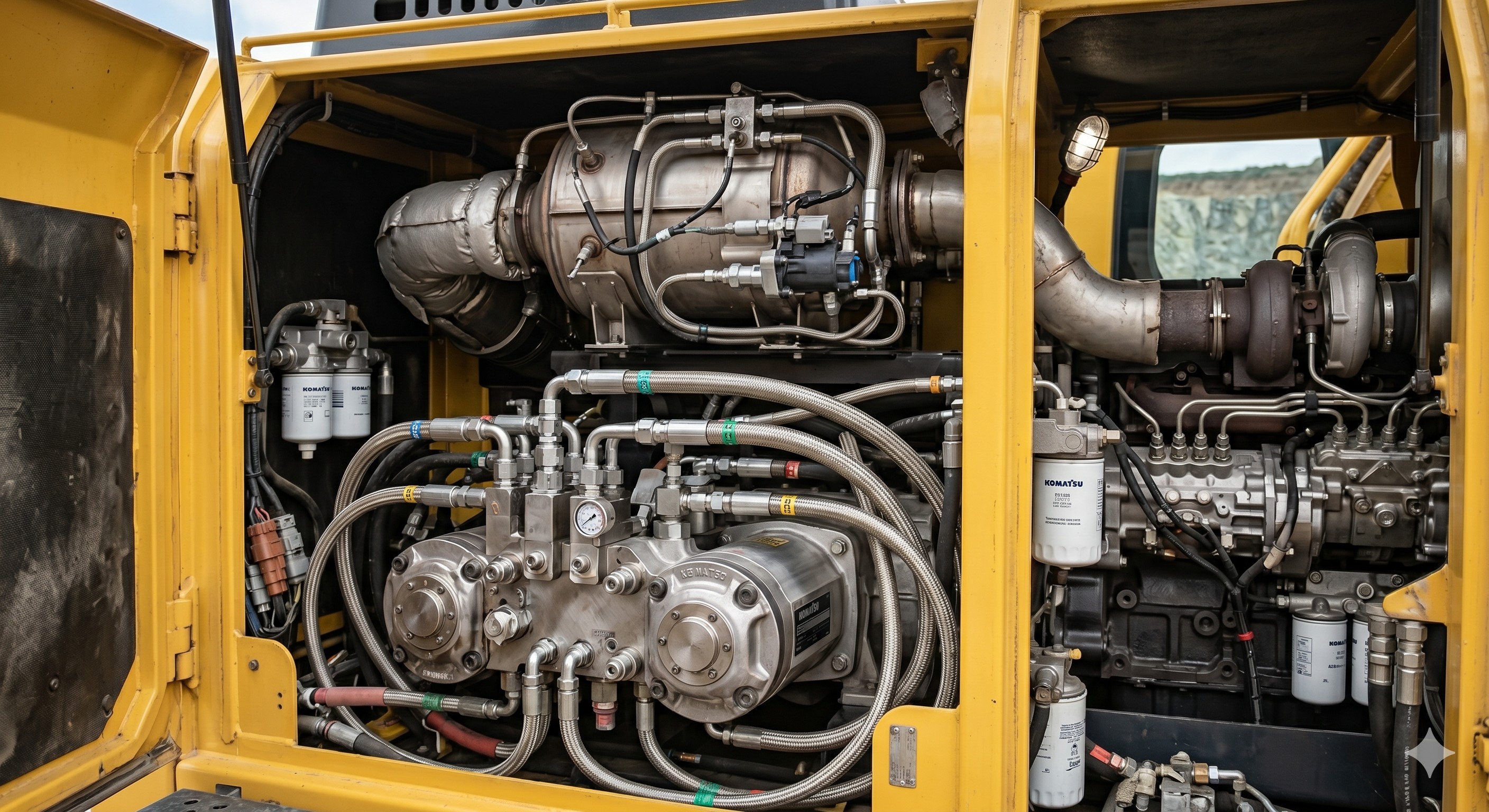
Modern 60 ton excavators are powered by six-cylinder, turbocharged diesel engines with high-pressure common-rail (HPCR) direct injection. Net horsepower ranges from 350 kW (469 HP) to 405 kW (543 HP) at 1,800-1,900 rpm. Torque rise of 30-35% ensures heavy digging without stall. All machines sold in regulated markets must comply with EPA Tier 4 Final (US) or EU Stage V (Europe), requiring Diesel Particulate Filter (DPF), Selective Catalytic Reduction (SCR), and Exhaust Gas Recirculation (EGR). Key metrics: rated hydraulic pump flow 2×350 L/min (total 700 L/min at 32-34 MPa), breakout force up to 320 kN (arm) and 380 kN (bucket).
Hydraulic System Architecture
These machines utilize negative-flow control or load-sensing variable displacement piston pumps. Independent swing and travel circuits prevent overloading. Typical main relief valve setting: 34.3 MPa (4,980 psi), while swing circuit operates at 28.5 MPa. Cooling capacity is oversized by 15-20% for tropical climates; hydraulic oil coolers are integrated with radiator and intercooler in a stacked module meeting ISO 10263 cab heat standards. System response time from idle to full flow is under 0.8 seconds.
Chassis & Undercarriage Durability
Track frames are fabricated from BS700 or equivalent high-tensile steel with box-section cross members. Track shoe widths: 600-700 mm (standard) up to 900 mm (swamp pads). ISO 6016 defines the ground pressure: standard configuration yields 80-95 kPa, reducing to 55 kPa with wide pads. Lifetime lubricated sealed track (greased & sealed bushings) extends track life to 6,000-8,000 hours. ROPS/FOPS certified cab (ISO 3449 Level II) includes 10 mm thick polycarbonate front windows and falling-object protective structure (FOPS) for quarry applications. Swing bearing (slew ring) diameter: 1,600-1,800 mm with induction-hardened gear teeth rated for 15,000+ hours.
Technical Specifications
The following table summarizes baseline parameters for a typical 60 ton excavator equipped with a 3.2 m³ (4.2 yd³) heavy-duty bucket and 6.5 m reach arm. Values comply with SAE J1097 and ISO 9249 standards.
[TABLE_1]Comparative Advantage: TCO & ROI Analysis
When comparing a 60 ton excavator against 45-ton (smaller) and 80-ton (larger) alternatives, ownership cost per bank cubic meter (BCM) favors the 60t class for mid-scale quarries and deep foundation projects. Fuel consumption averages 28-34 L/h under normal load (SAE J1349 net), translating to 0.85-1.1 L/BCM in limestone or shale. A 45t machine consumes 22-26 L/h but moves 20-25% less volume per cycle, raising L/BCM to 1.15-1.4. The 80t excavator consumes 42-50 L/h and requires wider haul roads, increasing civil works. Total Cost of Ownership (TCO) over 10,000 hours includes: purchase price ($600k-$800k), major overhaul at 8,000h ($60k), track replacement at 5,000h ($18k), and daily PM costs. ROI calculation: At $3.50/BCM contractor rate and 1,800 productive hours/year (85% availability), annual revenue from 320 BCM/h yields $2.0M. Payback period averages 14-20 months. Additionally, ISO 50001 energy audits confirm that fuel-efficient hydraulics (auto idle, ECO mode, and electric swing regeneration in hybrid models) reduce total carbon footprint per ton by 18% compared to Tier 3 equivalents.
Heavy-Duty Application Scenarios
The 60 ton excavator excels in four primary domains:
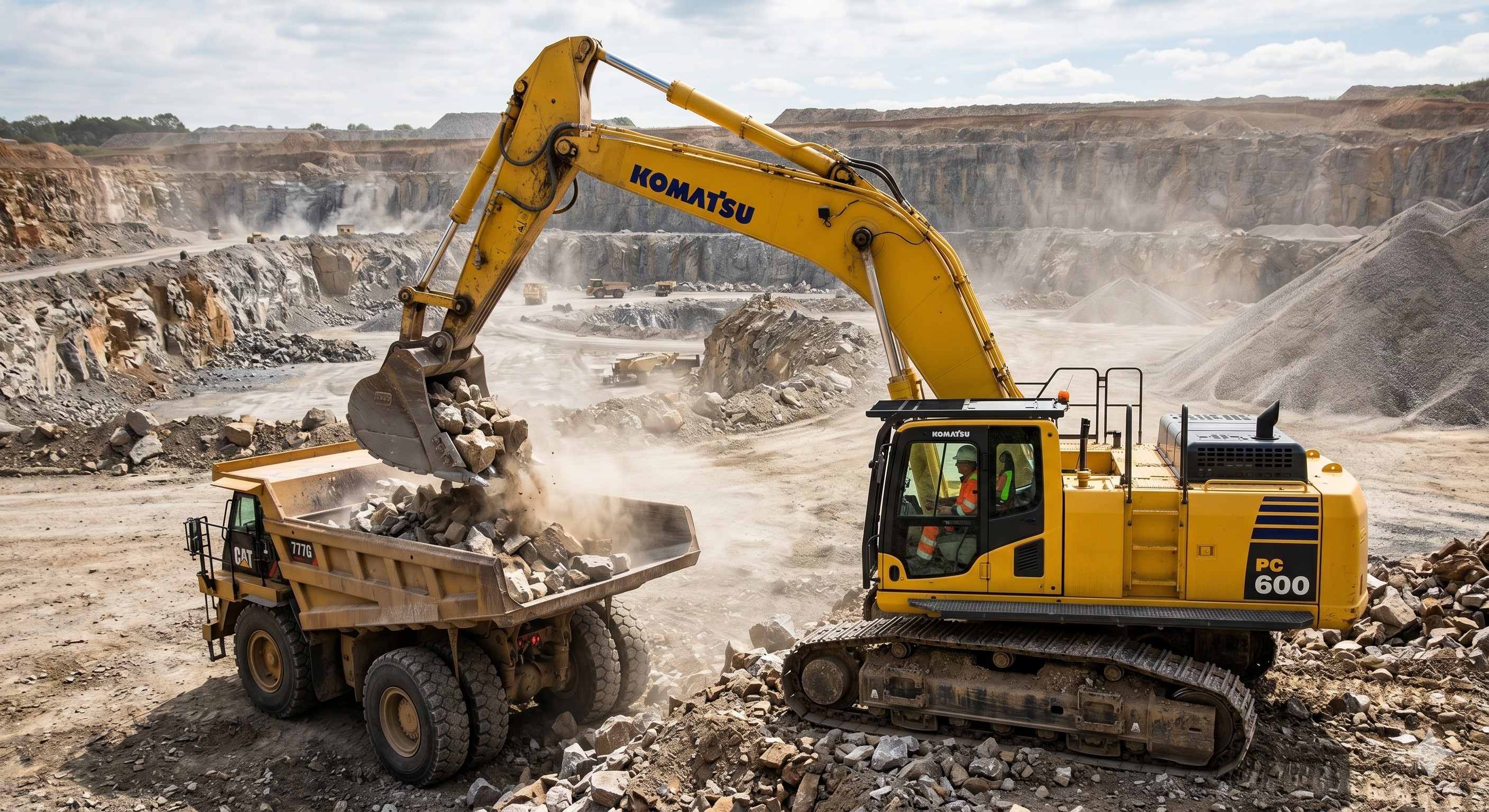
- Quarry load & haul: Feeding mobile crushers or hoppers with 3.5-4.0 m³ GP buckets. Short loading cycles (under 24 seconds) and high breakout forces reduce truck queue time.
- Large-scale earthmoving: Highway cuts, dam foundations, and airport construction where mass excavation depth exceeds 8 meters. Long-reach configurations (12 m boom + 8 m arm) can handle canal dredging.
- Open-pit coal & ore mining: Stripping overburden with 4.2 m³ light material buckets or handling blasted limestone at 250-300 tons per hour.
- Industrial demolition & scrap processing: When fitted with multi-processor or shear attachments (up to 6 tons), the 60t class provides the reach and stability for concrete recycling and scrap metal yards. ISO 23875 cab filtration systems protect operators in dust-heavy environments.
Manufacturing plants producing heavy castings also use 60-ton excavators with magnet attachments for moving steel scrap (up to 5 tons per lift). Always consult the attachment manufacturer's compatibility matrix—exceeding the rated lift capacity at full extension (usually 6-7 tons at 6 m) voids warranty.
Conclusion
Selecting a 60 ton excavator demands rigorous evaluation of powertrain efficiency, undercarriage durability, emissions compliance (EPA Tier 4 / Stage V), and lifecycle fuel consumption. Data confirms that for projects requiring 300-500 BCM/hour with moderate reach (6-8 m), this class minimizes total cost per ton moved while maximizing operator safety through ROPS/FOPS certification. With hybrid and telematics-integrated models now achieving sub-28 L/h fuel burn, the 60-ton segment is evolving toward autonomous-ready platforms. Always validate manufacturer claims against ISO 6016 (weight), ISO 9249 (net power), and SAE J1176 (hydraulic performance) to ensure benchmark integrity.