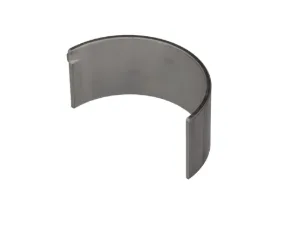
Product Features & Applications
This part is a replacement specifically designed for Komatsu engines, and it fits perfectly with Komatsu engines.
Crankshaft bearings are critical sliding bearing components inside an engine, located between the crankshaft and the main bearing housing in the cylinder block, and between the crankshaft and the connecting rod big end. Their function and material are crucial to the engine's lifespan and performance. I. Functions of Crankshaft Bearings The main function of crankshaft bearings is to support the crankshaft's operation under high-speed, high-pressure, and high-temperature environments. Supporting the Crankshaft: Installed between the crankshaft and the fixed bearing, ensuring the crankshaft remains in the central axis position during high-speed rotation, guaranteeing smooth engine power output. Reducing Friction and Wear: Forming a smooth sliding friction surface between the rotating crankshaft and the fixed cylinder block, greatly reducing wear. Lubrication Guiding: As a sliding bearing, it acts as a lubrication guide, allowing the crankshaft to float on an oil film, reducing direct metal-to-metal contact, and guiding lubrication flow to designated areas. Shock Resistance and Damping: Bearing the reciprocating inertial forces, gas pressure, tension, and centrifugal forces of the connecting rod. Joint Positioning: Some special bearings (such as flanged bearings) also limit crankshaft movement. II. Crankshaft Bearing Materials Crankshaft bearings generally employ a double- or triple-layer composite structure: a steel backing (ensuring strength) + a middle friction-reducing layer (wear and fatigue resistance) + a surface coating (ensuring basic running-in and lubrication). Copper-based Alloys: Characteristics: High-load bearing materials with excellent wear resistance, fatigue resistance, and lubrication performance, suitable for high-strength diesel engines and high-performance gasoline engines. Main types: High-lead copper, tin bronze, etc. Aluminum-based Alloys: Characteristics: Lightweight, good wear resistance, slightly lower fatigue strength than high-lead copper, but with a higher score, currently widely used in passenger car engines. Types: High-tin parts are common. Babbitt Metal (Tin-based Alloys): Characteristics: Very soft, with excellent embedding properties (encapsulating foreign objects), oleophilicity, and running-in properties, effectively protecting the crankshaft. Disadvantages: Low strength, poor fatigue resistance, suitable for low-fatigue, low-speed environments. Powder metallurgy: Characteristics: It utilizes powder processing and is suitable for unstable and volatile environments, but it has poor fatigue resistance under impact loads.
Jining Tuite Construction Machinery Co., Ltd.
Jining Tuite Construction Machinery Co., Ltd. is a company engaged in the sales of construction machinery equipment, R&D and sales of accessories, leasing and sales services. Established on August 17, 2018, located in Room 105, No. 366 East Outer Ring Road, High-tech Zone, Jining City, Shandong Province, with Wang Luwei as the legal representative and a registered capital of 1 million RMB. Business scope: R&D, leasing, maintenance, technical services and sales of construction machinery equipment and accessories (excluding special equipment and engines); sales of lubricating oil, office supplies, general labor protection supplies, mining equipment and accessories, electrical equipment and accessories. (Projects subject to approval in accordance with the law can only be carried out after approval by relevant departments).
- Location
- Room 105, No. 366 East Outer Ring Road, High-tech Zone, Jining City
- Main Products
- Construction Machinery Parts
- Employees
- Less than 50 People
- Factory Area
- 1,000-5,000 m²
- Annual Revenue
- US$1 Million - US$5 Million
- Main Markets
- Middle East & North Africa / Africa
View Supplier Profile