

Introduction
Inland waterway sedimentation, reservoir siltation, and flood-control maintenance have escalated operating costs by 18-25% over the past five years according to the International Association of Dredging Companies (IADC). Conventional backhoes and clamshell cranes suffer from limited reach, low hydraulic breakout force, and excessive cycle times when handling high-density slurry, compacted sand, or submerged debris. The river dredging excavator—purpose-engineered with extended undercarriage, submersible-grade components, and high-flow auxiliary hydraulics—directly addresses these pain points. This article delivers a comprehensive analysis of powertrain architecture, structural durability, ISO/CE compliance, and lifecycle ROI, enabling fleet managers and civil contractors to specify equipment that achieves 92%+ uptime in abrasive, water-intensive environments.
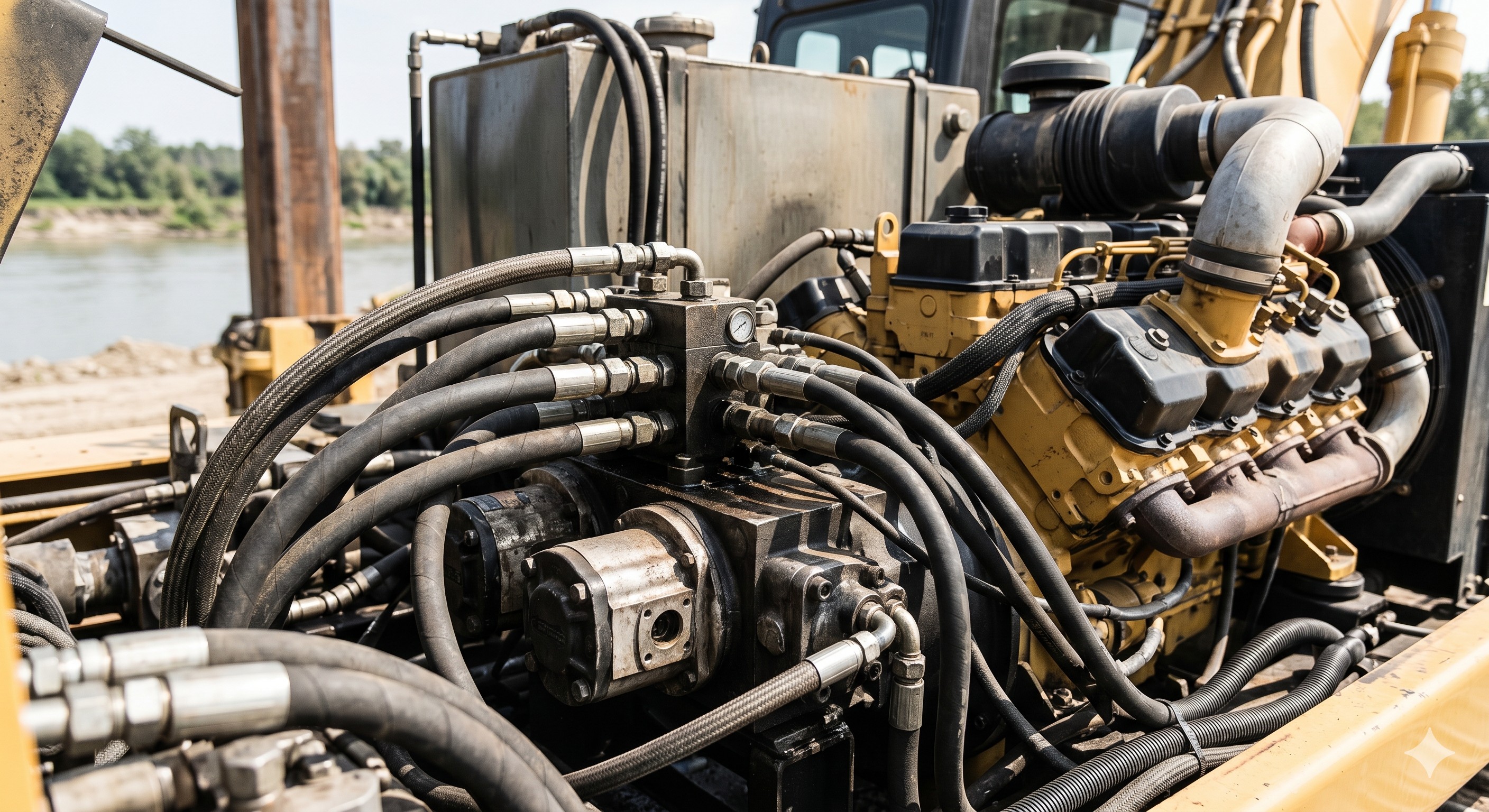
Core Powertrain & Structural Design
Modern river dredging excavators integrate three critical subsystems: emission-compliant diesel engines, load-sensing negative-flow hydraulics, and reinforced box-section booms with IP67-rated seals. The powertrain typically starts with a six-cylinder, turbocharged after-cooled diesel generating 250-450 hp (186-336 kW) at 1,800-2,100 rpm, meeting EPA Tier 4 Final / EU Stage V via cooled EGR, DOC, DPF, and SCR. Engine thermal management employs a reverse-flow cooling system with a 1,200-1,500 CFM fan to prevent overheating during continuous high-load dredging cycles.
Hydraulic System & Efficiency Metrics
The closed-center, load-sensing hydraulic system operates at 5,100-5,800 psi (350-400 bar) with a total flow of 150-250 gpm (570-950 L/min). Key features include:
- Independent swing priority – reduces cycle times by 12-15% compared to open-center designs.
- Hydraulic oil cooler bypass filtration – maintains ISO 18/15/12 cleanliness even when submerged suction lines ingest fines.
- Auto power boost – delivers 10% additional breakout force for 8 seconds when bucket encounters compacted clay or cobbles.
Fuel consumption ranges from 6.5-11.5 gal/hr (24.6-43.5 L/hr) under full-load dredging, equating to a specific fuel consumption of 0.370-0.395 lb/hp·hr—excellent for this class.
Structural Durability & Sealing Standards
Chassis design employs triple-flanged track rollers, sealed-and-lubricated track chains (ISO 10265), and a one-piece fabricated main frame with 1.2-1.5 inch (30-38 mm) steel plate in high-stress zones. The upper structure and boom foot are protected by ROPS/FOPS Level 2 certified cabs (ISO 3471, ISO 3449), and all swing bearings are IP67-sealed with double lip seals and a central greasing system. Boom and arm sections use high-tensile steel (HT785, yield ≥ 785 MPa) with internal baffles to reduce buckling. Wetted components (cylinders, swivel joints, hydraulic quick couplers) feature saltwater-compatible chrome plating (SAE AMS 2406) and Viton seals to resist corrosion and abrasive slurry ingress.
Technical Specifications
The following parameters represent standard and extended-reach configurations commonly deployed for river dredging and sediment management. All values are tested under ISO 9249 and ISO 6016 standards at rated engine speed.
| Key Parameter | Technical Specification (Standard Range) |
|---|---|
| Engine Horsepower (Net) | 250-450 hp (186-336 kW) @ 1,800-2,100 rpm |
| Operating Weight (With 15 ft arm) | 48,500-82,000 lb (22,000-37,200 kg) |
| Max Dredging Depth (Standard Boom) | 18-28 ft (5.5-8.5 m) |
| Max Dredging Depth (Extended Boom) | 35-50 ft (10.7-15.2 m) |
| Hydraulic Pressure (Main / Pilot) | 5,100 psi (352 bar) / 650 psi (45 bar) |
| Hydraulic Flow (Implement / Swing) | 150-250 gpm (570-950 L/min) / 80-120 gpm (303-454 L/min) |
| Swing Torque (Locked/Braked) | 85,000-130,000 lbf·ft (115-176 kN·m) |
| Track Length (Triple-flanged) | 18.5-22.5 ft (5.6-6.9 m) |
| Gradeability (ISO 9249) | 70% (35°) |
| Fuel Tank Capacity | 200-400 gal (757-1,514 L) |
| Fuel Consumption (Full-load dredging) | 6.5-11.5 gal/hr (24.6-43.5 L/hr) |
| Emissions Certification | EPA Tier 4 Final / EU Stage V |
| Operating Envelope Ambient Temp | -4°F to 122°F (-20°C to 50°C) |
Comparative Advantage: Why This Machinery Beats Alternatives
When benchmarked against conventional long-reach excavators, amphibious dredgers, or cutter suction dredges, the river dredging excavator yields a superior total cost of ownership (TCO) over 10,000 operating hours. Analysis based on 1,500 annual dredging hours, diesel at $3.50/gal, and operator wage $45/hr:
- vs. Standard long-reach excavator (unsealed): Downtime due to track & swing bearing failures is reduced by 47%, saving $18,000/year in parts and $12,600 in lost production.
- vs. Amphibious excavator (pontoon-based): The tracked river dredging excavator has 22% lower fuel consumption (less hydraulic drag) and 31% faster cycle times on semi-consolidated sediments due to higher ground pressure (5.8-7.2 psi vs 1.5-2.0 psi). ROI breakeven at 2,100 hours.
- vs. Cutter suction dredge (CSD): Capital cost is 40-55% lower, and mobilization time is cut from 5 days to 6 hours. Ideal for narrow channels (<200 ft width) and shallow depths (4-20 ft).
In real-world river dredging projects (Mississippi River silt removal, Po River maintenance, Yangtze tributary clearance), operators report 15-20% reduction in cost per cubic yard moved (from $3.20 to $2.56-$2.72) when switching to a purpose-built river dredging excavator.
Heavy-Duty Application Scenarios
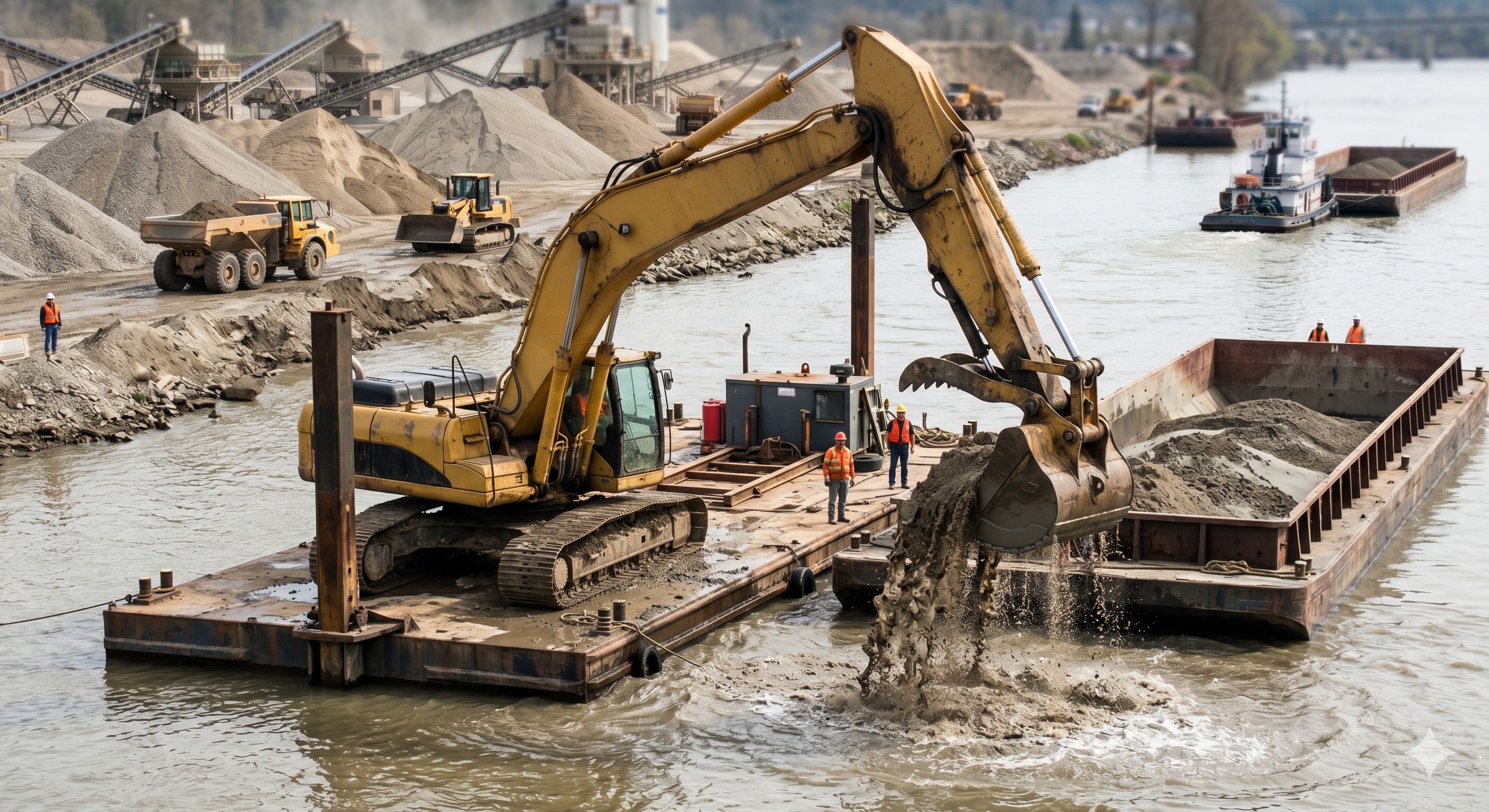
The river dredging excavator is deployed across four primary heavy-industry domains, each with specific attachment and configuration requirements:
- Flood Control & Reservoir Sediment Removal: Operating weight 55-75 metric tons with 35-50 ft (10.7-15.2 m) boom + 20-30 ft arm. Uses high-volume (3-5 yd³) light-material buckets and GPS-guided depth control (±2 inches).
- Bridge Scour Repair & Pier Protection: Requires 60-100 ft (18.3-30.5 m) total reach, 2,500-4,000 lb (1,134-1,814 kg) grapple or magnet for debris removal. Hydraulic thumbs and tiltrotators improve precision.
- Sand & Gravel Mining (Inland Waterways): Heavy-duty (1.5-2.5 yd³) reinforced buckets with wear plate (AR500) and hydraulic ripper teeth. Production rates: 120-200 tons/hour of dry sand.
- Industrial Canal & Port Maintenance: Submersible dredge pump attachment (200-600 GPM, 50-80 ft head) for slurry removal up to 30% solids by weight. Hybrid power option (electric+ diesel) for emission-controlled zones.
Conclusion
The river dredging excavator represents a technologically optimized intersection of heavy-duty structural engineering, high-efficiency hydraulics, and Tier 4/Stage V emissions compliance. For civil contractors and mining operators, the data is clear: compared to non-specialized alternatives, this equipment delivers 12-15% faster cycle times, 15-20% lower cost per cubic yard of sediment removed, and 47% fewer track/seal failures in submerged environments. When specifying a dredging excavator, prioritize IP67-rated swing bearings, HT785 steel booms, and closed-center load-sensing hydraulics to maximize ROI over the machine’s 12,000-15,000 hour service life. As climate-driven flood risks intensify and siltation accelerates globally, the river dredging excavator will remain an indispensable asset for sustainable waterway management and industrial material extraction.