

Introduction
A tandem semi trailer is a trailer whose rear load is carried by a tandem axle group—two axles positioned close together and connected by a suspension system that shares load between them. This is the dominant rear-axle configuration in North American general freight service, and its specification is defined by a single regulatory number: the US federal maximum gross weight on a tandem axle group is 34,000 pounds on the Interstate Highway System . That limit, combined with the 80,000-pound gross vehicle weight ceiling and the Federal Bridge Formula, determines the practical payload a tandem trailer can legally carry.
For fleet managers and maintenance planners, the tandem configuration is not simply a pair of axles. The two axles must share load within the suspension’s design limits, maintain alignment under braking and cornering, and distribute braking force evenly to avoid uneven tire wear. A tandem group that is misaligned or whose suspension bushings have worn allows the axles to “walk” out of position, producing irregular tire wear that the operator may misattribute to tire quality rather than suspension condition. The maintenance priorities for a tandem trailer therefore center on the suspension and alignment as much as on the tires and brakes.
This guide examines the tandem axle group’s design and weight limits, the suspension mechanics that determine load sharing, and the inspection and maintenance practices that protect tire life and braking stability.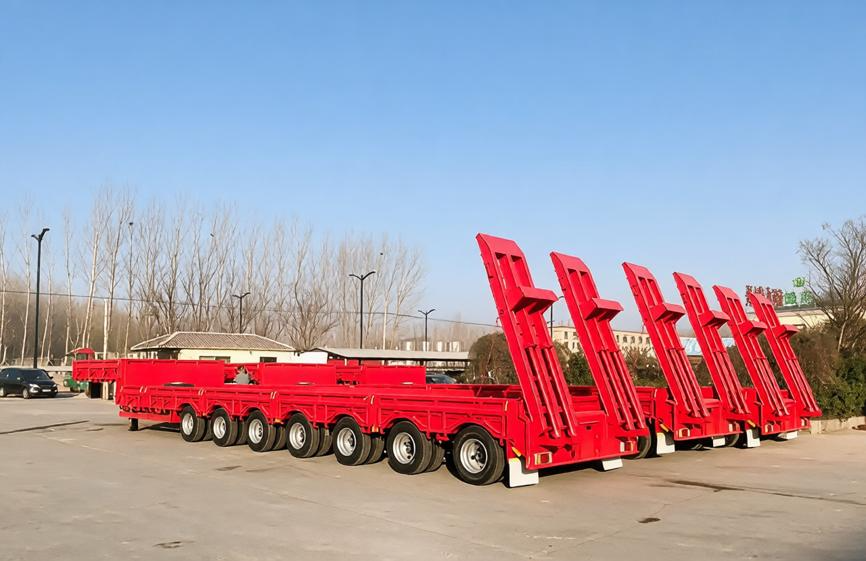
Core Powertrain and Structural Design
Engine and Transmission
A tandem semi trailer has no engine or transmission. Its performance depends on the tractor that tows it and the condition of the axle and suspension systems. The tandem group’s load-carrying capacity is determined by the axle beam ratings, the suspension’s rated capacity, and the tire load ratings—all of which must be consistent with the 34,000-pound federal tandem limit for Interstate operation .
Hydraulic System
Standard tandem semi trailers use mechanical or air suspension, not hydraulic systems, for the rear axle group. Air suspension uses air springs (bellows) and height control valves to maintain ride height and share load; mechanical suspension uses leaf springs and equalizer beams. Hydraulic systems appear only on specialized trailers with hydraulic lifting or steering axles, which are outside the scope of a conventional tandem configuration.
Chassis and Structural Durability
The suspension’s load-sharing mechanism is the defining structural feature of the tandem group. In a mechanical leaf-spring suspension, an equalizer beam pivots between the two axles, distributing load so that neither axle carries a disproportionate share. Air suspension achieves the same result through air springs and height control valves that adjust pressure to maintain ride height under varying loads. A suspension that fails to share load evenly will overload one axle and unload the other, producing tire wear and braking imbalance.
Alignment is the other critical durability factor. Worn suspension bushings at the trailing arm pivots or equalizer connections allow the axles to shift out of parallel, producing lateral scrub that wears tires rapidly. Industry maintenance guidance notes that bushings at trailing arm pivots wear out around 150,000–200,000 km on average, and that the resulting misalignment shows up as uneven tire wear before it produces any other symptom . Tire rotation and inspection for cupping or feathering every 40,000 km is the recommended early-detection practice, because those wear patterns are usually the first visible sign of a bent axle or worn suspension bushing rather than a tire defect .
Technical Specifications
The table below presents representative parameters for tandem semi trailers in US general freight service. Values are drawn from federal regulations and published maintenance guidance; actual specifications vary by manufacturer, suspension type, and configuration.
Comparative Advantages TCO and ROI
The tandem semi trailer competes with the tridem (three-axle) configuration and, in some applications, with split tandem arrangements. The tandem is the standard because it satisfies the 34,000-pound federal limit with two axles and four tire positions per side in dual configuration, keeping tare weight and tire count lower than a tridem. A tridem offers higher gross load capacity in states not limited by the 80,000-pound federal ceiling, and it is used in about 5 percent of US truck combinations, most commonly in the Northeast and for commodities such as building materials and heavy machinery . The trade-off is additional tare weight, more tires to maintain, and potentially higher pavement damage depending on axle spread and load limits .
A split tandem increases the spacing between the two axles from the standard approximately 4 feet to 8, 9, or 10 feet. This changes the regulatory treatment: instead of being considered a tandem with a 34,000-pound limit, the split tandem is treated as two single axles governed by the Bridge Formula, with combined allowable weights of 38,000 pounds at 8 feet, 39,000 pounds at 9 feet, and 40,000 pounds at 10 feet or more . The operational advantage is increased legal payload within the Bridge Formula, but the wider spacing affects turning geometry and tire scrub.
A defensible comparison requires stated assumptions. Consider a fleet operating at the 80,000-pound federal ceiling with a tractor tare of 18,000 lb and a trailer tare of 14,000 lb. The available payload is 48,000 lb, distributed across the steer axle, the tractor tandem, and the trailer tandem. If the trailer tandem is limited to 34,000 lb and the tractor tandem is similarly limited, the payload distribution is constrained by axle spacing and the Bridge Formula rather than by the trailer’s structural rating. A split tandem that increases the trailer group’s allowable weight to 38,000–40,000 lb may allow the fleet to carry more payload on the same gross weight, but only if the axle spacing and the route’s bridge formula provisions permit it. The calculation depends on the specific tractor wheelbase, trailer kingpin-to-rear-axle distance, and the states the fleet operates in.
Resale value favors standard tandem configurations because the buyer pool is broadest. Split tandems and tridems have narrower markets, though they command premiums in specific applications where their additional capacity is required.
Heavy Duty Application Scenarios
-
General freight and dry van operations: The standard tandem with air suspension is the dominant configuration. Load sharing and ride height control are the primary suspension functions, and tire wear diagnosis is the primary maintenance activity. Rotation and inspection at 40,000 km intervals catch misalignment before it consumes a set of tires .
-
Construction and heavy haulage: Tandem axles with 16-tonne capacity ratings and reinforced suspension are common. The higher structural rating provides margin for uneven loading and rough surfaces, but the legal limit remains 34,000 lb on Interstate highways. Split tandems may be specified where state regulations and Bridge Formula provisions allow higher group weights .
-
Container drayage and port operations: High-frequency stop-start cycles stress the brake system and the suspension bushings. The tandem group’s load sharing must be maintained to prevent one axle from carrying more braking force than the other, which accelerates lining wear on the overloaded axle.
-
Regional and state-specific operations: A tridem trailer may be advantageous in states that permit higher gross weights than the federal 80,000-pound ceiling, particularly for dense commodities. The additional axle increases legal payload but adds tare weight and maintenance surface area .
Selection and Maintenance Considerations
Selecting a tandem semi trailer begins with the legal weight limits on the routes served, not the trailer’s structural rating. The 34,000-pound federal tandem limit and the 80,000-pound gross ceiling, combined with the Bridge Formula, determine the maximum practical payload for Interstate operation . A trailer rated for more than the legal limit provides no operational benefit unless the fleet operates in jurisdictions with higher limits or obtains permits.
Key maintenance and selection considerations include:
-
Inspect suspension bushings and alignment at defined intervals. Worn trailing arm or equalizer bushings allow the axles to shift out of parallel, producing irregular tire wear. Pry bar inspection at PM intervals detects movement before it becomes visible as tire damage .
-
Rotate and inspect tires every 40,000 km. Cupping or feathering is the first visible sign of a bent axle or worn suspension bushing, not a tire defect. Catching it early allows alignment correction before the tires are destroyed .
-
Inspect air bags every 20,000 km on air suspension. Cracking or chafing indicates air spring degradation. A compressor that cycles more frequently than usual is an early indicator of an air bag or fitting leak, not necessarily a compressor fault .
-
Verify load sharing under loaded conditions. A tandem group that does not share load evenly will overload one axle and underload the other, producing braking imbalance and accelerated tire wear. The suspension’s equalizer or height control valves should be inspected for proper function.
-
Confirm the trailer’s tandem rating against the legal limit. A trailer with 16-tonne axles is structurally capable of more than the 34,000-pound federal tandem limit. The legal limit controls operation, and the extra structural capacity provides margin for uneven loading and rough surfaces rather than additional legal payload.
Conclusion
A tandem semi trailer is defined by its two-axle rear group and the 34,000-pound federal limit that governs its legal load on the Interstate Highway System . The tandem configuration is the standard because it satisfies that limit with a manageable tare weight and tire count, while the suspension’s load-sharing mechanism and alignment determine whether the axles and tires reach their design life.
The engineering priorities are clear: maintain suspension bushings and alignment, rotate and inspect tires at 40,000 km intervals to catch misalignment early, and verify load sharing under loaded conditions . The commercial priorities follow: match the tandem rating to the legal limit on the routes served, and consider split tandem or tridem configurations only when the route network and regulatory environment support their additional capacity . The tandem trailer whose suspension is maintained and whose axles are aligned delivers the tire life and braking stability the configuration was designed for.