

Overview
A semi trailer is a cargo-carrying vehicle with no front axle of its own, designed to be coupled to a tractor unit through a kingpin and fifth wheel arrangement. The tractor carries the front portion of the trailer’s weight and provides the motive power; the trailer’s rear axles carry the remainder. This configuration allows one tractor to pull multiple trailers over its service life, with trailers parked on landing gear when uncoupled .
For fleet managers and procurement teams, understanding what a semi trailer is—and is not—matters because the category covers a wide range of configurations, from dry vans and flatbeds to lowboys and tankers, each with different payload limits, maintenance priorities, and legal constraints. This FAQ addresses the definition, coupling mechanism, main types, and the basic procurement and maintenance knowledge that applies across the category.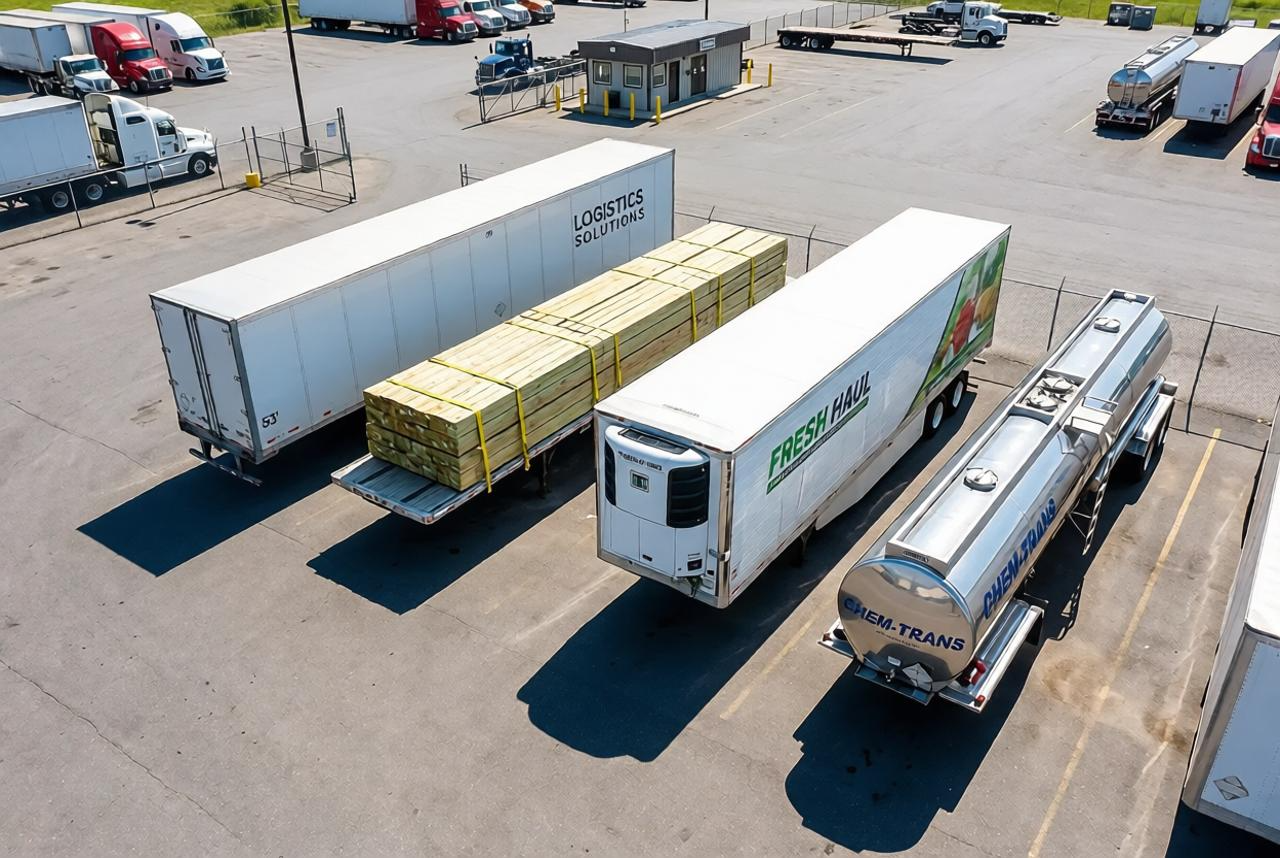
Frequently Asked Questions
What is the definition of a semi trailer?
A semi trailer is a trailer without a front axle, supported at the front by the towing tractor through a fifth wheel coupling and at the rear by its own axles. The term “semi” refers to this partial support: the trailer carries only part of its own weight and payload, with the tractor bearing the rest through the kingpin .
This distinguishes it from a full trailer, which has axles at both front and rear and does not impose a vertical load on the towing vehicle. The semi trailer’s front section—the upper coupler area—contains the kingpin, a hardened steel pin that the fifth wheel’s locking jaws grip. When uncoupled, the trailer rests on landing gear at the front and its own axles at the rear.
How does a semi trailer couple to a tractor?
A semi trailer couples to a tractor through the kingpin and fifth wheel: the tractor backs under the trailer’s front section, the fifth wheel’s jaws close around the kingpin, and a locking mechanism secures the connection. The driver then verifies the lock with a visual check and a tug test before connecting the air lines and electrical cable.
The coupling is designed to allow articulation during turns while transmitting the trailer’s vertical load to the tractor. The kingpin sits in the trailer’s upper coupler plate; the fifth wheel on the tractor provides a load-bearing surface and a pivot point. A properly coupled combination moves as a single unit, with the trailer tracking behind the tractor . Failure to verify the lock is a safety-critical error—a trailer that separates from its tractor at speed is a fatal risk.
What are the main types of semi trailers?
The main semi trailer types are flatbed, dry van, refrigerated (reefer), curtain-side, lowboy, dump, and tanker, each defined by its cargo structure and loading method. A flatbed has an open deck for containers, steel, and machinery; a dry van is fully enclosed for general freight; a reefer maintains temperature control; a lowboy has a double-drop deck for tall equipment; a dump trailer unloads by gravity or hydraulic tilt; and a tanker carries liquids or bulk materials .
The selection follows the cargo profile, not a default preference. A fleet hauling palletized goods needs a van or curtain-side; a fleet moving excavators needs a lowboy; a fleet carrying aggregate needs a dump trailer. Each type has its own payload range, maintenance priorities, and legal dimension constraints.
What are the standard dimensions of a semi trailer?
The dominant dimensions are 53 feet long, 102 inches wide, and 13 feet 6 inches high in the United States, and 13.6 meters long and 2.55 meters wide in the European Union . These are the prevailing specifications for dry van and curtain-side trailers in each market.
Length and width are regulated dimensions with jurisdiction-specific limits, while height is constrained by bridge clearances. A semi trailer’s actual dimensions should be confirmed against its data plate and the manufacturer’s specification sheet, particularly for specialized types such as lowboys or extendable flatbeds, where the ranges differ substantially .
What payload can a semi trailer carry?
Semi trailer payload ranges from approximately 20 tons for standard European configurations to 40 tons or more for North American flatbeds and dry vans, with specialized heavy-haul trailers reaching higher capacities . A typical North American flatbed carries a maximum freight weight of approximately 48,000 lbs, while a 3-axle flatbed or side-wall trailer can list a 40-ton payload.
Payload is governed by the lowest of the trailer’s rated capacity, the tractor’s gross combination weight rating, and the legal axle load limits on the route. The trailer data plate rating is a ceiling, not a guarantee of legal capacity. Fleets should verify the axle ratings and the route regulations before assuming a trailer can carry its headline payload.
What maintenance does a semi trailer require?
A semi trailer requires brake inspection and adjustment, tire and wheel-end checks, suspension inspection, lighting checks, and landing gear lubrication, plus type-specific maintenance for hydraulic systems, refrigeration units, or tank valves depending on the trailer. Because trailers have no odometer, maintenance should be scheduled on a calendar basis combined with usage tracking.
The brake system is the highest-priority area because brake defects are the leading roadside out-of-service condition. Pushrod stroke, lining thickness, and drum condition should be measured at every preventive maintenance interval. Wheel-end leaks, tire pressure, and tread depth are the next priority, followed by structural inspection of the frame, deck, and doors. The trailer manufacturer’s maintenance manual controls the specific intervals for a given model.
What should I verify before buying a semi trailer?
Verify the trailer type matches the cargo, the payload rating matches the legal axle limits, the dimensions are legal on the operating routes, and the condition of the brakes, tires, and structure before purchase. A used trailer with serviceable brakes and a sound frame is a better asset than a newer unit with neglected maintenance.
The verification checklist should include the data plate (model, dimensions, axle ratings, tare weight), the brake system condition (stroke, lining, drum), the tire and wheel-end condition, the structural condition (frame cracks, deck soft spots, door seals), and the title and VIN match. For cross-border purchases, confirm the lighting and braking compliance for the destination market.
Conclusion
A semi trailer is defined by its kingpin-and-fifth-wheel coupling, its lack of a front axle, and the wide range of cargo configurations it can take. The category covers everything from a 53-foot dry van to a lowboy carrying an excavator, and the procurement decision should start from the cargo profile and the legal operating environment rather than from a generic specification. The trailer data plate and the manufacturer’s manual remain the controlling references for payload, dimensions, and maintenance intervals.