

Overview
The 53-foot semi trailer is the dominant dry van specification in North American interstate freight, having displaced the 48-foot trailer as the standard for general cargo since the 1980s. Its advantage is geometric: a 53-foot floor accommodates 26 standard 48-inch by 40-inch pallets in 13 rows, with enough margin for the door to close without rearranging the load .
For fleet managers and procurement teams, the 53-foot trailer presents a compliance nuance that the headline length obscures. The federal standard is 53 feet on the National Network, but individual states maintain grandfathered limits and axle-spacing conditions that determine whether a specific trailer can operate without a permit on a specific route . This FAQ addresses the dimensions, payload, legal constraints, and procurement checks that matter most when specifying or buying 53-foot semi trailers.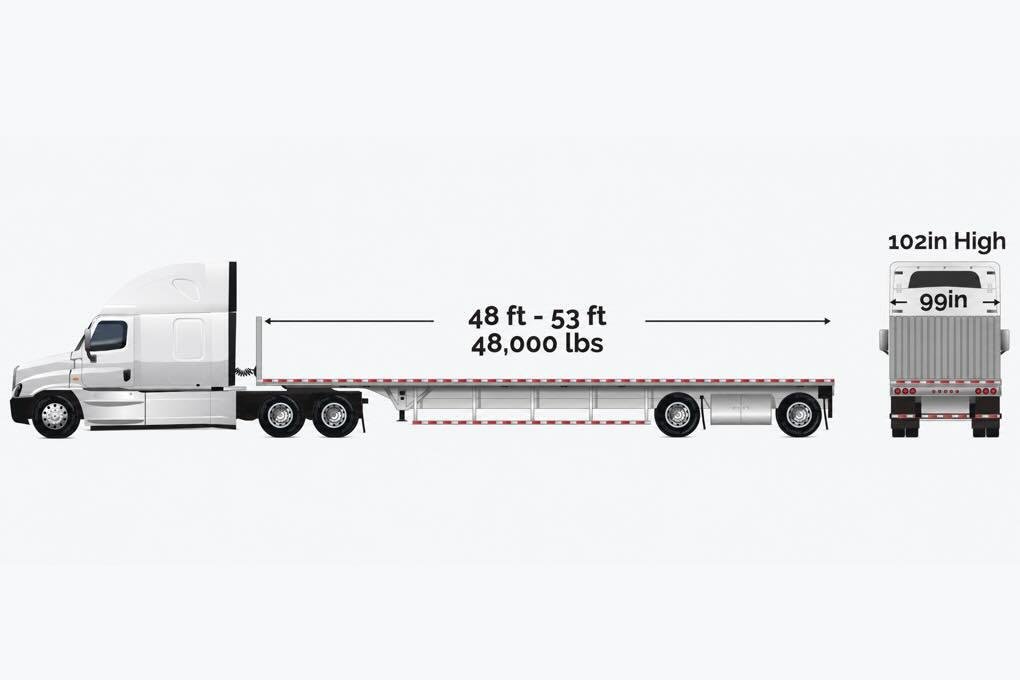
Frequently Asked Questions
What are the exterior and interior dimensions of a 53-foot semi trailer?
A standard 53-foot dry van measures 53 feet long, 8 feet 6 inches (102 inches) wide, and 13 feet 6 inches high on the exterior, with an interior height of approximately 110 inches and a kingpin location 36 inches behind the front . These are the dominant specifications for North American dry van fleets.
The interior dimensions are what determine cargo fit. The 110-inch interior height accommodates standard pallet stacks, and the 102-inch exterior width provides an internal width that allows two 48-inch pallets side by side with clearance. The fifth wheel height on a typical tractor is around 47 inches, which affects the trailer’s front deck height and the overall combination height when loaded . Buyers should request the specific interior length, width, and door opening dimensions from the manufacturer for a fit check against their cargo.
How many pallets does a 53-foot semi trailer hold?
A 53-foot semi trailer holds 26 standard 48-inch by 40-inch pallets arranged in 13 rows of two . This is the primary reason the 53-foot length became the North American standard: it maximizes pallet count without the unused floor space that a 55-foot trailer would carry.
The pallet count assumes the pallets are loaded in the standard orientation with the 48-inch dimension across the trailer width. If the cargo is loaded differently or the pallets are oversized, the count drops. For dense freight, the weight limit may be reached before the pallet positions are filled, in which case the 53-foot length does not translate into additional legal payload. Fleets hauling heavy palletized goods should model both cube and weight utilization before assuming the 53-footer’s full capacity is usable.
What is the typical payload of a 53-foot dry van?
A 53-foot dry van typically carries 40,000 to 45,000 pounds of freight, with a typical full truckload around 45,000 pounds . The payload is governed by the trailer’s tare weight, the tractor’s gross combination weight rating, and the legal axle load limits on the route.
The payload figure is not a fixed specification. A trailer with a heavier spec—reinforced floor, lift gate, or swing doors—will have a higher tare weight and a correspondingly lower available payload. The federal gross vehicle weight limit on the Interstate System is 80,000 pounds, and the tractor’s own weight consumes a portion of that. A fleet hauling near the 45,000-pound ceiling should confirm the tare weight of the specific unit and the tractor’s weight before assuming the trailer’s rated payload is legally available.
Is a 53-foot semi trailer legal in every US state?
A 53-foot semi trailer is not uniformly legal in every state without conditions. Federal law sets a 48-foot minimum for semi trailers on the National Network, and 29 states have grandfathered limits above that minimum, many of them at 53 feet . However, several states impose axle-spacing conditions that a 53-foot trailer must satisfy to operate without a permit.
The conditions vary by state. California permits 53-foot trailers without a permit if the kingpin-to-rearmost axle distance is 38 feet or less . Indiana allows 53-foot trailers with a kingpin-to-rearmost axle distance of 40 feet 6 inches . Wisconsin permits 53 feet with a kingpin-to-rear axle distance of 41 feet, measured to the center of the rear tandem assembly . Some states, such as Louisiana and Oklahoma, allow semi trailers up to 59 feet 6 inches, while others remain at 48 feet or have different limits . A fleet operating across state lines should verify both the length limit and the axle-spacing condition for every jurisdiction on the route.
What is the tare weight of a 53-foot trailer?
The tare weight of a 53-foot trailer varies substantially by type and specification. A 53-foot combination flatbed with aluminum and steel construction lists an empty weight of approximately 11,100 pounds . A 53-foot logging tridem lists a tare weight of 15,100 pounds with a GVWR of 82,500 pounds . Dry van tare weights typically fall between these figures depending on body construction, axle count, and accessories.
The tare weight directly affects the available payload. A heavier trailer consumes more of the 80,000-pound gross combination limit, leaving less for freight. Fleets comparing two 53-foot trailers with similar purchase prices should compare tare weights, because the lighter unit provides more legal payload capacity and better fuel efficiency over the trailer’s service life.
What axle configurations are available for 53-foot trailers?
Common 53-foot trailer axle configurations are tandem (2-axle) and tridem (3-axle), with tandem being the standard for dry vans and flatbeds. A sliding tandem axle is widely specified on dry vans to allow the axle group to be repositioned for weight distribution and bridge formula compliance .
The axle configuration affects both payload and maneuverability. A tridem distributes load more effectively and can support a higher GVWR, but it increases tare weight and tire scrub in tight turns. A sliding tandem allows the fleet to adjust the kingpin-to-axle distance to satisfy state requirements, which is particularly relevant for California and Indiana operations where the axle-spacing condition is the difference between legal operation and a permit. Buyers should confirm whether the trailer’s suspension allows the axle position to be adjusted and whether the adjustment range covers the states in the operating network.
What should I verify before buying a 53-foot semi trailer?
Verify the length and axle-spacing dimensions against the operating states, the tare weight against the payload requirement, and the structural and brake condition on any used unit. The 53-foot trailer is a mature product, and the difference between a good and a poor purchase is usually condition and compliance, not specification innovation.
The verification checklist should include:
-
Length and kingpin-to-axle distance: Measure or confirm from the data plate, and check against the most restrictive state on the route.
-
Tare weight: Confirm the actual weight, not the published estimate.
-
Brake system: Measure pushrod stroke and lining thickness; brake defects are the leading out-of-service condition.
-
Floor and roof condition: Walk the deck for soft spots and inspect the roof for punctures that admit water.
-
Axle and suspension: Confirm the axle brand and rating, and check for wear that indicates misalignment or overloading.
Conclusion
The 53-foot semi trailer’s dominance comes down to its 26-pallet capacity and the freight economics that follow from it. But the trailer’s legality is not uniform: the federal 48-foot floor, the grandfathered 53-foot limits in many states, and the kingpin-to-axle conditions in California, Indiana, and Wisconsin mean that a fleet must verify the specific trailer against the specific route . The payload range of 40,000 to 45,000 pounds is a planning figure, not a guarantee, and the tare weight of the individual unit determines what is actually available. The trailer data plate and the current regulation for each operating jurisdiction remain the controlling references for every purchase and deployment decision.