

Introduction
A side tipping semi trailer is a bulk haulage trailer that discharges its load by tilting the cargo box laterally to the left or right, rather than raising the bed rearward as an end dump trailer does. The mechanism relies on a set of multi-stage hydraulic cylinders mounted beneath or alongside the tub, which extend to lift one side of the box and allow the material to flow out along the trailer's length.
The operational pressure driving interest in side tipping is the discharge geometry itself. An end dump trailer must reverse against a tipping wall or pad, raise its bed to full height, and hold that elevated position while the load flows out. On uneven ground, soft shoulders, or sites without a engineered tipping face, that raised bed is a stability risk. A side tipper discharges through a low arc, keeping the center of gravity closer to the ground and allowing the driver to tip wherever the trailer stands—no reversing, no alignment, no waiting for the truck ahead to clear the pad . For mining fleets, quarry operators, and construction contractors working in confined or rough terrain, this geometric difference translates directly into cycle time and safety.
This article examines the engineering of side tipping semi trailers, the hydraulic and structural systems that determine their performance, and the specification considerations for fleets evaluating this equipment class. All specifications are presented as industry ranges from published manufacturer data; actual values vary by configuration and should be confirmed with the supplier.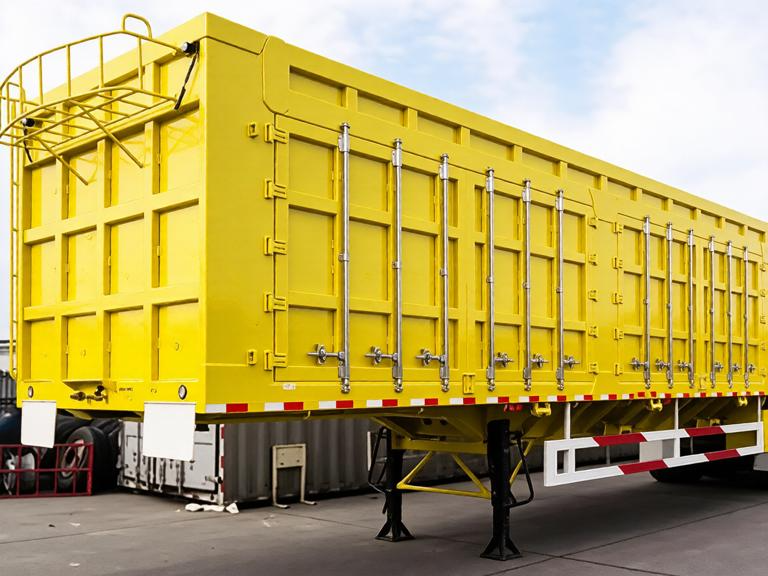
Core Powertrain and Structural Design
Hydraulic System: Multi-Stage Cylinders and Control
The hydraulic system is the defining engineering subsystem of a side tipping trailer. Most designs use multi-stage telescopic cylinders—commonly three to five stages—mounted to the trailer frame and the cargo box. A typical configuration described by Özgül uses three 6-stage hydraulic cylinders, with a 160-liter oil tank mounted on the right-hand side of the undercarriage . Chinese export models frequently specify a 5-cylinder side tipping system plus a shifting cylinder, enabling discharge to both sides . The shifting cylinder allows the box to be repositioned laterally so that tipping can occur in either direction without repositioning the trailer.
The cylinder arrangement determines both the lifting force and the tipping arc. Multi-stage cylinders provide high force from a compact retracted length, which is essential given the limited space beneath the trailer frame. The hydraulic pressure and flow requirements depend on the cylinder volume and the desired tipping speed; a system that tips slowly extends the discharge cycle, while one that tips too quickly can impose dynamic loads on the frame and the load itself. Mechanical safety locks are a critical specification—the box must remain pinned in the transport position even if hydraulic pressure is lost, and the lock must be engaged before the trailer moves .
Structural Design and Cargo Box Construction
The cargo box on a side tipping trailer must resist two distinct load cases: the static and dynamic loads of transport, and the concentrated forces imposed during tipping when one side of the box is lifted and the load shifts laterally. The box is typically constructed from high-strength steel or manganese plate for abrasive resistance. Common specifications include a 4–6 mm floor and 3–5 mm side walls, with manganese plate preferred for abrasive loads such as ore and aggregate .
The frame and main beam dimensions determine the trailer's ability to carry the rated payload without deflection. A typical main beam height of 460–500 mm with upper and lower flange thicknesses in the 14–18 mm range appears across multiple manufacturer specifications . The tub-to-frame attachment points—the pivot and cylinder mounting bosses—are stress concentration areas that require reinforcement. A side tipper that is loaded to its rated capacity and tipped repeatedly will fatigue these areas if the weld schedule and plate thickness are inadequate for the duty cycle.
Stability Geometry and Site Advantages
The stability advantage of side tipping is geometric. An end dump trailer at full lift raises its bed to a steep angle, moving the combined center of gravity of the trailer and load significantly upward and rearward. On a side slope or soft ground, that elevated center of gravity creates an overturning moment that the trailer's footprint may not resist. A side tipper lifts one side of the box through a much shallower arc, keeping the center of gravity lower and the load distribution more favorable .
This geometry has practical consequences at the discharge point. A side tipper can discharge along a roadside stockpile or into a narrow strip without the trailer needing to be perpendicular to the pile. The driver stops, tips to the appropriate side, and moves on. For operations where the tipping pad is constrained or where multiple trucks queue at a single wall, the cycle time savings accumulate across every load .
Technical Specifications
The table below presents typical industry ranges for side tipping semi trailers, drawn from published manufacturer listings. These are reference values, not specifications for any single model. Actual capacities and dimensions vary by configuration, axle count, and regulatory market.
Comparative Advantages TCO and ROI
The commercial case for a side tipping semi trailer versus an end dump trailer rests on cycle time, stability, and site compatibility rather than purchase price alone. Side dump trailers typically carry a higher initial cost than equivalent end dumps due to the specialized hydraulic system and reinforced box construction . The ROI calculation must account for the operational conditions where the side tipper's advantages actually apply.
Cycle time at the discharge point. An end dump must reverse to the tipping wall, align, raise the bed, discharge, lower the bed, and pull forward. A side tipper eliminates the reversing and alignment steps and discharges through a shorter lift cycle. On sites where trucks queue at a single tipping point, the cumulative time savings across a fleet shift can be material . The value of that time depends on the haul distance and the number of cycles per shift; short-haul operations with frequent tipping benefit most.
Stability and site tolerance. The low tipping arc reduces the risk of overturning on uneven or soft ground, which is the primary safety advantage cited by operators who have switched from end dumps in mining and rough-terrain applications . A stability incident with a raised end dump can destroy the trailer, injure the driver, and block the site. The avoided cost of even a single incident contributes to the side tipper's economic case, though this is a risk-avoidance benefit rather than a predictable annual saving.
Material handling. Side tippers handle sticky, damp, or clay-coated materials more effectively than end dumps because the lower lift angle allows the load to shed without the driver rocking the bed to shake it loose . This reduces fuel consumption and cylinder wear associated with repeated partial lifts.
ROI assumptions. A fleet comparing a side tipper against an end dump would model the purchase price difference against the cycle time savings per load, multiplied by loads per shift and shifts per year. If the side tipper saves even a few minutes per load and the fleet runs multiple loads per shift, the annual time recovery can justify the premium. The calculation requires the fleet's actual haul profile and site conditions; a side tipper on a site with an engineered, uncongested tipping pad may not deliver the same advantage as one operating in a confined quarry.
Heavy Duty Application Scenarios
Side tipping semi trailers are deployed in operating environments where the discharge geometry matters:
-
Mining and quarrying. Rough haul roads, uneven pads, and sticky ore favor the low-arc discharge and stability of side tipping. Fleets in African mine sites have shifted portions of their haulage to side tippers specifically to address tipping stability and cycle time at the pile .
-
Construction and demolition debris. Confined urban sites and road construction projects where the trailer cannot reverse to a tipping wall benefit from lateral discharge. The ability to place material precisely alongside the trailer suits road-building and site-preparation work .
-
Aggregate and sand haulage. Roadside stockpiling and narrow discharge strips are natural applications for side tipping. The trailer discharges along its length without requiring the space for a rearward tipping maneuver.
-
Agriculture and bulk commodities. Grain, silage, and feed can be discharged laterally into pits or stockpiles. The lower tipping height reduces the risk of the load bridging or hanging in the box.
Selection and Maintenance Considerations
For fleet managers and procurement teams specifying a side tipping semi trailer, the following considerations reduce risk and improve lifecycle value:
-
Verify the hydraulic system specification against the duty cycle. Multi-stage cylinder count, oil tank capacity, and the presence of a shifting cylinder for dual-side tipping are the key variables. A system sized for occasional use will not withstand continuous high-cycle operation .
-
Confirm the cargo box steel grade and thickness. Manganese or high-strength steel with a 4–6 mm floor and 3–5 mm sides is the baseline for abrasive loads. A specification that does not state the steel grade should prompt a direct question .
-
Check the mechanical safety lock. The box must remain secured in the transport position without hydraulic pressure. Verify that the lock engages automatically or is positively engaged by the operator before movement .
-
Match payload capacity to the material density and road limits. A 60-ton rated trailer loaded with dense ore may reach the axle limit before the volume limit. Conversely, a low-density material may fill the box before reaching the weight rating. Confirm the intended material's density and the legal axle loads .
-
Inspect pivot and cylinder mounting points during PM. These are the stress concentration areas that fatigue under repeated tipping cycles. Cracks at the pivot bosses or cylinder mounts are a structural warning that should not be ignored.
-
Confirm parts availability for the hydraulic system in the operating region. Cylinder seals, hoses, and control valves are wear items. A trailer with a proprietary hydraulic system and no regional parts support creates downtime risk that outweighs any purchase price advantage.
Conclusion
A side tipping semi trailer solves a specific operational problem: discharging bulk material where an end dump cannot reverse, cannot raise its bed safely, or cannot afford the cycle time at a congested tipping point. The engineering that delivers this capability—multi-stage hydraulic cylinders, a reinforced cargo box, and a low-arc tipping geometry—carries a cost premium over a conventional end dump, and that premium is justified only when the site conditions actually require lateral discharge. For fleets operating in mining, quarrying, construction, or confined stockpiling environments, the stability and cycle time advantages are measurable and repeatable. For fleets with wide, engineered tipping pads and free-flowing materials, the end dump remains the lower-cost solution. The specification decision should follow the site geometry, the material characteristics, and the haul cycle—not the equipment category alone.