

Overview
A side tipping semi trailer—also called a side tipper or side dump trailer—is a bulk material transport trailer whose cargo box tilts laterally to discharge sand, gravel, coal, ore, or grain to the side of the vehicle rather than to the rear. Fleet managers and procurement teams specify side tippers when rear-discharge access is constrained, when faster unloading cycles justify the hydraulic complexity, or when the cargo needs to be placed alongside the trailer rather than behind it.
The procurement problem is not whether side tippers can discharge bulk material—they can, with documented payload capacities from 30 to 100 tons depending on configuration—but whether the buyer understands the unique structural and stability risks that side discharge introduces. A side tipping trailer transmits substantial torsional loads to the fifth wheel and chassis during tipping, and a premature stop in discharge can shift the center of gravity toward the discharge side and create a rollover risk . This FAQ addresses the capacity ranges, hydraulic configurations, stability considerations, and maintenance requirements that determine whether a side tipping semi trailer is a safe and productive addition to a fleet.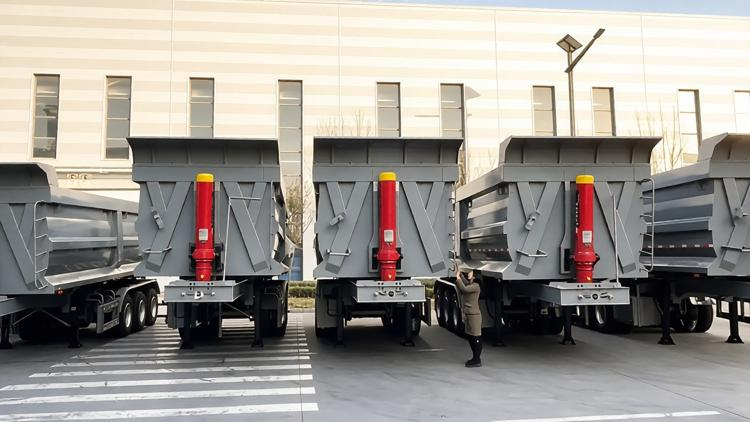
Frequently Asked Questions
What payload capacity does a side tipping semi trailer offer?
A side tipping semi trailer typically carries 30 to 80 tons in standard export configurations, with heavy-duty builds rated up to 100 tons for mining and quarry applications. Chinese manufacturer listings show payload ranges of 40 to 80 tons for 3-axle side dump trailers, with customization available up to 100 tons . Sinotruk’s side tipper listing specifies a standard 40-ton capacity with a maximum carrying capacity of 80 to 100 tons for heavy-duty configurations . The Özgül side tipping trailer uses 3 × 12-ton axles with a 12.6 to 13.6 meter overall length . The capacity is governed by the main beam dimensions, axle rating, and hydraulic system capacity—not by the box volume alone.
What hydraulic system does a side tipping trailer use?
A side tipping trailer uses multiple hydraulic cylinders to lift the cargo box laterally, with configurations ranging from 3 to 6 stages and cylinder counts of 3 or more depending on the trailer length and payload. The Özgül trailer specifies 3 × 6-stage hydraulic cylinders with a 160-liter oil tank mounted on the right side of the undercarriage . Chinese manufacturers commonly quote HYVA hydraulic systems or domestic alternatives, with cylinder counts and stroke lengths matched to the box dimensions and tipping angle . The hydraulic system is the primary maintenance cost driver on a side tipper: cylinder seals, hoses, and control valves wear with every tipping cycle, and a cylinder failure during a loaded discharge is a stability event, not merely a downtime event.
What stability risks are unique to side tipping semi trailers?
The primary stability risk unique to side tipping is torsional loading transmitted to the fifth wheel and chassis during discharge, which conventional fifth wheel arrangements are not well adapted to handle. An Australian patent application notes that side-tipping bulk material can apply substantial forces corresponding to torsional loads parallel to the trailer’s long axis, and that in extreme cases transmitted torsional loads can cause the leading vehicle to topple . The risk is more pronounced when tipping dense, wet material that grips the bin, and when discharge is stopped prematurely with material still on the raised side . Side-mounted hold-down portions have been developed to reduce kingpin loading and transmit torsional loads more safely . Fleets operating side tippers should confirm that the tractor’s fifth wheel is rated for the torsional loads the trailer imposes.
How should a side tipping trailer be operated to avoid rollover?
A side tipping trailer should be operated on level, firm ground with the hydraulic cylinder raised slowly and the tipping angle controlled, because sudden hydraulic jolts and uneven ground are the primary triggers of stability loss. Loading guidance recommends parking the trailer on flat, firm ground before tipping, lifting the cylinder slowly, and avoiding sharp turns or sudden braking with a raised load . The trailer should never be tipped on an incline, and the discharge side should be clear of personnel and equipment. If material becomes stuck and discharge stops prematurely, the operator should lower the box and clear the obstruction rather than continuing to raise the cylinder against a stationary load, because the raised box with retained material shifts the center of gravity toward the discharge side .
What maintenance intervals apply to a side tipping semi trailer?
A side tipping semi trailer requires daily pre-trip checks of the hydraulic system for leaks, hose condition, and fluid level, with quarterly hydraulic fluid analysis and annual full inspection recommended for commercial operations. Daily checks should cover tires, lights, brakes, hydraulic fluid level and leaks, fifth wheel grease, wheel hub oil, air lines, fasteners, and safety chains . The hydraulic system should receive periodic fluid and filter replacement, with complete fluid replacement recommended every 1,000 operating hours or annually, and cylinders inspected for rod scratches, pitting, and seal leakage . Brake components should be checked for wear, with brake shoes replaced when lining thickness reaches 1/4 inch or less, and S-cam bushings and slack adjusters lubricated every 3 months or 25,000 miles . The manufacturer’s service manual for the specific trailer and hydraulic system remains the controlling reference for intervals and fluid specifications.
What are the typical applications for a side tipping semi trailer?
Side tipping semi trailers are used for bulk material transport in construction, mining, quarrying, and agriculture, including sand, gravel, coal, ore, grain, and building materials . The side discharge configuration is advantageous where the trailer cannot access a rear-dump location, where the material needs to be placed along a road edge or embankment, or where faster unloading reduces cycle time. The trailer’s ability to discharge without the vehicle repositioning makes it suitable for road construction and maintenance, where material is placed alongside the pavement. Side tippers are less suited to applications requiring precise placement or where the discharge side cannot be cleared for the material to fall.
How does a side tipping trailer compare to a rear tipping trailer?
A side tipping trailer discharges laterally, eliminating the need to reposition the vehicle after unloading and allowing discharge in confined spaces where a rear tipper would require backing maneuvers, while a rear tipping trailer relies on gravity discharge behind the vehicle and is simpler in hydraulic and structural design. The side tipper’s advantage is cycle time and placement flexibility; its disadvantage is the torsional loading and stability risk that rear tippers do not impose. A rear tipper’s discharge is directed behind the trailer, which requires clear space but does not shift the center of gravity laterally. Fleets should select based on the discharge location constraints and the material placement requirements, not on capacity alone.
Conclusion
Specifying a side tipping semi trailer starts with the discharge environment and the material, not the payload figure. Confirm that the tractor’s fifth wheel can handle the torsional loads side tipping imposes, specify a hydraulic system with cylinder count and brand matched to the payload and duty cycle, and establish a daily hydraulic inspection and annual fluid replacement schedule before the trailer enters service. The side tipper that discharges cleanly on level ground with a maintained hydraulic system is a productivity asset; the one operated on an incline with a leaking cylinder is a stability hazard.