

Introduction
Transport operators face increasing pressure to improve payload utilization, reduce delivery delays, control maintenance costs, and comply with vehicle height and weight regulations. When conventional flatbed trailers cannot accommodate cargo with unusual height or loading requirements, a semi trailer with a step-up front may provide a suitable alternative.
This description generally refers to a semi trailer with a raised front deck section, creating a stepped platform profile. Depending on the manufacturer's design, the elevated section may be positioned above the main cargo deck or arranged as part of a specialized platform configuration. The exact meaning should be confirmed through the trailer's engineering drawings and deck-height measurements.
A step-up front design can be useful when cargo needs a different platform arrangement, when the trailer must accommodate specific tractor and coupling geometry, or when the load requires a combination of elevated and lower deck sections. It should not automatically be confused with a conventional step deck or drop deck semi trailer, which typically has a raised front deck and a lower rear loading platform.
For procurement managers and fleet operators, the key purchasing considerations include front deck height, main deck height, usable platform length, payload rating, axle configuration, frame strength, and tractor compatibility. These factors determine whether the trailer can safely transport the intended cargo.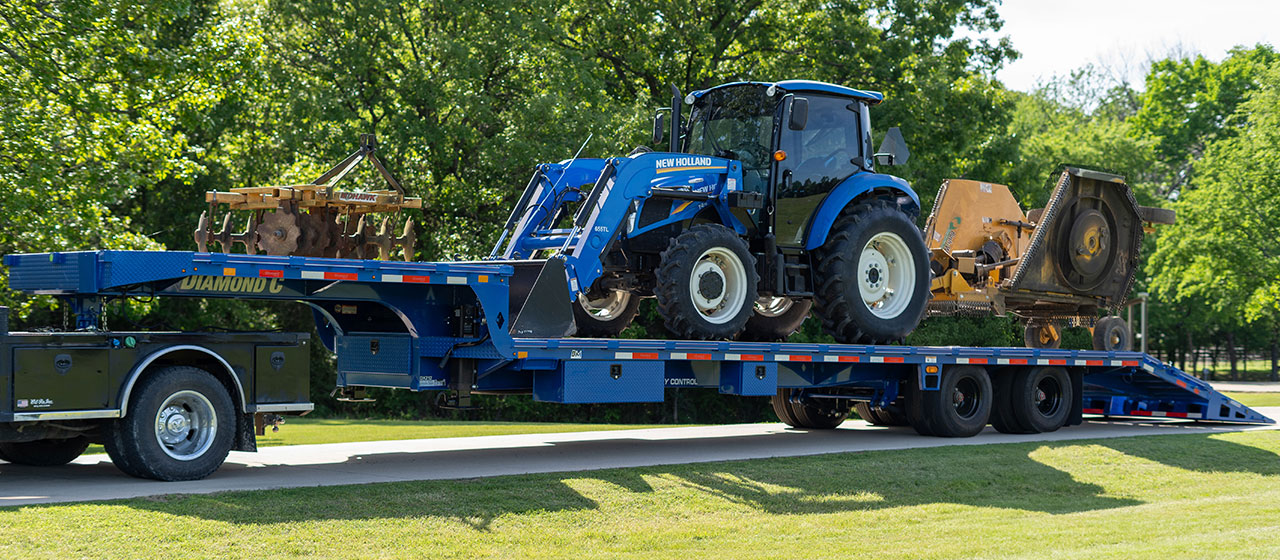
Core Powertrain and Structural Design
A conventional semi trailer is an unpowered vehicle. It receives propulsion from the tractor unit and uses its own structural frame, suspension, axle assemblies, braking system, and electrical equipment to support cargo transportation.
Engine and Transmission
A semi trailer with a step-up front does not normally have its own engine or transmission. The tractor unit supplies the driving force through its engine, transmission, driveline, and rear axles.
Trailer selection must therefore account for the tractor's rated towing capacity and fifth-wheel compatibility. Important considerations include:
-
Fifth-wheel height: The tractor coupling height must match the trailer's kingpin and front structure.
-
Kingpin position: The kingpin location affects the distribution of vertical load between the tractor and trailer axles.
-
Gross combination weight: The tractor must be suitable for the combined operating weight of the tractor, trailer, and cargo.
-
Turning clearance: The raised front section and trailer structure must provide adequate clearance during articulation.
-
Brake and electrical connections: The tractor must support the trailer's pneumatic braking and electrical systems.
A mismatch between tractor and trailer geometry can cause poor alignment, excessive coupling stress, or insufficient clearance during turning.
Hydraulic System
Most step-up front semi trailers do not require a hydraulic system because their primary function is to provide a fixed cargo platform. However, hydraulic components may be incorporated into specialized configurations.
Possible hydraulic features include:
-
Hydraulic loading ramps for machinery transportation.
-
Hydraulic suspension or ride-height adjustment on specialized trailers.
-
Hydraulic deck extensions or movable platform sections.
-
Hydraulic equipment used for specialized loading and unloading operations.
If hydraulic ramps or movable components are specified, buyers should verify cylinder capacity, operating pressure, hose protection, valve arrangement, and compatibility with the tractor's hydraulic power supply where applicable.
Hydraulic equipment should be selected according to the actual loading task. Unnecessary hydraulic features increase purchase cost and create additional inspection and maintenance requirements.
Chassis and Structural Durability
The chassis is particularly important in a trailer with a stepped front profile. The transition between different deck heights creates changes in structural geometry and load paths. The frame must distribute cargo forces without excessive bending, twisting, or localized stress.
Major structural components include:
-
Main longitudinal beams.
-
Crossmembers supporting the cargo platform.
-
Reinforcement around the raised front section.
-
Kingpin mounting structure.
-
Landing gear supports.
-
Axle and suspension mounting brackets.
-
Cargo tie-down points and platform edge structures.
The raised section should be engineered to withstand the intended vertical loads and dynamic forces during transportation. The connection between the elevated platform and the lower or adjacent deck section requires particular attention because abrupt changes in frame geometry can create stress concentrations.
Buyers should request information about the frame material, beam dimensions, welding quality, reinforcement arrangement, corrosion protection, and rated loading points.
Axles, Suspension, and Braking Systems
Axle and suspension selection determines how the trailer distributes its load and responds to road conditions. Depending on the intended payload and local regulations, a step-up front semi trailer may use two, three, or more axles.
Common suspension options include:
-
Mechanical leaf-spring suspension: A relatively simple system that is widely used for commercial trailers.
-
Air suspension: Uses compressed air to support the trailer and can provide ride-height adjustment and improved cargo protection in suitable applications.
-
Specialized suspension: May be used for heavy-duty or unusual cargo configurations requiring specific load distribution.
The braking system should be compatible with the tractor and destination-market requirements. Pneumatic service brakes are common on road-going semi trailers, while ABS and other electronic braking functions depend on the applicable specification and regulations.
The number of axles alone does not determine legal payload. Individual axle ratings, spacing, tire load ratings, suspension capacity, and local axle-load restrictions must all be considered.
Technical Specifications
The specifications of a semi trailer with a step-up front vary according to its design, intended cargo, and manufacturer. There is no single standard dimension or payload rating for every trailer using this description. Buyers should request a technical drawing showing the front platform height, main deck height, transition geometry, usable deck length, overall dimensions, and axle positions.
The following table summarizes the main parameters to evaluate during procurement.
|
Key Parameter |
Typical Technical Specification |
Operational Significance |
|---|---|---|
|
Front deck configuration |
Raised front platform or stepped front structure |
Determines cargo arrangement and tractor clearance |
|
Front deck height |
Manufacturer-designed dimension |
Affects loading geometry and overall vehicle height |
|
Main deck height |
Depends on chassis and suspension design |
Determines cargo loading height and clearance |
|
Payload capacity |
Manufacturer-rated value for the complete trailer |
Establishes the permitted technical cargo load |
|
Axle configuration |
Commonly 2, 3, or more axles depending on design |
Influences load distribution and road compliance |
|
Suspension |
Mechanical, air, or specialized suspension |
Affects ride quality and maintenance |
|
Braking system |
Pneumatic brakes, with required electronic functions where applicable |
Supports safe and compliant braking |
|
Main frame |
Steel beams, crossmembers, and reinforced structural sections |
Determines structural strength and durability |
Deck Height and Cargo Clearance
Deck height is one of the most important measurements for specialized trailer selection. The total loaded vehicle height is affected by the platform height, cargo height, and any additional supports or packaging beneath the cargo.
A raised front platform may be useful for specific cargo arrangements, but it can also increase the overall transport height if tall cargo is placed on that section.
Before ordering, buyers should confirm:
-
Height from the ground to the front deck.
-
Height from the ground to the main cargo deck.
-
Length and width of each usable platform section.
-
Height and geometry of the transition between sections.
-
Clearance around the tractor and fifth-wheel coupling.
-
Overall loaded height under the intended cargo arrangement.
These measurements are essential when transporting industrial equipment, prefabricated structures, and other cargo subject to height restrictions.
Comparative Advantages TCO and ROI
A semi trailer with a step-up front should be evaluated against a conventional flatbed trailer, step deck trailer, or specialized lowbed trailer. The best option depends on cargo geometry and loading requirements rather than the appearance of the trailer alone.
Comparison with Conventional Flatbed Trailers
A conventional flatbed has a relatively consistent deck height across its cargo platform. It is suitable for general freight, steel products, timber, construction materials, and machinery that fits within the available transport height.
A step-up front configuration provides a different platform arrangement. It may offer advantages for specialized cargo that requires an elevated front section or a specific deck geometry. However, the additional structural complexity may increase manufacturing cost and create more demanding loading considerations.
Comparison with Step Deck and Lowbed Trailers
A conventional step deck semi trailer generally features a higher front deck and a lower rear deck. This arrangement allows taller cargo to be transported while helping maintain compliance with overall vehicle-height restrictions.
A lowbed semi trailer has a substantially lower loading platform and is commonly used for heavy machinery and oversized equipment. It may be more appropriate when maximum cargo height clearance is the main requirement.
A step-up front trailer should therefore not be selected simply because it has a raised section. Buyers should compare the actual platform dimensions and determine which configuration best accommodates the intended cargo.
Total Cost of Ownership
Total cost of ownership (TCO) includes the purchase price and all major operating expenses over the trailer's working life.
Key cost categories include:
-
Initial purchase price and financing.
-
Tire replacement and wheel maintenance.
-
Brake and suspension servicing.
-
Structural inspection and repair.
-
Corrosion protection and repainting.
-
Insurance, registration, and road charges.
-
Downtime and lost transportation revenue.
-
Resale value at the end of ownership.
A specialized trailer may cost more initially than a standard flatbed, but it may provide commercial value if it allows the operator to carry cargo that would otherwise require a different transport solution.
ROI Evaluation
Return on investment depends on the number of transport jobs, revenue per trip, trailer utilization, maintenance expenses, and the cost of alternative transportation arrangements.
For example, a company considering a step-up front trailer for industrial cargo should compare its expected annual revenue with the purchase and operating costs. The calculation should account for realistic annual trips, cargo availability, loading time, empty return journeys, and any route restrictions.
A specialized configuration does not guarantee higher profitability. Its financial advantage depends on whether the trailer consistently serves suitable cargo and avoids unnecessary operational limitations.
Heavy Duty Application Scenarios
A semi trailer with a step-up front may be considered for specialized cargo transportation where a raised platform section is required. The actual application depends on the platform dimensions, rated payload, and structural design.
Industrial Equipment Transportation
Manufacturing facilities may need to move machinery, production equipment, steel structures, and industrial components between factories and installation sites.
A stepped platform arrangement may be useful when different sections of the cargo require different support heights. Buyers should verify the position of the cargo's center of gravity and ensure that the platform and tie-down points can safely support the load.
Construction and Infrastructure Projects
Construction projects often involve transporting equipment and materials with irregular dimensions. Depending on the specific trailer configuration, applications may include:
-
Construction machinery and equipment components.
-
Steel structures and prefabricated sections.
-
Industrial generators and power equipment.
-
Long construction materials.
-
Specialized project cargo.
The trailer must be selected according to the actual cargo dimensions, loading method, and route restrictions. Machinery transportation may require ramps, winches, or other loading equipment, depending on the design.
Manufacturing and Specialized Freight
Industrial manufacturers may use specialized trailers to transport products that cannot be arranged efficiently on a standard flatbed.
A raised front platform can provide a particular cargo-support arrangement, but buyers should confirm that the load does not exceed the platform's rated capacity and that sufficient space remains for securement equipment.
Long-Distance Heavy Cargo Transportation
For long-distance transportation, road vibration, braking loads, and repeated changes in road gradient place continuous demands on the trailer structure.
Operators should pay particular attention to:
-
Cargo weight distribution.
-
Axle loading and tire capacity.
-
Brake condition and adjustment.
-
Structural fatigue around deck transitions.
-
Cargo restraint and load stability.
-
Route height, width, and weight restrictions.
Selection and Maintenance Considerations
Selecting the right semi trailer with a step-up front requires a clear understanding of the cargo and the intended operating conditions. Buyers should not rely on a general product name alone because different manufacturers may use different structural arrangements.
Key Purchasing Considerations
Before requesting a quotation, prepare the following information:
-
Cargo type: Identify the machinery, industrial products, or materials to be transported.
-
Cargo dimensions: Provide the maximum length, width, height, and weight.
-
Platform requirements: Confirm whether the front deck must be raised and specify the required height difference.
-
Payload rating: Determine the required rated payload and verify the manufacturer's technical documentation.
-
Axle configuration: Select an appropriate arrangement according to the intended load and local road regulations.
-
Tractor compatibility: Confirm kingpin dimensions, fifth-wheel height, coupling clearance, and gross combination weight.
-
Loading method: Determine whether loading will use forklifts, cranes, ramps, or other equipment.
-
Destination regulations: Check vehicle dimensions, axle loads, braking requirements, and registration rules.
-
After-sales support: Evaluate spare-parts availability, warranty coverage, and technical assistance.
Preventive Maintenance
The stepped structural design makes regular frame inspections especially important. Maintenance personnel should pay attention to areas where the front platform connects to the main chassis and where the frame geometry changes.
A practical inspection program should include:
-
Structural frame: Check longitudinal beams, crossmembers, welds, and reinforcement areas for cracks or deformation.
-
Axles and suspension: Inspect springs, air bags, shock absorbers, bushings, hubs, and mounting fasteners.
-
Braking equipment: Check brake linings, chambers, air hoses, valves, and electronic braking components where fitted.
-
Tires and wheels: Monitor inflation pressure, tread wear, wheel fasteners, and load ratings.
-
Kingpin and coupling area: Inspect the kingpin, mounting plate, and surrounding structure for abnormal wear or damage.
-
Landing gear: Check operation, lubrication, and mounting brackets.
-
Electrical system: Test lights, connectors, wiring, and warning systems.
-
Cargo restraints: Inspect tie-down points, winches, locks, and other securing equipment.
Inspection intervals should follow the manufacturer's recommendations and applicable local regulations. Heavy-duty operation, poor road conditions, frequent loading, and corrosive environments may require more frequent inspections.
Supplier Documentation and Quality Control
Before confirming an order, request a complete technical package from the manufacturer. This should include:
-
General arrangement and dimensional drawings.
-
Front deck and main deck height measurements.
-
Rated payload and gross vehicle weight information.
-
Axle, suspension, and tire specifications.
-
Braking system configuration.
-
Frame material and structural details.
-
Available options and customization information.
-
Warranty and spare-parts arrangements.
The buyer should also confirm which accessories are included in the quotation, such as spare tires, toolboxes, landing gear, ramps, and cargo-securing equipment.
Clear technical documentation reduces the risk of receiving a trailer that does not match the intended cargo or tractor configuration.
Conclusion
A semi trailer with a step-up front is a specialized transport configuration that provides an elevated front platform or stepped structural arrangement. Its suitability depends on the exact deck geometry, cargo dimensions, payload rating, frame design, axle configuration, and tractor compatibility.
For fleet managers and industrial buyers, the most important factors are platform height, structural strength, load distribution, braking performance, cargo securement, and destination-market compliance. Comparing the design with conventional flatbed, step deck, and lowbed trailers helps identify the most practical solution.
Before purchasing, buyers should obtain detailed engineering drawings, verify the intended loading arrangement, and confirm that the complete tractor-trailer combination meets applicable road requirements. A correctly specified trailer can support safe cargo transportation, reliable operation, and long-term fleet value.