

Introduction
Semi trailer parts form an interdependent mechanical system in which each component’s service life is shaped by the duty cycle of the whole vehicle. A brake chamber that is correctly sized for the axle load but starved of clean, dry air will fail prematurely. A suspension bushing that is neglected will accelerate tire wear and place abnormal stress on the axle beam. For fleet managers and maintenance planners, parts selection is not a catalogue exercise—it is a reliability engineering decision that determines roadside breakdown frequency, maintenance labor hours, and ultimately the cost per kilometer of the trailer asset.
The operational pressures are familiar: uptime targets, driver shortages, and the cost of unscheduled repairs. A semi trailer taken out of service for a failed wheel seal or a cracked suspension hanger costs not only the repair invoice but also the revenue lost during the downtime window. This guide examines the primary wear and structural components of a semi trailer—axles, suspension systems, brake chambers, landing gear, and the fifth-wheel kingpin—and provides the engineering context needed to specify, inspect, and replace them on a defensible schedule.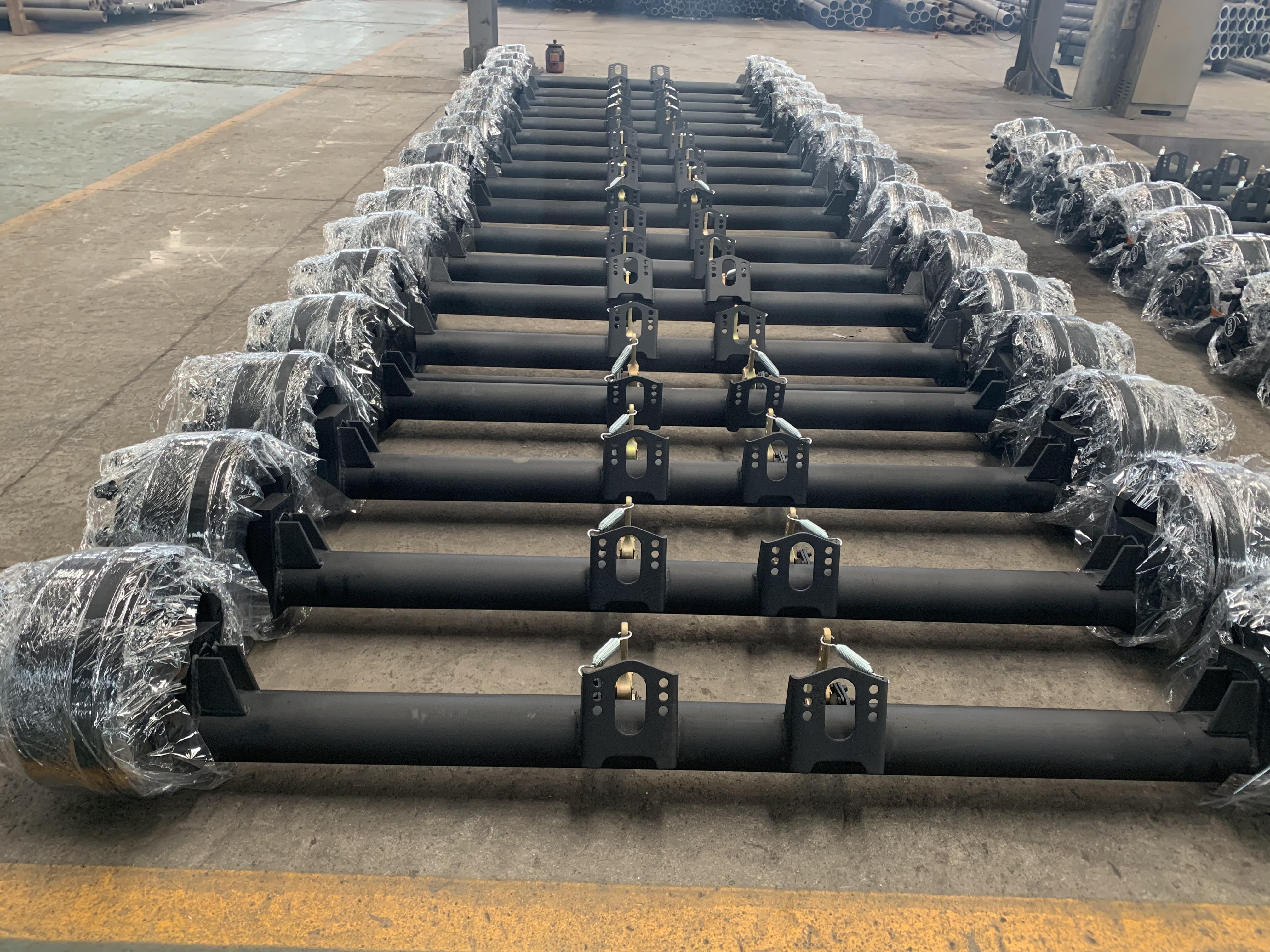
Core Powertrain and Structural Design
Axle Assemblies and Load Ratings
The semi trailer axle is the primary load-bearing rotating component. Axle capacity ratings commonly fall into 13-tonne and 16-tonne classes for general freight trailers, with heavier ratings available for lowbed and heavy-haul configurations . The axle beam is typically a square or round section—150 mm square beam is a common American-type specification—with spindle ends machined to accept hub bearings and brake components .
Axle specification must account for more than static load. The brake chamber center distance and spring seat installation dimensions determine compatibility with the suspension and brake system. Track width affects tire clearance and scrub radius. Wheel fixing pattern—whether hub-piloted or stud-piloted—must match the wheel and rim specification. A mismatch in any of these dimensions produces installation difficulty at best and premature component failure at worst.
Suspension Systems and Structural Durability
Semi trailer suspension divides into mechanical leaf spring and air suspension architectures. Mechanical suspension uses a stack of leaf springs clamped to the axle and pivoted at hanger brackets, with an equalizer beam distributing load between adjacent axles. Common specifications include hanger thickness of 6 mm or 8 mm, equalizer thickness of 10 mm or 12 mm, and equalizer pin diameters of 50 mm, 60 mm, or 70 mm . These dimensions directly affect the suspension’s resistance to lateral forces during cornering and its tolerance for overload events.
Air suspension replaces the leaf spring with an air spring (bellows) and a trailing arm or four-link mechanism. The primary advantage is ride height control and reduced road shock transmission to cargo. The trade-off is additional maintenance surface area: air bags, height control valves, and associated pneumatic lines introduce failure points that mechanical suspension does not have. For high-value or fragile freight, air suspension’s cargo protection typically justifies the added complexity.
Structural durability of the suspension depends on the hanger-to-frame welds and the equalizer pin bushings. Worn bushings allow the equalizer to shift under load, altering axle alignment and producing irregular tire wear. Hanger weld cracking is a fatigue failure mode that should be inspected at every major service interval, particularly on trailers operating on rough roads or with frequent overload exposure.
Brake Chambers and Pneumatic System
The brake chamber converts compressed air pressure into mechanical force applied to the brake camshaft or disc caliper. Standard chamber types for semi trailers include T24 and T30 single chambers, and T30/30 double (spring brake) chambers for parking and emergency braking . Typical operating pressure is 0.8 MPa, with maximum working pressure of 1.0 MPa and an operating temperature range of -40°C to +80°C .
Chamber selection must match the brake foundation—drum or disc, camshaft or air disc—and the required braking torque for the axle load. A T30 chamber produces more force than a T24, but oversizing a chamber relative to the foundation can cause brake imbalance and accelerated lining wear. Pushrod stroke is the critical wear indicator: as the brake lining wears, the pushrod extends further to apply the brake. When stroke exceeds the adjustment limit, the chamber must be replaced or the slack adjuster re-indexed, or braking performance degrades.
Kingpin and Coupling Interface
The kingpin is the mechanical link between tractor and trailer, and its dimensions are standardized for interchangeability. The 2-inch (50.8 mm) kingpin, specified in ISO 337 (and historically BS AU 1c), is the standard coupling for semi trailers operating within normal weight regulations . For extra-heavy-duty applications exceeding those limits, the 3.5-inch (89 mm) kingpin specified in ISO 4086 is used .
Kingpin wear is a safety-critical inspection point. The pin diameter, the mounting bolt hole pattern, and the weld condition at the trailer upper coupler plate all affect coupling security. A worn kingpin can produce steering looseness and abnormal fifth-wheel jaw wear. The upper coupler plate itself—the reinforced structure that transfers kingpin loads into the trailer main beams—is vulnerable to fatigue cracking at the kingpin reinforcement welds and should be inspected visually at every PM interval.
Technical Specifications
The table below presents representative parameters for primary semi trailer components in general freight service. Values are labeled as typical industry ranges; actual specifications vary by manufacturer, model, configuration, and local regulations.
| Key Parameter | Typical Technical Specification | Operational Significance |
|---|---|---|
| Axle capacity | 13 t (standard); 16 t (heavy-duty) | Sets legal payload ceiling per axle; must match tire and suspension ratings |
| Axle beam | 150 mm square (American type); 127–150 mm options | Bending stiffness under load; larger beam for heavier duty cycles |
| Suspension hanger thickness | 6 mm or 8 mm | Resistance to lateral forces and fatigue at frame attachment |
| Equalizer pin diameter | 50 mm, 60 mm, or 70 mm | Bushing wear rate and axle alignment stability |
| Brake chamber operating pressure | 0.8 MPa (normal); 1.0 MPa (maximum) | Braking force generation; system must maintain pressure for safe stopping |
| Brake chamber stroke limit | 64 mm (typical T24/T30) | Exceeding limit indicates lining wear; requires adjustment or replacement |
| Kingpin diameter | 2 in (50.8 mm) standard; 3.5 in (89 mm) heavy-haul | Coupling interchangeability and load transfer capacity |
| Landing gear static capacity | 28 t (common) | Stability during uncoupled loading and parking |
Comparative Advantages TCO and ROI
The closest alternative to OEM-specified replacement parts is the aftermarket parts channel. The cost comparison is not simply OEM price versus aftermarket price; it is cost per service kilometer that matters. A brake chamber that costs 30% less but fails at 60% of the service life of the OEM equivalent increases total cost through replacement labor and downtime.
Consider a fleet operating 50 semi trailers, each averaging 100,000 km annually. Assume brake chambers are replaced on a 2-year cycle at an average cost of 400 CNY per chamber (parts and labor), with 4 chambers per trailer. Annual brake chamber cost is approximately 40,000 CNY across the fleet. If a lower-cost aftermarket chamber priced at 280 CNY fails at 18 months instead of 24, the annualized cost rises to approximately 46,700 CNY—a 17% increase despite the lower unit price. The calculation excludes the cost of a roadside failure, which can exceed the parts and labor differential by an order of magnitude.
Suspension bushing quality follows a similar logic. Bronze or mixed-material equalizer bushings may cost more than rubber bushings, but their wear rate under heavy load is typically lower, and they maintain axle alignment more consistently over the service interval . For fleets operating on routes with frequent tight turns or poor road surfaces, the bushing upgrade often pays back within one tire replacement cycle through reduced irregular wear.
ROI assumptions should be stated explicitly: the above examples assume scheduled replacement intervals, average utilization, and parts pricing that varies by region and supplier. Buyers should substitute their own fleet data.
Heavy Duty Application Scenarios
-
Container drayage: High-frequency coupling and short trips place heavy demands on the kingpin, landing gear, and brake chambers. Landing gear with 28-tonne static capacity is standard, but the cyclic loading of frequent coupling and uncoupling accelerates wear at the landing gear leg pivot and the upper coupler plate . Brake chambers on drayage trailers may require more frequent stroke inspection due to the high number of brake applications per kilometer.
-
Long-haul highway freight: The dominant duty cycle for most semi trailers. Axle and suspension components experience steady load and relatively low lateral stress. The primary wear drivers are mileage accumulation and brake lining consumption. Air suspension is commonly specified for cargo protection and ride height control.
-
Heavy-haul and lowbed operations: Axle ratings of 16 tonnes and above are common, with multi-axle configurations distributing concentrated loads . The kingpin is often the 3.5-inch heavy-duty type. Suspension components must tolerate overload events and uneven load distribution that would be abnormal in general freight service.
-
Construction and rough-terrain delivery: Impact loading from potholes and unpaved site roads accelerates suspension bushing wear and increases the risk of hanger weld fatigue. Mechanical suspension is often preferred for its tolerance of abuse, though reinforced air suspension systems are increasingly specified for mixed routes.
Selection and Maintenance Considerations
Parts selection begins with dimensional and load compatibility, not price. The axle must match the suspension spring seat dimensions and brake chamber mounting pattern. The brake chamber must match the foundation brake type and the required torque for the axle load. The kingpin must match the fifth-wheel jaw specification and the trailer’s weight class.
Key maintenance practices for semi trailer parts include:
-
Axle hub lubrication and bearing inspection. Hub bearing cavity lubrication should be performed at brake pad replacement and at least every six months or 50,000 km. Bearing clearance and hub nut torque should be checked at the same interval . Wheel nut torque must be verified after initial loaded driving and after any wheel replacement, using a calibrated torque wrench in a crisscross sequence.
-
Brake chamber stroke and pushrod inspection. Check pushrod stroke at every PM interval. When stroke approaches the adjustment limit, investigate lining wear and slack adjuster condition before replacing the chamber. Air line contamination—oil or moisture from a failed compressor or dryer—is a common cause of chamber diaphragm failure.
-
Suspension bushing and hanger inspection. Worn equalizer bushings allow axle misalignment and should be replaced in sets. Hanger welds should be inspected for cracks, particularly on trailers with high mileage or a history of overload.
-
Kingpin and upper coupler inspection. Verify kingpin diameter and weld condition at every major service. A worn kingpin can be detected by coupling looseness or by measurement against the standard diameter.
-
Landing gear function and structural check. Test landing gear operation under load and inspect the leg structure, pivot pins, and mounting brackets for deformation or cracking. A landing gear that collapses during loading is a serious safety event.
Conclusion
Semi trailer parts management is a reliability discipline. The components that fail most often—brake chambers, suspension bushings, wheel seals, and landing gear—are also the components where specification shortcuts produce the most predictable and costly consequences. Matching axle capacity to legal load limits, selecting brake chambers that match the foundation brake, and using suspension bushings that maintain alignment under load are not premium choices; they are the baseline for a trailer that completes its service life without excessive downtime.
Commercially, the parts decision is a cost-per-kilometer decision. The lowest unit price is rarely the lowest total cost when failure frequency and labor hours are included. Fleets that standardize on proven component specifications, track replacement intervals by serial number or position, and inspect wear items at defined intervals achieve lower maintenance cost and higher resale value than fleets that replace parts reactively. The engineering and the economics point in the same direction: specify for the duty cycle, maintain on a schedule, and replace before failure.