

Introduction
A used semi trailer for sale typically costs 40 to 70 percent of a comparable new unit, depending on age, condition, and market demand. A five-year-old dry van or flatbed may trade in the range of $15,000 to $30,000, while older or higher-mileage units can be found below $10,000 . These figures are market references, not guarantees; the actual value of a used trailer depends on structural integrity, brake and tire condition, and whether the maintenance history supports the seller’s claims.
The operational pressures around used trailer purchases are concrete. A unit that fails the federally mandated annual inspection cannot legally operate in interstate commerce, and documentation of that inspection must be kept on the vehicle . A trailer with a cracked frame or contaminated brake system will consume maintenance budget at a rate that erases the acquisition saving within months. Used trailer inventory has tightened in some segments, and prices vary widely by type and configuration—basic box or skeleton trailers typically fall in the lower range, while specialized refrigerated or tank units command higher prices .
This guide examines the engineering and commercial factors that determine whether a used semi trailer for sale is a sound investment: structural and brake inspection priorities, tire and axle evaluation, and the total cost of ownership that extends beyond the purchase invoice.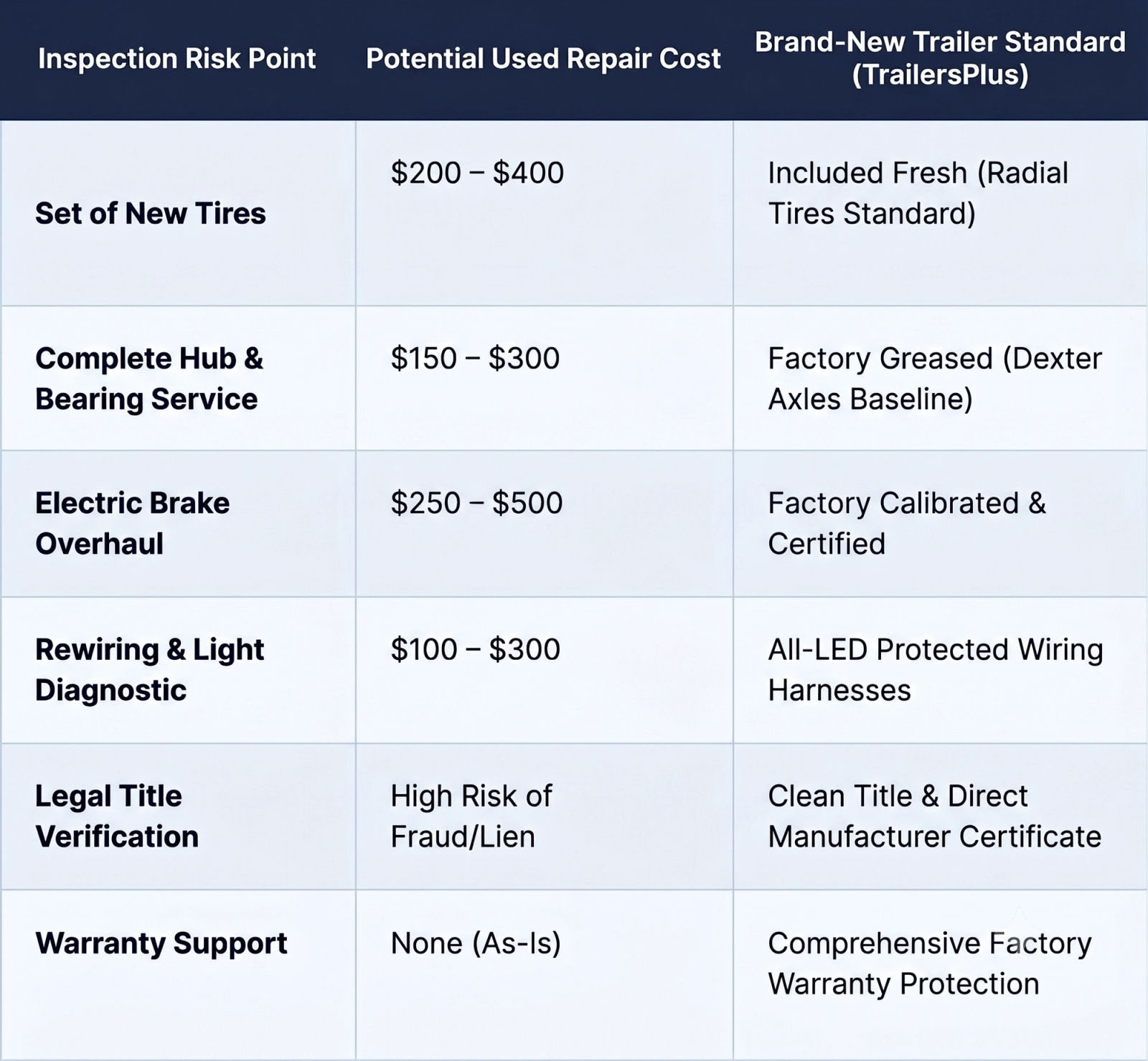
Core Powertrain and Structural Design
Engine and Transmission
A semi trailer has no engine or transmission. Its value lies in the condition of its structural and running gear systems. The critical interface is the kingpin and upper coupler: the kingpin must be within wear limits, and the upper coupler plate must be free of cracks and deformation. A worn kingpin that cannot be gripped securely by the fifth-wheel jaws is a coupling failure waiting to occur.
Hydraulic System
Most general-freight used trailers have hydraulic systems limited to landing gear operation. For lowbed and heavy-haul trailers, hydraulic gooseneck detachment and axle lift are essential functions. A lowbed with a compromised hydraulic system may be functionally unusable regardless of frame condition, because it cannot be detached or loaded safely. Cylinder seals, hose condition, and valve function should be inspected before purchase.
Chassis and Structural Durability
The frame is the first inspection priority for any used semi trailer. Fatigue cracking at suspension bracket welds, cross-member intersections, and kingpin reinforcement plates is the dominant structural failure mode in high-mileage service . Cracks around welds are a red flag; they often indicate stress, fatigue, or past overloading. Surface rust is common and often cosmetic, but deep corrosion, flaking steel, or perforated sections signal structural weakening that cannot be economically reversed .
Frame deformation may not be immediately visible. Indicators include doors that do not close properly, irregular tire wear patterns, or a trailer that does not track straight behind the tractor . Professional repairs are acceptable if documented; sloppy welds or illogical reinforcement plates warrant closer scrutiny or rejection.
Technical Specifications
The table below presents representative inspection parameters and price references for used semi trailers. Values are market references and typical inspection thresholds; actual specifications vary by manufacturer, model, configuration, and condition.
Comparative Advantages TCO and ROI
The used semi trailer purchase is a total cost of ownership decision, not a price comparison. A used trailer priced below the market average may simply be deferring maintenance that the buyer will pay for. A unit with documented service records and recent brake and tire work may cost more upfront but deliver lower cost per kilometer over its remaining service life.
A critical hidden cost category is initial catch-up maintenance. A used trailer may need brake chambers, suspension bushings, and tires within the first year. Tire replacement alone can cost $300 to $600 per tire depending on brand and size, and a trailer with eight tires represents a significant potential expense . Brake shoe replacement runs $150 to $400 per set, and suspension bushing replacement adds $100 to $300 per service . These costs should be estimated before purchase and added to the effective acquisition price.
A defensible comparison requires stated assumptions. Consider a fleet evaluating a used dry van at $20,000** against a new unit at **$45,000. Assume the used trailer requires $8,000 in catch-up maintenance in the first year—brake chambers, tires, and suspension bushings—while the new trailer requires minimal unscheduled maintenance. Over a five-year horizon, the used trailer’s total outlay may approach the new unit’s, but the used trailer’s resale value at year five is lower. The used trailer’s advantage is lower initial capital outlay and freed working capital; the new trailer’s advantage is predictable maintenance and higher residual value. The decision hinges on the fleet’s cash position, maintenance capability, and tolerance for downtime.
Resale value for used trailers is strongly condition-dependent. A trailer with documented maintenance history and clean inspection records commands a higher trade-in offer than an equivalent unit without documentation. Water damage in enclosed trailers and structural cracks in flatbeds are the largest value destroyers.
Heavy Duty Application Scenarios
-
General freight and distribution: A used dry van or curtainsider is the most common purchase. Inspection priority is floor condition, door seals, and brake system integrity. Soft spots in the floor or water stains indicate potential structural damage that may not be visible from outside .
-
Container drayage and port operations: A used container chassis with twist locks and a fixed kingpin setting. High-cycle coupling accelerates landing gear and brake chamber wear. Inspect the upper coupler plate for cracking and verify that twist locks operate freely and lock securely.
-
Construction and flatbed haulage: A used flatbed or dropside trailer carrying rebar, lumber, or prefabricated components. Deck plate condition and strapping point integrity are selection criteria. Used flatbeds should be checked for deck deformation from past point loads and for corrosion at cross-member connections .
-
Heavy machinery transport: A used lowbed trailer with hydraulic gooseneck and multi-axle configuration. Hydraulic system condition is as important as structural inspection. A lowbed with a compromised hydraulic system may be unable to detach or load safely.
Selection and Maintenance Considerations
Selecting a used semi trailer for sale begins with the inspection, not the asking price. The first step is a systematic walk-around and underbody check. If the seller resists a full inspection or limits access, walk away; no unit is worth buying blind .
Key pre-purchase considerations include:
-
Inspect the frame and underbody first. Look for rust, cracks, weld marks, or previous damage. Check for sag or uneven stance that could signal a bent frame . Deep corrosion at cross-members or suspension hangers is a rejection criterion.
-
Test the brake system thoroughly. Air lines must build and hold pressure without hissing or slow fill-ups. Brake lining should have at least 1/4 inch remaining. The ABS warning light should illuminate at startup and extinguish as expected .
-
Check tires for even wear and matching. Uneven wear may suggest axle misalignment or suspension problems. Tires of different types or ages may indicate emergency repairs rather than planned maintenance .
-
Confirm inspection documentation. Under 49 CFR 396.17, a commercial motor vehicle must be inspected at least once annually, and documentation must be kept on the vehicle . A trailer without current inspection documentation cannot legally operate in interstate commerce and represents an immediate compliance cost.
-
Verify parts availability for the specific model. Older or low-volume models may face long lead times for structural or brake components. A trailer that cannot be repaired promptly is a liability regardless of its acquisition price .
Conclusion
A used semi trailer for sale is an asset whose value is determined by structural integrity, brake system condition, and documented maintenance history—not by the asking price. The engineering priorities are clear: inspect the frame for cracks and corrosion at welds and suspension attachment points, verify brake system function and air quality, confirm axle alignment through tire wear patterns, and ensure current annual inspection documentation. The commercial priorities follow directly: treat the purchase as a total cost of ownership decision rather than a capital outlay decision, budget for initial catch-up maintenance on used units, and walk away from any trailer whose seller resists a full inspection.
Fleets that apply inspection discipline and specification matching consistently achieve lower cost per kilometer and fewer unscheduled downtime events than those that buy on price alone. The used trailer market rewards informed buyers; the inspection checklist and compliance verification outlined in this guide provide the framework for that discipline.