

Introduction
Semi trailer truck turning radius is not a single dimension but a family of measurements that describe how a combination vehicle tracks through a turn. The most commonly cited figure is the minimum design turning radius, which for a standard interstate semi trailer (the AASHTO WB-67 design vehicle) is 45 feet to the outside of the front tire, corresponding to a centerline turning radius of 41 feet measured at the center of the front axle . The critical companion measurement is the minimum inside radius, which for the same vehicle is approximately 19.3 feet—the path traced by the inner rear tire as the trailer cuts the corner .
The gap between those two numbers is the engineering problem that matters for fleet operators. A tractor-trailer does not follow a single arc through a turn; the trailer’s rear axles track inside the path of the tractor’s front wheels, a phenomenon called offtracking. In a tight 90-degree turn with a 50-foot radius, a WB-67 combination can offtrack by 19.4 feet, producing a swept path width of 27.6 feet . A driver who steers the tractor around a corner without accounting for that sweep will put the trailer’s rear wheels over the curb, into a parked vehicle, or across a lane line.
This guide examines the standards that define semi trailer turning geometry, the mechanics of offtracking, the specifications that affect a given combination’s maneuverability, and the route planning and training practices that prevent turning-related incidents.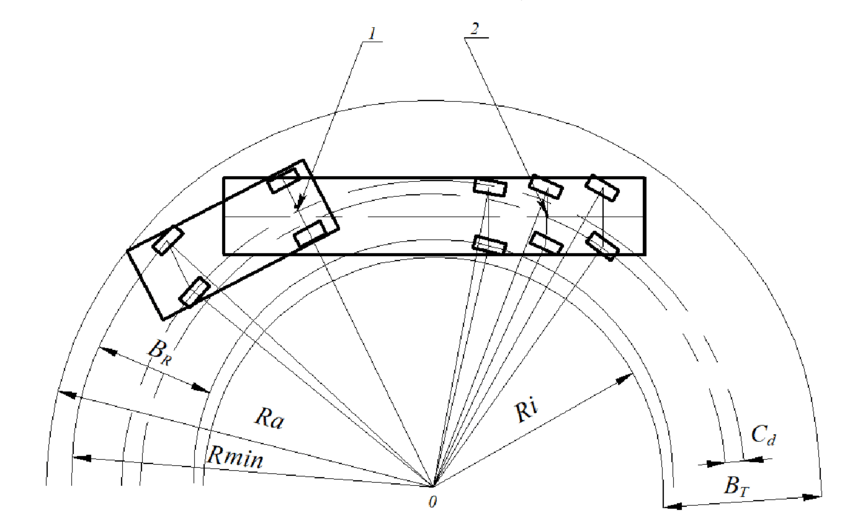
Core Powertrain and Structural Design
Engine and Transmission
A semi trailer’s turning radius has no relationship to the tractor’s engine or transmission. However, the tractor’s wheelbase and steering angle determine the path of the front axle, which in turn sets the geometry that the trailer must follow. A shorter tractor wheelbase produces a tighter turning path for the front axle, but it also changes the relationship between the tractor’s rear axle and the trailer’s kingpin—the pivot point from which the trailer’s path is generated.
Hydraulic System
Hydraulic systems do not affect standard semi trailer turning radius. On trailers equipped with hydraulic steering axles—common on lowbed and heavy-haul configurations—the rear axles can steer in coordination with the tractor, reducing offtracking and tightening the effective turning radius. A lowbed trailer with hydraulic steering may achieve a turning radius significantly smaller than a comparable fixed-axle trailer, but these systems add cost, maintenance complexity, and a failure mode that fixed axles do not have.
Chassis and Structural Durability
The kingpin-to-rear-axle distance (often called the trailer wheelbase) is the dominant trailer-side variable in offtracking. A longer trailer wheelbase produces greater offtracking because the rear axles have more distance to cut inside the turn. A 53-foot trailer with a 40-foot kingpin-to-rear-axle setting will offtrack more than a 48-foot trailer with a 38-foot setting, even though the difference in overall length is modest.
Axle configuration also matters. A tandem-axle trailer’s effective wheelbase is measured to the centerline between the tandem axles, not to the rear axle alone. A tridem or multi-axle group changes the effective pivot point and the trailer’s path through the turn. Suspension type—mechanical leaf spring versus air suspension—does not directly change turning geometry, but worn suspension bushings allow the axles to shift under load, producing inconsistent tracking and accelerated tire wear.
Technical Specifications
The table below presents representative turning geometry parameters for common semi trailer configurations, drawn from AASHTO design vehicle standards and published research on offtracking. Values are reference figures; actual turning paths vary by tractor specification, trailer wheelbase, and turn geometry.
Comparative Advantages TCO and ROI
The turning radius decision is a route compatibility versus payload trade-off. A shorter trailer wheelbase or a shorter overall trailer length produces better maneuverability and less offtracking, reducing the risk of curb strikes, tire sidewall damage, and property damage in tight urban environments. A longer trailer carries more cargo but requires wider turns, longer intersection radii, and more careful route selection.
The cost of a turning-related incident is straightforward to estimate. A trailer that strikes a curb at low speed may damage a tire, bend a wheel, or misalign an axle—repair costs in the hundreds to low thousands of currency units, plus downtime. A trailer that strikes a parked vehicle or a pedestrian in a crosswalk during a tight turn produces liability exposure, insurance claims, and reputational damage that dwarf the repair invoice. A fleet that routes 53-foot trailers through urban delivery networks designed around 48-foot vehicles is choosing payload capacity at the expense of maneuverability, and the incident rate will reflect that choice.
A defensible comparison requires stated assumptions. Consider a fleet evaluating 48-foot versus 53-foot dry vans for a route network that includes urban delivery. Assume the 53-foot trailer carries 10 percent more cargo per trip, generating additional revenue of 50,000 CNY per trailer per year on weight-limited lanes. However, the 53-foot trailer’s longer wheelbase increases offtracking by an estimated 1–2 feet in tight turns, raising the risk of curb strikes and tire damage. If the fleet experiences one additional tire replacement per trailer per year at 1,200 CNY, plus occasional wheel and alignment repairs, the maneuverability penalty may consume 20–30 percent of the payload gain. The decision hinges on the route map: if the 53-foot trailer operates primarily on highway lanes with generous turning radii, the maneuverability penalty is minimal; if it operates in dense urban networks, the penalty may erase the payload advantage.
Route planning and driver training are the controllable variables that reduce turning-related cost without changing the trailer specification. A fleet that trains drivers on offtracking awareness and routes longer trailers around tight intersections can capture the payload benefit while avoiding the incident cost.
Heavy Duty Application Scenarios
-
Long-haul highway freight: Turning radius is rarely the limiting factor. Highway interchanges and truck stops are designed for WB-67 vehicles, and the 45-foot minimum design radius provides adequate margin. The relevant specification concern is bridge formula compliance, which depends on kingpin-to-rear-axle distance rather than turning geometry.
-
Urban delivery and last-mile distribution: Turning radius becomes a critical constraint. Tight intersections, narrow streets, and parked vehicles on both sides leave little margin for offtracking. A 48-foot trailer or a shorter wheelbase configuration may be required to navigate routes that a 53-foot trailer cannot safely negotiate.
-
Construction and heavy haulage: Lowbed trailers with hydraulic steering axles reduce offtracking and allow access to confined job sites. The hydraulic steering system adds cost and maintenance complexity, but it may be the only way to deliver machinery to a site with a narrow access road and a tight turn.
-
Container drayage and port operations: Port terminals and container yards are often designed around specific turning radii. A chassis that is longer than the design vehicle may not be able to maneuver between container stacks or into loading positions without multi-point turns. Drivers should verify turning clearance before committing to a tight yard turn.
Selection and Maintenance Considerations
Selecting a semi trailer configuration begins with the route survey, not the payload calculation. The first question is: what is the tightest turn the trailer must negotiate on its regular routes, and what is the available curb-to-curb width? The second question is: does the trailer’s offtracking in that turn exceed the available space?
Key considerations include:
-
Verify the design vehicle standard for the routes served. AASHTO WB-67 is the standard for interstate semi trailers, but local roads and private facilities may be designed to a smaller vehicle. A trailer that meets WB-67 may still not fit a yard designed around a shorter single-unit truck.
-
Understand that offtracking increases as turn radius decreases. A turn that a trailer negotiates comfortably at 100-foot radius may require a multi-point maneuver at 50-foot radius. Drivers should be trained to recognize tight turns and to swing wide enough to keep the trailer’s rear wheels clear of the curb.
-
Account for trailer wheelbase, not just overall length. A 53-foot trailer with a short kingpin-to-rear-axle setting may offtrack less than a 48-foot trailer with a long setting. The specification sheet should list the kingpin-to-rear-axle distance, and that number should be used in route planning.
-
Inspect suspension bushings and axle alignment at PM intervals. Worn bushings allow the axles to shift under load, producing inconsistent tracking that the driver cannot compensate for. A trailer that “tracks differently” after a suspension repair should be checked for alignment.
Conclusion
Semi trailer truck turning radius is defined by the AASHTO design vehicle standards: the WB-67 interstate semi trailer has a 45-foot minimum design turning radius to the outside front tire, a 41-foot centerline radius, and a 19.3-foot minimum inside radius . The number that matters in operation is offtracking—the amount the trailer’s rear cuts inside the tractor’s path—which reaches 19.4 feet in a tight 50-foot-radius turn .
The engineering and commercial priorities converge on route compatibility. A trailer that fits the routes it serves, with adequate margin for offtracking, generates revenue without curb strikes and property damage. A trailer that is too long or too tightly wheelbased for its routes imposes a recurring cost that erodes its payload advantage. Fleets that survey their routes, train drivers on offtracking awareness, and specify trailer wheelbase against actual turning geometry make decisions that hold up in operation. The trailer that clears the curb on the tightest turn on the route is the one that delivers its payload without incident.