

Overview
A semi trailer lock is not a single product category. The term covers kingpin locks that prevent a dropped trailer from being coupled and towed away, door locks and seals that secure cargo against unauthorized access, and gladhand air-line locks that keep a parked trailer’s brakes applied. For fleet managers and procurement teams, the security decision is a layered one: a kingpin lock without a door seal leaves cargo accessible, and a door seal without a kingpin lock leaves the entire trailer movable.
This FAQ addresses the lock types, selection criteria, and procurement practices that matter most when securing semi trailers and their cargo. Product specifications and certification claims are drawn from published manufacturer data; the fleet’s risk assessment and the facility’s security requirements control the specific purchase.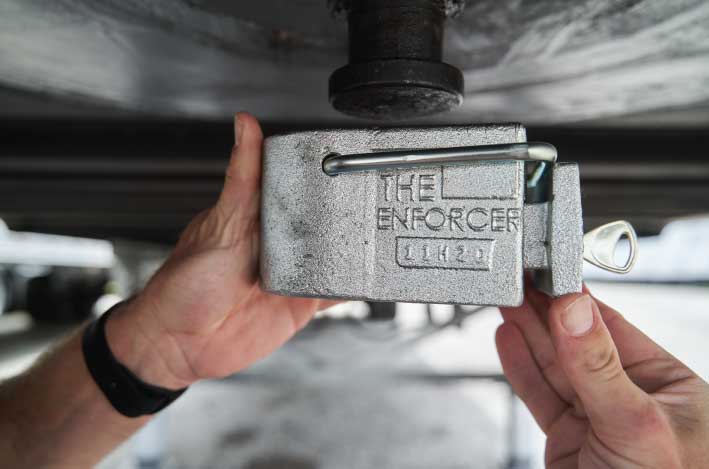
Frequently Asked Questions
What is a semi trailer kingpin lock and how does it work?
A semi trailer kingpin lock is a heavy-duty steel or cast-iron device that fits over the trailer’s kingpin and covers it completely, preventing the fifth wheel jaws from engaging. With the kingpin covered, the trailer cannot be coupled to a tractor and driven away, which protects dropped trailers in yards, terminals, and roadside parking areas.
A typical heavy-duty kingpin lock for a standard 2-inch kingpin is constructed from cast steel or ductile iron with a powder-coated finish, includes two keys, and may feature a bell-shaped casting to prevent the lock from wedging in the fifth wheel . Some models include a yellow warning flag to alert drivers that a lock is installed and prevent accidental hook-up attempts . Keyed-alike options allow a fleet to use a single key across multiple trailers, simplifying key management.
How do reusable trailer door seals work?
Reusable trailer door seals are mechanical locking devices that secure the trailer’s rear door handles and generate a unique tamper-evident code or number. When the seal is closed, the system produces a random code that remains fixed until the unit is reopened; if the code does not match at the destination, the load has been accessed in transit.
One representative product, the SecureLoc, uses an armored cable through the trailer handle and a keyed locking unit that mechanically generates a unique 5-digit number. The unit can only be opened with a fleet-specific key, and the random code provides a check against unauthorized access by anyone who does not have the key . The manufacturer claims the device is rated for up to 50,000 operations and requires no maintenance or servicing . These reusable seals eliminate the recurring cost and plastic waste of disposable seals, but the key control program becomes the critical security element—if the key is duplicated or lost, the seal’s protection is compromised.
What is a gladhand lock and when is it used?
A gladhand lock is a device that attaches to the trailer’s emergency air-line gladhand and prevents the tractor’s air supply from being connected. Without air pressure, the trailer’s spring brakes remain applied and the trailer cannot be moved.
The locking mechanism typically includes a plunger that extends into the gladhand’s air passage and a tongue that engages the gladhand housing, preventing removal without the key . This type of lock is used when a trailer is parked for an extended period and the fleet wants to ensure it cannot be moved even if the kingpin lock is defeated or the tractor is available. It complements rather than replaces the kingpin lock, because it does not physically secure the coupling.
What should I look for in a trailer door lock or seal?
Look for tamper evidence, key control, and compatibility with the trailer’s door hardware. The lock must fit the specific door configuration—roll-up, swing, or barn door—and must be difficult to defeat without leaving visible evidence of the attempt.
The selection criteria include:
-
Tamper evidence: A mechanical code, numbered seal, or “blushing” feature that shows whether the device has been opened .
-
Key control: A restricted keyway or recodable cylinder that prevents unauthorized key duplication .
-
Durability: Corrosion-resistant materials and a mechanism rated for the expected number of operations.
-
Compatibility: Confirmation that the device fits the trailer’s handle, locking bars, or door frame without modification.
Disposable plastic seals remain in use for one-way shipments where the consignee verifies the seal number at delivery, but they provide no physical barrier against entry and are easily cut .
How do I choose the right lock combination for my fleet?
Match the lock combination to the trailer’s exposure and the value of the cargo. A trailer parked overnight in a secure terminal requires less physical security than one staged at an unguarded drop yard or traveling through high-theft corridors.
A practical layering approach is:
-
Kingpin lock: Standard for any trailer left uncoupled, regardless of cargo value. This is the lowest-cost, highest-consequence control.
-
Door seal or lock: Required for loaded trailers carrying high-value or theft-attractive goods. Reusable seals offer lower long-term cost and tamper evidence; disposable seals suit one-way shipments.
-
Gladhand lock: Appropriate for long-term parking or out-of-service trailers where movement prevention is the priority.
-
Tracking and alerts: Cargo theft data shows that a single GPS tracker is often found and disabled within an hour, so a layered approach with covert tracking and tamper alerts is more effective than any physical lock alone .
What maintenance do semi trailer locks require?
Semi trailer locks require periodic inspection for wear, corrosion, and key mechanism function, with lubrication of moving parts. A kingpin lock that is difficult to install or remove indicates corrosion or damage that should be addressed before it fails at the worst moment.
The inspection should cover the locking mechanism for smooth operation, the keyway for debris or damage, and the body for cracks or deformation. Reusable door seals should be checked for cable fraying, latch function, and code-generation reliability. Gladhand locks should be inspected for seal integrity and plunger movement. A lock that requires excessive force to operate is a lock that will eventually be left off or forced, defeating its purpose.
What should I verify before buying a used trailer with a lock installed?
Verify that the lock can be removed with the supplied key, that the kingpin or door hardware has not been damaged by the lock, and that the seller has the authority to transfer the lock. A trailer sold with a lock for which no key is available is a trailer that cannot be coupled or opened until the lock is cut off, which may damage the component it protects.
The inspection should confirm that the kingpin lock releases smoothly and that the kingpin underneath shows no deformation from a forced removal attempt. Door locks and seals should be checked for evidence of tampering, and the trailer’s VIN and title should be verified independently of the lock’s presence. A lock is a security device, not a substitute for due diligence on the trailer’s identity and condition.
Conclusion
Semi trailer lock selection comes down to layering the right controls for the trailer’s exposure: a kingpin lock for any uncoupled trailer, a tamper-evident door seal or lock for loaded high-value cargo, and a gladhand lock for long-term parking where movement prevention is the priority. No single physical lock defeats a determined theft crew, and cargo security research shows that tracking and response layers are as important as the barrier itself . Fleets should standardize on keyed-alike systems where practical, inspect locks during the same routine that covers trailer brakes and tires, and treat key control as the security foundation that every mechanical lock depends on.