

Introduction
A semi trailer for sale represents a capital decision that extends far beyond the purchase invoice. Unlike a tractor unit, a trailer has no powertrain to depreciate rapidly, no emissions aftertreatment to fail, and no driver interface to wear. Its value lies in structural integrity, brake system reliability, and configuration fit with the cargo it will carry. For fleet managers, contractors, and industrial buyers, the semi trailer market offers a wide range of new and used options—but the inspection discipline required to separate a sound asset from a hidden liability is often underestimated.
The operational pressures are concrete. A trailer that fails inspection cannot enter service. A trailer with a cracked frame or contaminated brake system will consume maintenance budget at a rate that erases any acquisition savings within months. Used semi trailer inventory has tightened in recent periods, with supply declining and values rising in some segments, making informed selection more important than ever . This guide examines the engineering and commercial factors that determine whether a semi trailer for sale is a sound investment: structural condition, configuration matching, price benchmarks, inspection priorities, and the total cost of ownership that follows the purchase decision.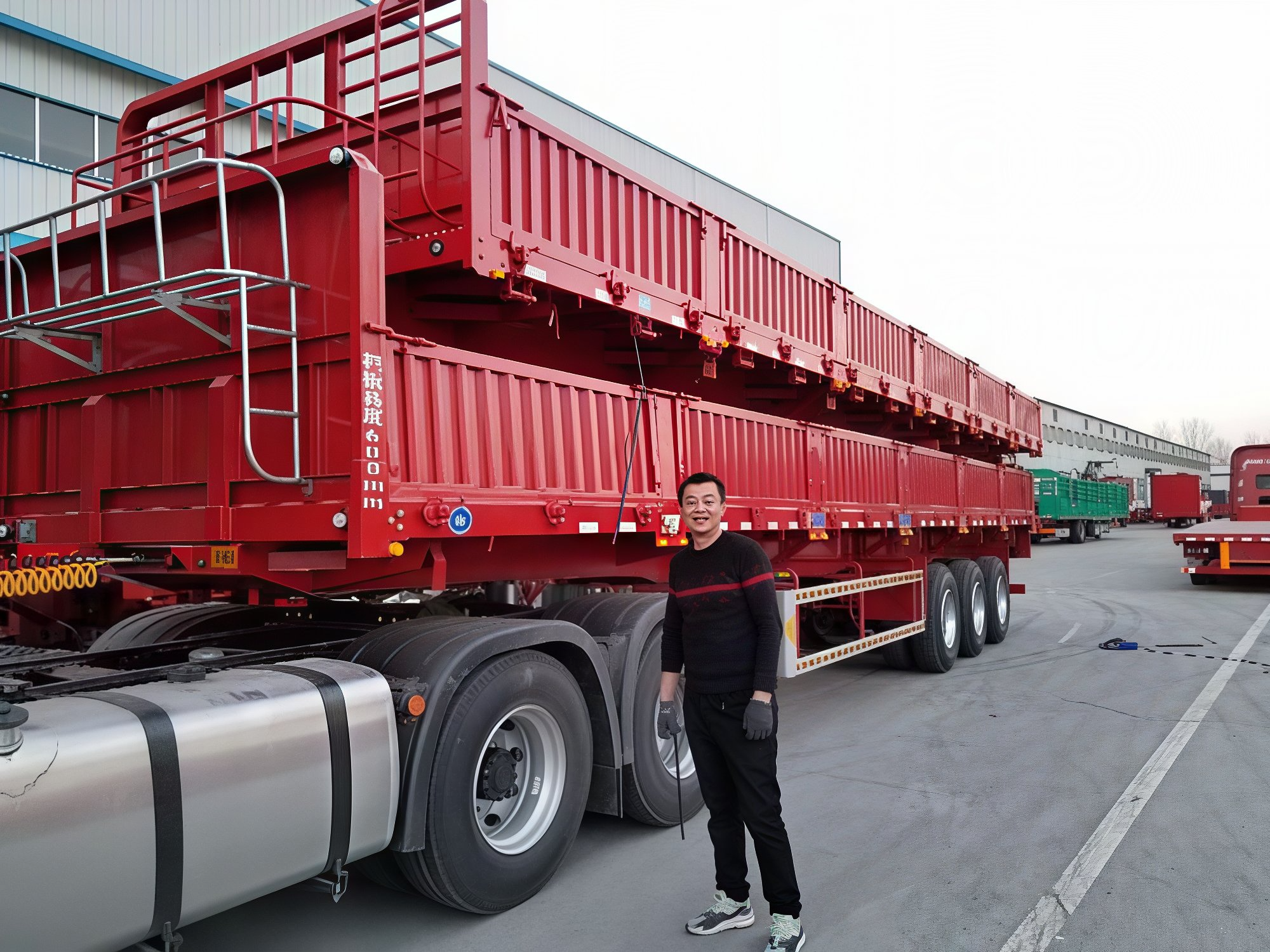
Core Powertrain and Structural Design
Frame and Chassis Integrity
The trailer frame is the first inspection priority for any semi trailer for sale, new or used. Main longitudinal beams carry bending loads between the fifth-wheel coupling and the suspension hangers, and fatigue cracking at suspension bracket welds, cross-member intersections, and kingpin reinforcement plates is the dominant structural failure mode. Cracks around welds are a major red flag—they often indicate stress, fatigue, or past overloading . Surface rust is common and often cosmetic, but deep corrosion, flaking steel, or perforated sections signal structural weakening that cannot be economically reversed.
Frame deformation may not be immediately visible. Indicators include doors that do not close properly, irregular tire wear patterns, or a trailer that does not track straight behind the tractor . Professional repairs are acceptable if documented; sloppy welds or illogical reinforcement plates warrant closer scrutiny or rejection. The upper coupler assembly—the reinforced structure that transfers kingpin loads into the main beams—deserves particular attention because it is difficult and expensive to repair correctly.
Axles, Suspension and Brake Systems
The undercarriage reveals more about a trailer’s history than any other area. Irregular tire wear—cupping, one-sided shoulder wear, or feathered edges—points to axle misalignment, worn suspension bushings, or bent components . All axles should track evenly and show no signs of having been shifted or modified. Leaf springs should not sag; airbags should not leak or show cracking.
Brake system inspection is safety-critical and often neglected in casual pre-purchase checks. Air lines must build and hold pressure without hissing or slow fill-ups. Brake lining should have at least 1/4 inch remaining on both sides of each chamber. The ABS warning light should illuminate at startup and extinguish as expected—a light that stays on indicates a fault that may require diagnostic tooling to resolve . Contaminated air—oil or moisture from a failed compressor or dryer on the towing tractor—is a common cause of chamber diaphragm failure and should be suspected if multiple chambers show premature wear.
Floor, Doors and Cargo-Specific Structure
For enclosed trailers, the floor and door seals determine cargo protection and long-term structural life. Wood floors should be dry, solid, and free from soft spots or water damage. Aluminum decks should be checked for deep pitting, corrosion, or weld fatigue under concentrated load points. Walking the full length of the floor—listening and feeling for give—is a basic but effective inspection method . Doors should open and close without forcing; rubber gaskets must compress fully and form a tight seal. Water stains, soft ceilings, or rust trails inside an enclosed trailer are hard rejection criteria because they indicate compromised sealing and potential structural damage.
Technical Specifications
The table below presents representative parameters for a general-freight semi trailer offered for sale. Values are labeled as typical industry ranges; actual specifications vary by manufacturer, model, configuration, and duty cycle. They should not be treated as official figures for any specific unit.
| Key Parameter | Typical Technical Specification | Operational Significance |
|---|---|---|
| Overall length | 12.5–13.6 m (common flatbed/van); up to 16 m specialized | Determines cargo deck area and container compatibility |
| Payload capacity | 25–40 t (general freight); 60–100 t (heavy-haul lowbed) | Must align with local axle load limits, not just structural rating |
| Tare weight | 4.5–8.5 t (flatbed); 12–16 t (lowbed) | Subtracted from gross combination weight to establish net payload |
| Axle capacity | 13 t (standard); 16 t (heavy-duty) | Per-axle legal ceiling; must match tire and suspension ratings |
| Suspension type | Mechanical leaf spring or air suspension | Air protects cargo and enables height control; mechanical is simpler and lower cost |
| Brake system | Dual-circuit pneumatic with ABS/EBS | Mandatory for heavy combinations; chamber condition and air quality affect stopping reliability |
| Kingpin | 2 in (50.8 mm) standard; 3.5 in (89 mm) heavy-haul | Coupling interchangeability and load transfer capacity |
| Floor plate thickness | 3 mm checkered steel (common flatbed/container chassis) | Resistance to concentrated loads and point loading damage |
Comparative Advantages TCO and ROI
The semi trailer for sale market divides into new, late-model used, and high-hour used segments, and the total cost comparison favors each under different conditions. New trailers offer full warranty coverage, current safety technology, and predictable maintenance for the first several years. Their acquisition cost is highest, but financing terms are often more favorable and downtime risk is lowest. Late-model used trailers—typically three to seven years old with documented maintenance—capture much of the new trailer’s remaining service life at a lower capital outlay, making them attractive for fleets expanding capacity without committing to full depreciation. High-hour used trailers carry the lowest acquisition price but require thorough inspection and should be budgeted with an immediate repair allowance.
A defensible cost comparison requires stated assumptions. Consider a fleet evaluating a new flatbed semi trailer versus a five-year-old used unit. Assume the new trailer costs 180,000 CNY and the used unit costs 95,000 CNY. The new trailer is expected to require minimal unscheduled maintenance for five years, while the used trailer may need brake chambers, suspension bushings, and tires within the first two years—an estimated 25,000 CNY allowance. Over a ten-year horizon, both trailers may require similar cumulative maintenance beyond the initial catch-up period, but the new trailer’s resale value at year ten is likely higher. The used trailer’s lower capital cost frees working capital, but the buyer accepts higher near-term maintenance variability and potential downtime. The decision hinges on the fleet’s cash position, maintenance capability, and tolerance for unscheduled repair events—factors that vary too widely for a universal recommendation.
Used trailer values have shown upward pressure in some segments due to tightening inventory, which may narrow the new-versus-used price gap and shift the calculus toward new units for buyers who can wait for delivery . Buyers should verify current local market conditions rather than relying on historical assumptions.
Heavy Duty Application Scenarios
-
General freight and distribution: A dry van or curtainsider semi trailer with air suspension and EBS is the standard configuration. Inspection priority is floor condition, door seals, and brake system integrity. Irregular tire wear on a van trailer often indicates axle misalignment that will continue to consume tires until corrected.
-
Container drayage and port operations: A container chassis with twist locks and a fixed kingpin setting. High-cycle coupling and short trips accelerate landing gear and brake chamber wear. Inspect the upper coupler plate for cracking and verify that twist locks operate freely and lock securely.
-
Construction and flatbed haulage: A flatbed or dropside trailer carrying rebar, lumber, or prefabricated components. Deck plate condition and strapping point integrity are selection criteria. Used flatbeds should be checked for deck deformation from past point loads and for corrosion at cross-member connections.
-
Heavy machinery transport: A lowbed trailer with hydraulic gooseneck and multi-axle configuration. Hydraulic system condition—cylinder leaks, hose condition, and valve operation—is as important as structural inspection. A lowbed with a compromised hydraulic system may be unable to detach or load safely, making it functionally unusable regardless of frame condition.
Selection and Maintenance Considerations
Selecting a semi trailer for sale begins with the regulatory envelope and the cargo definition, not the listing price. Gross combination weight limits, axle load limits, and length restrictions determine the maximum practical payload. A trailer rated for 40 tonnes is commercially irrelevant if local bridge formulas cap the route at 36 tonnes.
Key pre-purchase and ownership considerations include:
-
Paperwork verification: Confirm a clean title, maintenance records, and no lien history. A seller who resists a full inspection or limits access to records should be treated as a red flag . For used trailers, verify that parts are still available for the specific model and configuration—older or low-volume models may face long lead times for structural or brake components .
-
Configuration matching over price: A trailer that does not match the intended cargo, route, or axle configuration will consume more in operating inefficiency than it saves in acquisition cost. Air suspension for fragile freight, mechanical suspension for abusive loading, and correct axle count for legal load limits are non-negotiable specification decisions.
-
Preventive maintenance baseline: Establish a maintenance schedule immediately after purchase, regardless of the seller’s claims. Brake adjustment and lining inspection, tire pressure checks, suspension bushing inspection, and structural crack checks at high-stress weld zones should be performed at defined intervals. For used trailers, an initial full inspection by a qualified technician is a cost-effective investment.
-
Documentation for resale value: Maintain repair records and inspection documentation. Trailers with documented maintenance history command higher resale values and are easier to sell when fleet requirements change.
Conclusion
A semi trailer for sale is an asset whose value is determined by structural integrity, configuration fit, and maintenance history—not by paint condition or listing price. The engineering priorities are clear: inspect the frame for cracks and corrosion at welds and suspension attachment points, verify brake system function and air quality, confirm axle alignment through tire wear patterns, and match the configuration to the cargo and regulatory envelope. The commercial priorities follow directly: treat the purchase as a total cost of ownership decision rather than a capital outlay decision, budget for initial catch-up maintenance on used units, and document everything to protect resale value.
Fleets that apply inspection discipline and specification matching consistently achieve lower cost per kilometer and fewer unscheduled downtime events than those that buy on price alone. The semi trailer market rewards informed buyers; the inspection checklist and configuration analysis in this guide provide the framework for that discipline.