

Introduction
Purchasing a semi trailer is a capital decision that shapes fleet productivity for a decade or more, yet the transaction often receives less scrutiny than the tractor that will pull it. A low asking price can conceal frame cracks, brake system neglect, or a specification that is illegal on the routes the fleet actually operates. A new trailer’s higher sticker price buys specification control and warranty coverage, but only if the buyer verifies what is being ordered and what is being promised in writing.
The operational pressures are concrete. A trailer without current annual inspection documentation cannot legally operate in interstate commerce in the United States . A used unit with worn brake chambers or misaligned axles will consume maintenance budget at a rate that erases acquisition savings within months. Used trailer pricing varies widely—a used semi trailer may cost approximately 40% to 70% of a comparable new unit, depending on age, condition, and market demand . The buyer’s task is to determine whether that discount reflects fair depreciation or hidden deferred maintenance.
This guide examines the purchase decision through the lens of specification verification, inspection priorities, and total cost of ownership. It treats the trailer as an engineered asset whose value is determined by structural integrity and configuration fit, not by paint condition or list price.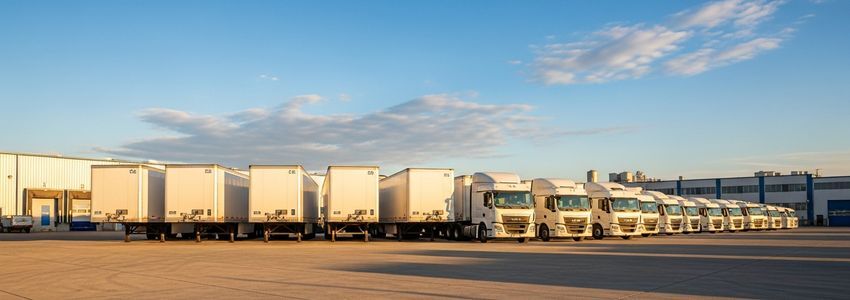
Core Powertrain and Structural Design
Engine and Transmission
A semi trailer has no engine or transmission. Its performance depends on the tractor that couples to it and the condition of the systems that transfer load and braking force. The critical interface is the fifth-wheel coupling: the kingpin and upper coupler plate must be within wear limits, and the trailer’s air and electrical lines must be compatible with the tractor’s connector standard. For buyers evaluating a complete combination, the tractor’s powertrain specification—engine horsepower, transmission type, and rear axle ratio—must match the gross combination weight and route profile. But the trailer itself is evaluated on structure, brakes, and dimensions.
Hydraulic System
Most general-freight semi trailers have hydraulic systems limited to landing gear operation. For lowbed and heavy-haul trailers, hydraulic gooseneck detachment and axle lift are essential functions. A lowbed with a compromised hydraulic system may be functionally unusable regardless of frame condition, because it cannot be detached or loaded safely. Cylinder seals, hose condition, and valve function should be inspected as part of any pre-purchase assessment.
Chassis and Structural Durability
The frame is the first inspection priority. Fatigue cracking at suspension bracket welds, cross-member intersections, and kingpin reinforcement plates is the dominant structural failure mode in high-mileage trailers. Cracks around welds are a red flag; they often indicate stress, fatigue, or past overloading . Surface rust is common and often cosmetic, but deep corrosion, flaking steel, or perforated sections signal structural weakening that cannot be economically reversed.
Frame deformation may not be immediately visible. Indicators include doors that do not close properly, irregular tire wear patterns, or a trailer that does not track straight behind the tractor . Professional repairs are acceptable if documented; sloppy welds or illogical reinforcement plates warrant closer scrutiny or rejection.
Technical Specifications
The table below presents representative parameters for a general-freight semi trailer. Values are labeled as typical industry ranges; actual specifications vary by manufacturer, model, configuration, and jurisdiction. The manufacturer’s data plate and the seller’s documentation control the specific transaction.
Comparative Advantages TCO and ROI
The purchase decision divides into three segments: new, late-model used, and high-hour used. New trailers offer full warranty coverage and predictable maintenance for the first several years, at the highest acquisition cost. Late-model used trailers capture much of the new trailer’s remaining service life at a lower capital outlay. High-hour used trailers carry the lowest acquisition price but require thorough inspection and should be budgeted with an immediate repair allowance.
A defensible cost comparison requires stated assumptions. Consider a fleet evaluating a new flatbed semi trailer versus a five-year-old used unit. Assume the new trailer costs approximately 180,000 CNY and the used unit costs approximately 95,000 CNY. The new trailer is expected to require minimal unscheduled maintenance for five years. The used trailer may need brake chambers, suspension bushings, and tires within the first two years—an estimated 25,000 CNY allowance. Over a ten-year horizon, both trailers may require similar cumulative maintenance beyond the initial catch-up period, but the new trailer’s resale value at year ten is likely higher. The used trailer’s lower capital cost frees working capital, but the buyer accepts higher near-term maintenance variability and potential downtime.
Warranty coverage is a material differentiator for new purchases. Warranty structures commonly separate the main beam from body structure and bought-in components. One manufacturer’s published policy offers a ten-year warranty on the main beam and a twelve-month warranty on body structure and welded joints, with axles, braking systems, and landing gear covered by their original manufacturers’ terms . Buyers should obtain warranty terms for each major subassembly in writing and confirm the claim procedure before purchase. Consumables such as tires, brake linings, and seals are typically excluded.
Insurance and inspection compliance add recurring costs that should be included in the total calculation. Physical damage coverage on a trailer is typically priced as a percentage of equipment value. Annual inspection documentation must be current for interstate operation .
Heavy Duty Application Scenarios
-
General freight and distribution: A dry van or curtainsider with air suspension is the standard configuration. Inspection priority is floor condition, door seals, and brake system integrity. Irregular tire wear on a van trailer often indicates axle misalignment that will continue to consume tires until corrected .
-
Container drayage and port operations: A container chassis with twist locks and a fixed kingpin setting. High-cycle coupling accelerates landing gear and brake chamber wear. Inspect the upper coupler plate for cracking and verify that twist locks operate freely and lock securely.
-
Construction and flatbed haulage: A flatbed or dropside trailer carrying rebar, lumber, or prefabricated components. Deck plate condition and strapping point integrity are selection criteria. Used flatbeds should be checked for deck deformation from past point loads and for corrosion at cross-member connections.
-
Heavy machinery transport: A lowbed trailer with hydraulic gooseneck and multi-axle configuration. Hydraulic system condition is as important as structural inspection. A lowbed with a compromised hydraulic system may be unable to detach or load safely.
Selection and Maintenance Considerations
Purchasing a semi trailer begins with the regulatory envelope and the cargo definition, not the listing price. Gross combination weight limits, axle load limits, and length restrictions determine the maximum practical payload. In the US, federal interstate limits include 20,000 lb per single axle and 34,000 lb per tandem, with the Federal Bridge Formula governing weight distribution across axle groups.
Key pre-purchase considerations include:
-
Verify the annual inspection documentation. Under 49 CFR 396.17, a commercial motor vehicle—including each unit in a combination—must have passed an inspection within the preceding 12 months . A trailer without current documentation cannot legally operate in interstate commerce and represents an immediate compliance cost.
-
Inspect the brake system thoroughly. Air lines must build and hold pressure without hissing or slow fill-ups. Brake lining should have at least 1/4 inch remaining. The ABS warning light should illuminate at startup and extinguish as expected—a light that stays on indicates a fault requiring diagnostic tooling .
-
Check tires for even wear and matching. Uneven wear may suggest axle misalignment or suspension problems. Tires of different types or ages may indicate emergency repairs rather than planned maintenance .
-
Confirm parts availability for the specific model. Older or low-volume models may face long lead times for structural or brake components. A trailer that cannot be repaired promptly is a liability regardless of its acquisition price.
-
Obtain a written specification sheet with the quotation. Compare component brands—axles, suspension, braking valves, landing gear—rather than comparing unit prices alone. A lower quotation that specifies unbranded axles and basic braking components is not the same product as a higher quotation with recognized component manufacturers .
Conclusion
Purchasing a semi trailer is a specification and inspection discipline, not a price negotiation. The engineering priorities are clear: inspect the frame for cracks and corrosion at welds and suspension attachment points, verify brake system function and air quality, confirm axle alignment through tire wear patterns, and ensure current annual inspection documentation. The commercial priorities follow directly: treat the purchase as a total cost of ownership decision rather than a capital outlay decision, obtain written warranty terms for each major subassembly, and budget for initial catch-up maintenance on used units.
Fleets that apply inspection discipline and specification matching consistently achieve lower cost per kilometer and fewer unscheduled downtime events than those that buy on price alone. The semi trailer market rewards informed buyers; the inspection checklist and compliance verification outlined in this guide provide the framework for that discipline.