

Introduction
The terms trailer and semi trailer are often used interchangeably in casual conversation, but they describe structurally distinct vehicles with different weight distribution, coupling mechanics, and regulatory treatment. A trailer—more precisely a full trailer—supports its entire weight on its own axles and connects to the towing vehicle through a drawbar that transmits tractive force but no significant vertical load . A semi trailer transfers a substantial portion of its weight to the towing tractor through a fifth-wheel coupling, resting on the tractor’s rear frame while carrying the remainder on its own rear axles .
This distinction is not semantic. It determines how the vehicle brakes, how it maneuvers in reverse, how it behaves on uneven roads, and how it is regulated. For fleet managers and procurement teams, understanding the engineering difference between a trailer and a semi trailer is the first step in selecting the right asset for a given duty cycle. A full trailer offers full self-support when decoupled and simpler manufacturing, but its high-speed stability is compromised by the additional articulation point at the drawbar . A semi trailer offers superior straight-line stability and reverse maneuverability because it has only one pivot point, but it requires a tractor with a fifth wheel and cannot stand independently without landing gear .
This guide examines the structural and operational differences between these two trailer architectures, the regulatory definitions that govern their use, and the selection criteria that determine which configuration suits a given fleet operation.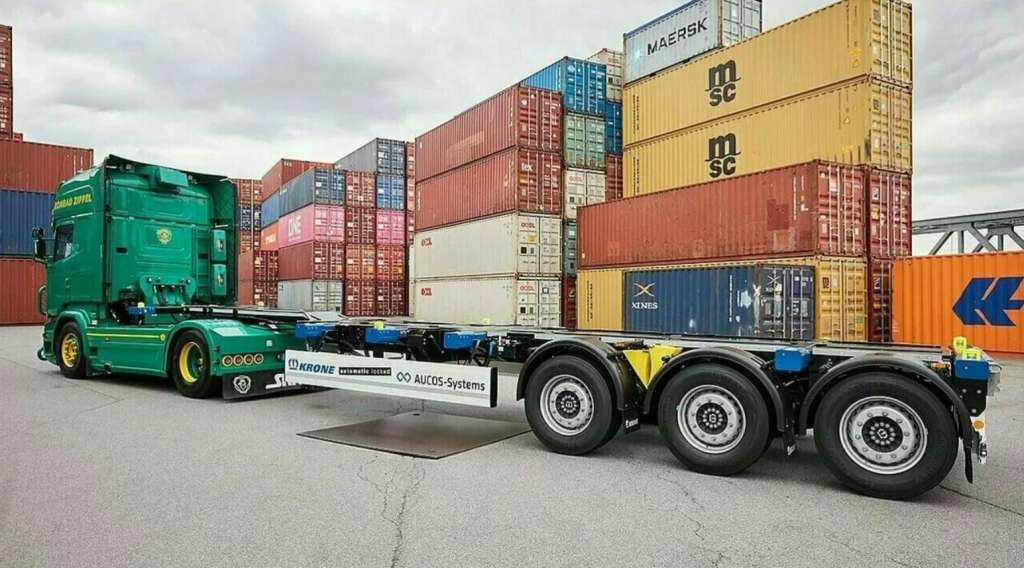
Core Powertrain and Structural Design
Engine and Transmission
Neither a trailer nor a semi trailer has an engine or transmission. Both are unpowered vehicles that rely entirely on the towing unit for propulsion. The difference lies in how tractive force is transmitted. A full trailer connects through a drawbar and towing hitch, which transmits horizontal forces but allows vertical movement independent of the towing vehicle . A semi trailer transmits both horizontal and vertical forces through the kingpin and fifth-wheel coupling, a rigid connection that carries a portion of the trailer’s weight on the tractor .
Hydraulic System
Hydraulic systems on both trailer types are limited to auxiliary functions: landing gear operation, tipper body lift, or lowbed gooseneck detachment. The relevant distinction is that a semi trailer requires landing gear to support its nose when uncoupled, because it cannot stand independently without the tractor’s fifth wheel . A full trailer, being self-supporting on its own axles, does not require landing gear for stability when parked—its drawbar may rest on a support, but the vehicle’s weight remains on its own wheels.
Chassis and Structural Durability
The structural difference between a trailer and a semi trailer begins with weight distribution. A full trailer’s axles are positioned to carry the entire gross weight of the trailer body and cargo . A semi trailer’s axles are positioned behind the vehicle’s center of gravity, with the kingpin located forward to transfer a portion of the load to the tractor . This architecture allows the semi trailer to carry more payload for a given axle count, because the tractor’s drive axles share the vertical load.
The trade-off appears in frame design. A semi trailer’s frame must be reinforced to handle the concentrated bending moments at the fifth-wheel and suspension hanger zones, which can make it heavier than a comparable full trailer for the same payload . A full trailer’s frame distributes load more evenly across its own axles, but the drawbar connection introduces a second articulation point that affects stability at speed. Semi trailers exhibit better straight-line stability and are less susceptible to lateral and vertical accelerations from road irregularities, while full trailers can develop noticeable sway at speeds of 40–45 km/h with a two-axle configuration .
Technical Specifications
The table below presents representative structural and operational parameters for full trailers and semi trailers in commercial freight service. Values are typical industry references; actual specifications vary by manufacturer, configuration, and jurisdiction.
Comparative Advantages TCO and ROI
The total cost comparison between a trailer and a semi trailer is shaped by three factors: acquisition cost, operational efficiency, and regulatory compliance. A full trailer is generally cheaper to manufacture because it lacks the reinforced fifth-wheel structure and landing gear required on a semi trailer . However, the full trailer’s higher brake system complexity—requiring ABS on at least one front and rear axle in the US, compared to one axle for a semi trailer—adds cost and maintenance surface area .
Operationally, the semi trailer’s advantage is asset decoupling. A tractor can drop a loaded semi trailer and hook a pre-loaded unit, reducing idle time during loading and unloading . This drop-and-hook model is the foundation of semi trailer economics in high-turnover freight networks. A full trailer cannot be decoupled as efficiently because it requires a towing vehicle with a compatible drawbar hitch, and its self-supporting design means it occupies yard space without the compact footprint of a semi trailer on landing gear.
A defensible cost comparison requires stated assumptions. Consider a fleet evaluating full trailers versus semi trailers for a terminal shuttle operation with a 5 km route. Assume the full trailer costs 20% less to acquire but requires a more expensive brake system and offers no drop-and-hook capability. The semi trailer’s higher acquisition cost is offset by its ability to keep the tractor productive while trailers are loaded. If the terminal operates 10 tractors and 20 trailers, the semi trailer configuration allows each tractor to service multiple trailers per shift, while the full trailer configuration requires a tractor to remain coupled during loading. The productivity difference typically favors the semi trailer for any operation where loading time exceeds a few minutes.
Resale value for semi trailers is generally stronger in highway freight markets because the buyer pool is larger. Full trailers have a narrower market, primarily terminal and yard operations, which reduces liquidity at disposal.
Heavy Duty Application Scenarios
-
Long-haul highway freight: The semi trailer is the standard configuration. Its single articulation point provides better straight-line stability at highway speed, and the drop-and-hook model supports efficient fleet utilization . Full trailers are prohibited from expressways in some jurisdictions, including China, due to stability concerns .
-
Port and terminal yard operations: Full trailers remain common in confined yard environments where their self-supporting design and simpler coupling are advantageous. The lower speeds in yards reduce the stability concern that limits full trailer use on highways .
-
Construction and heavy haulage: Semi trailers dominate because the fifth-wheel coupling distributes concentrated loads more effectively and allows the use of multi-axle lowbed configurations for heavy machinery. Full trailers are rarely used for heavy-haul applications because the drawbar cannot transmit vertical load to the tractor’s drive axles for traction.
-
Agricultural and bulk haulage: Both configurations appear, but the semi trailer is preferred where road speeds exceed 40 km/h. Full trailers may be used for short field-to-storage transport where highway stability is not a factor.
Selection and Maintenance Considerations
Selecting between a trailer and a semi trailer begins with the duty cycle, not the acquisition price. The first question is: what speeds will the vehicle operate at, and what coupling/un coupling frequency does the operation require? The second question is: what regulatory constraints apply to each configuration in the operating jurisdiction?
Key selection criteria include:
-
Speed and stability requirements: For sustained operation above 40–45 km/h, the semi trailer’s single pivot point provides a stability advantage that full trailers cannot match without complex stabilization systems . For low-speed yard work, the full trailer’s self-supporting design simplifies staging.
-
Coupling frequency and drop-and-hook capability: Operations that require frequent trailer swaps benefit from the semi trailer’s fifth-wheel coupling, which is faster and more standardized than drawbar hitching. A single tractor can service multiple semi trailers, reducing fleet capital requirements .
-
Brake system complexity and cost: In the US, a full trailer requires ABS on at least one front and rear axle, while a semi trailer requires ABS on one axle . This affects both acquisition cost and maintenance complexity.
-
Regulatory restrictions: Some jurisdictions restrict full trailer operation on high-speed roads. China prohibits full trailers from expressways, limiting their use to terminal and short-haul operations . Fleet managers must verify local rules before specifying either configuration.
Conclusion
The distinction between a trailer and a semi trailer is an engineering decision with commercial consequences. A full trailer carries its entire weight on its own axles, connects through a drawbar, and offers self-supporting staging at the cost of high-speed stability and reverse maneuverability. A semi trailer transfers a portion of its weight to the tractor through a fifth wheel, provides superior highway stability and drop-and-hook efficiency, but requires landing gear and a compatible tractor.
Fleets that match the trailer architecture to the duty cycle—semi trailers for highway freight and high-turnover networks, full trailers for low-speed yard and terminal operations—achieve lower operating cost and fewer stability-related incidents. The acquisition price difference is rarely the deciding factor; the operational and regulatory characteristics of each configuration determine which vehicle belongs on which route.