

The Situation: What Looked Like Strength Was Really Just Timing

Let's be clear about what happened in 2025. Yes, volumes were up. But a lot of that growth came from businesses moving early to get ahead of trade policy they couldn't predict . Importers rushed goods through the pipeline, afraid that the next tariff announcement would leave them holding the bag. It made sense at the time. But now that inventory is sitting in warehouses, and the orders that would have come in early 2026 already happened last year.
The "front-loading" effect is fading fast . And as it fades, the underlying weakness in global trade is coming into focus. The World Bank sees global GDP growing just 2.4 percent in 2026, barely above 2025's 2.3 percent . The WTO is even more pessimistic on goods trade, forecasting a measly 0.5 percent increase this year compared to 2.4 percent in 2025 .
On top of that, shipping lines are dealing with their own success. The wave of new vessel orders placed during the pandemic boom is finally hitting the water. Fleet capacity is projected to grow 3.6 to 5 percent in 2026, while demand lags far behind at 1.5 to 3 percent . That's a recipe for rate pressure.
Breaking Down What's Actually Happening
The Container Conundrum
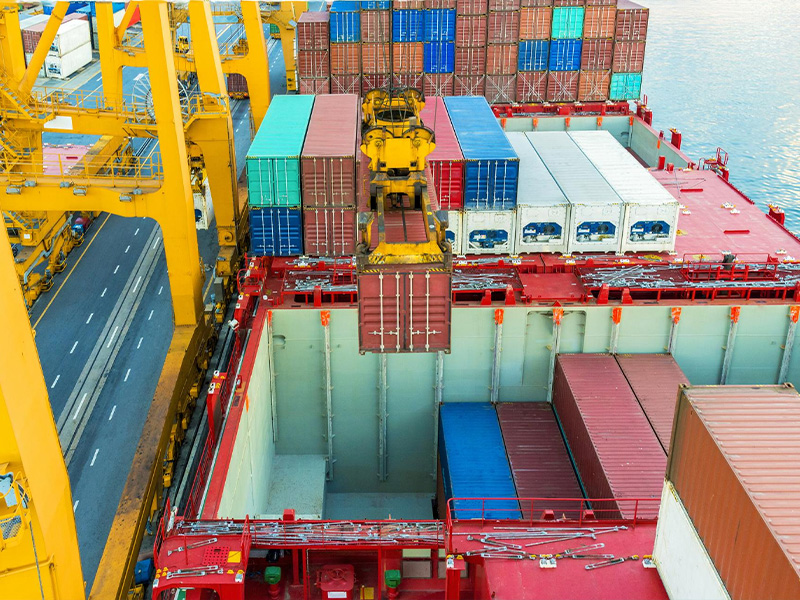
Container shipping is ground zero for the industry's problems. After years of volatility, the fundamentals are tilting hard toward oversupply. Alphaliner predicts global containership capacity will hit 34.7 million TEU in 2026, up 3.8 percent, with another 7.8 percent jump in 2027 . Most of that growth is in large and ultra-large vessels that will be deployed on the main east-west trades, exactly where demand is softening most .
Rates are already feeling the pinch. Average global spot freight rates could fall as much as 25 percent year-over-year, with long-term contracts dropping 8 to 12 percent . Some analysts are forecasting industry-wide losses approaching $10 billion in 2026 .
The wild card is the Red Sea. If shipping lines fully return to Suez Canal routings, it would release about 10 percent of effective capacity back into the market, putting even more pressure on rates . French carrier CMA CGM has already announced plans to resume transits in early 2026 .宁波 Shipping Exchange estimates that a full return to the Red Sea could pull Asia-Europe rates back down to 2023 levels of $1,100 to $1,600 per FEU, with risk of falling below the $1,500 breakeven point .
Tankers: The Bright Spot
Not every segment is suffering. Tanker markets are expected to remain relatively resilient through 2026 . VLCCs averaged daily rates above $100,000 in the fourth quarter of 2025, levels not seen since before the 2008 financial crisis . OPEC+ production increases, strong Atlantic exports, and sanctions-driven trade distortions are all supporting demand .
Longer sailing distances—a byproduct of rerouted trade flows—are also boosting tonne-mile demand. And with new tanker deliveries only now starting to pick up after a low in 2024, supply remains relatively tight . Clarksons projects VLCC demand growth of 1.4 percent in 2026 against effective supply growth of negative 0.3 percent, leaving a 1.7 percent supply-demand gap that should keep rates supported .
The risks? A de-escalation in geopolitical tensions or a full return to Red Sea transits could change the math quickly .
Dry Bulk: Waiting on Simandou
Dry bulk markets are in a wait-and-see mode. The sector finished 2025 with some momentum, particularly in capesizes, which saw rates climb from $20,000 per day earlier in the year to nearly $45,000 during the seasonal peak .
The big story for 2026 is the Simandou iron ore project in Guinea. With potential capacity of up to 120 million tons annually, Simandou represents a major shift in trade patterns . Because Guinea is roughly twice as far from China as Australia, every ton of ore from Simandou generates significantly more tonne-mile demand than traditional Australian exports . BIMCO now forecasts ship demand growth of 2 to 3 percent in 2026, revising its outlook upward by 0.5 percentage points .
But there are headwinds. Chinese steel production is slowing. Coal volumes remain under pressure from energy transition policies. And new vessel deliveries in the panamax and supramax segments are accelerating . BIMCO expects the capesize segment to continue outperforming, but warns that a full return to the Red Sea could shave 2 percent off tonne-mile demand by shortening sailing distances .
The Tariff and Trade Policy Factor
Trade policy remains the industry's biggest variable. The U.S. Supreme Court is expected to rule on the legality of certain tariff measures, and depending on the outcome, importers could face either refund chaos or a new wave of front-loading .
Meanwhile, the EU Emissions Trading System moved to 100 percent compliance for shipping on January 1, 2026, embedding permanent new costs into Europe-linked trade lanes . That cost will ultimately pass through to shippers, adding another layer of complexity to rate negotiations.
Trade flows are also shifting. Exports from Asia excluding China are forecast to rise 13.2 percent, with about 70 percent tied to technology products . Vietnam and Thailand, early beneficiaries of supply chain diversification, are seeing labor and construction costs rise, pushing some investment toward Indonesia and Cambodia . Mexico and Canada are gaining attention as nearshoring options .
How Shippers Can Navigate 2026
Stop Relying on a Single Forecast
If 2026 teaches anything, it's that no one has a crystal ball. The gap between best-case and worst-case scenarios is too wide. S&P Global's outlook lays out two very different paths: one where Suez reopens smoothly and rates ease, another where disruption keeps markets tight . Smart shippers plan for both.
Build Flexibility Into Contracts
The days of rigid annual contracts are fading. Top shippers are moving toward continuous rate governance, with ABC lane segmentation—A lanes contracted, C lanes on spot—and frequent renegotiations tied to index-linked pricing . The goal is to maintain contract viability while avoiding the negotiation fatigue that comes with quarterly resets.
Centralize Your Data
Data is the new oil, but only if you can refine it. Best-in-class shippers are building single-source-of-truth data lakes with APIs that allow instant tender launches and real-time visibility into mode optimization . AI-enabled tools are increasingly handling C-lane procurement autonomously, freeing up procurement teams to focus on strategic partnerships.
Watch the Orderbook Like a Hawk
The newbuilding pipeline isn't done yet. Veson Nautical estimates that 2026 and beyond will see increased idle capacity and downward pressure on vessel values, especially if Suez transits normalize . But deliveries are lumpy, and orderbooks can be adjusted. Keep tracking where the new ships are going and which segments are most exposed.
Diversify Sourcing
Trade policy uncertainty isn't going away. The smart play is to build a multi-region sourcing framework that balances cost, stability, and supply continuity . Southeast Asia, India, Mexico, and Canada all have roles to play. Use purchase order management tools to maintain visibility across multiple suppliers and regions.
Factor in the New Cost Structure
Lower freight rates don't mean lower total costs. EU ETS compliance, rising insurance premiums, and the cost of financing inventory all add up. Run the numbers on total landed cost, not just ocean freight. And if you're relying on Section 321 for sub-$800 shipments, keep an eye on 2026 reform discussions—the rules could change.
The Bottom Line
Global shipping in 2026 is a story of divergence. Container markets face real pressure from oversupply and fading demand. Tankers look resilient, supported by longer hauls and supply constraints. Dry bulk hangs on the fate of Simandou and Chinese steel. And underneath it all, trade policy and environmental regulation keep shifting the ground.
For shippers, the takeaway is simple: this is not a year to set and forget. Rates will be softer, but volatility isn't going anywhere. The companies that come out ahead will be the ones who stay flexible, invest in data, and build supply chains that can bend without breaking.
As one analyst put it, 2026 brings relief on rates, but not certainty . Plan accordingly.
Frequently Asked Questions
Q: Why did shipping volumes look strong in 2025 but are expected to slow in 2026?
A: 2025's growth was partly driven by "front-loading"—companies accelerated shipments to get ahead of potential tariff increases. That pulled demand forward, leaving a slower start to 2026 as inventory is worked through .
Q: Are any shipping segments doing well?
A: Tanker markets are expected to remain resilient, supported by longer sailing distances, OPEC+ production increases, and relatively tight supply . VLCC rates in late 2025 were at their highest levels since before the 2008 financial crisis .
Q: What's the Simandou project and why does it matter for dry bulk?
A: Simandou is an iron ore mining project in Guinea with potential capacity of up to 120 million tons annually. Because Guinea is roughly twice as far from China as Australia, exports from Simandou will generate significantly more tonne-mile demand than traditional Australian ore, supporting capesize rates .
Q: How could the Red Sea situation affect 2026 shipping markets?
A: If shipping lines fully return to Suez Canal routings, it could release about 10 percent of effective capacity back into the market, putting downward pressure on rates .宁波 Shipping Exchange estimates Asia-Europe rates could fall back to 2023 levels of $1,100 to $1,600 per FEU .
Q: What new regulations are affecting shipping in 2026?
A: The EU Emissions Trading System moved to 100 percent compliance for shipping on January 1, 2026, adding permanent costs to Europe-linked trade lanes . The U.S. Supreme Court is also expected to rule on the legality of certain tariff measures, which could trigger further market volatility .
Q: How should shippers adapt their procurement strategies for 2026?
A: Leading shippers are moving away from rigid annual contracts toward continuous rate governance, using ABC lane segmentation (contracted A lanes, spot C lanes), frequent renegotiations tied to index-linked pricing, and centralized data platforms for real-time visibility . Diversifying sourcing across multiple regions is also critical .