

Introduction
Container transportation is a critical part of international logistics, port operations, and intermodal freight networks. Fleet operators must manage payload requirements, fuel consumption, vehicle availability, road regulations, and maintenance costs while maintaining reliable delivery schedules. A skeletal truck semi trailer, commonly called a skeletal semi trailer or container chassis trailer, is designed specifically to carry shipping containers using a lightweight open-frame structure rather than a full enclosed cargo platform.
The trailer consists primarily of a longitudinal chassis, crossmembers, container locking devices, axles, suspension, wheels, and braking equipment. Its open structure allows containers to be loaded and unloaded using port cranes, reach stackers, and other container-handling equipment. Depending on its design, a skeletal trailer may accommodate standard 20-foot, 40-foot, or other approved container configurations.
For transport companies, logistics providers, shipping operators, and container terminals, selecting the correct skeletal trailer involves more than comparing purchase prices. Chassis strength, container compatibility, axle arrangement, tare weight, braking performance, and local road regulations all influence operational suitability and long-term ownership costs.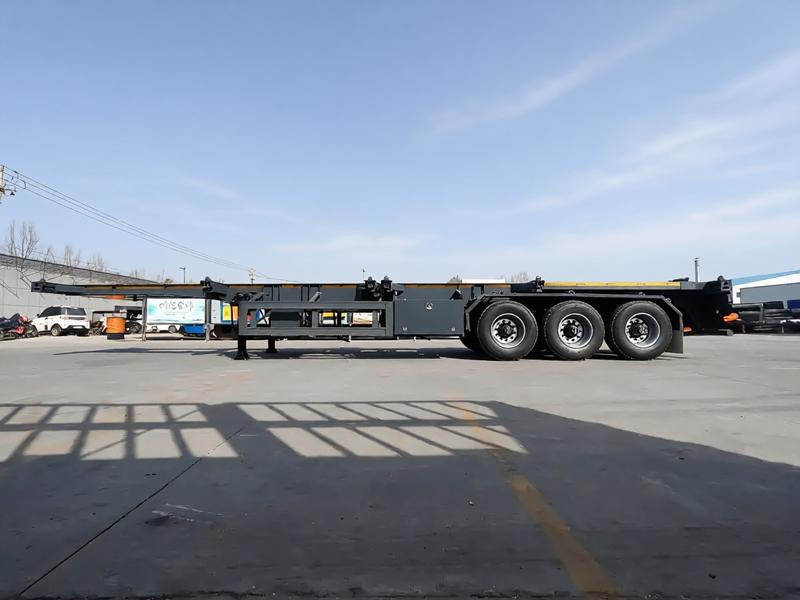
Core Powertrain and Structural Design
Unlike a powered truck, a skeletal semi trailer does not normally have its own engine or transmission. It is a passive transport unit connected to a tractor truck through a fifth-wheel coupling. Its engineering priorities are structural strength, load distribution, secure container positioning, braking reliability, and compatibility with the towing vehicle.
Chassis Frame and Structural Design
The chassis is the primary load-bearing structure of a skeletal truck semi trailer. It typically consists of longitudinal main beams connected by crossmembers, with reinforced areas around the kingpin, suspension mounting points, axle assemblies, and container locking positions.
The frame must withstand several types of mechanical stress:
-
Vertical loads: The weight of the container and its cargo transfers through the container support points into the chassis.
-
Longitudinal forces: Acceleration and braking generate forces that act along the trailer frame.
-
Lateral forces: Cornering, road camber, and uneven surfaces create side loads.
-
Torsional stress: Uneven road surfaces and unevenly distributed cargo can cause the chassis to twist.
High-strength structural steel is commonly used to balance load-bearing capability, durability, and weight. However, material grade, beam dimensions, welding procedures, and reinforcement design vary by manufacturer and trailer configuration.
An appropriately engineered frame helps maintain structural integrity during repeated loading cycles and long-distance transportation. Buyers should examine the manufacturer's rated capacity, structural drawings, welding quality, and corrosion protection rather than judging strength by external appearance alone.
Container Locking System and Compatibility
Container locking devices, commonly known as twist locks, secure the container to the trailer chassis. They engage with the container's standardized corner castings to prevent unwanted movement during transportation.
The number and position of twist locks depend on the intended container configuration. A trailer designed for a single 40-foot container may have a different locking arrangement from a model intended to carry one 20-foot container or two 20-foot containers.
Before purchasing, operators should confirm:
-
Supported container lengths and configurations.
-
Twist-lock quantity, spacing, and locking operation.
-
Container support-point alignment.
-
Compatibility with the intended container types.
-
Any restrictions on carrying multiple containers simultaneously.
Container dimensions alone do not establish legal payload capacity. The loaded combination must also comply with axle-load limits, gross combination weight restrictions, and applicable road regulations.
Axles, Suspension, and Tires
The axle and suspension assemblies transfer the trailer load to the road. Skeletal trailers commonly use two-axle or three-axle configurations, although the appropriate arrangement depends on rated capacity, road conditions, local regulations, and intended container loads.
Suspension systems may include mechanical leaf-spring designs or air suspension. Each has different characteristics in terms of ride behavior, maintenance, cost, and load management.
Mechanical suspension is widely used in heavy-duty applications because of its relatively straightforward construction and service requirements. Air suspension can provide improved ride characteristics and adjustable ride height on compatible configurations, which may be useful in operations requiring frequent loading-dock or terminal access.
Tire selection should match the trailer's axle ratings, expected operating speed, road conditions, and duty cycle. Tire load index, dimensions, pressure requirements, and wheel compatibility must all be checked before operation.
Braking System and Electrical Connections
A skeletal semi trailer normally uses a pneumatic braking system supplied by the tractor truck. The trailer braking equipment may include service brakes, parking functions, emergency braking provisions, and anti-lock braking systems (ABS), depending on the market and specification.
Electronic braking systems (EBS) may also be available on certain configurations. These systems coordinate braking control electronically and may provide additional monitoring or stability-related functions when supported by the tractor and trailer equipment.
Important components include:
-
Air reservoirs and pneumatic lines.
-
Brake chambers and actuators.
-
Foundation brakes and brake linings.
-
ABS or EBS control components where fitted.
-
Electrical connectors and lighting circuits.
The tractor and trailer must have compatible pneumatic and electrical interfaces. Buyers should also verify that the braking configuration satisfies the applicable vehicle regulations in the destination market.
Corrosion Protection and Serviceability
Skeletal trailers frequently operate in ports, coastal regions, container yards, and industrial environments where moisture, salt, dirt, and chemical exposure can accelerate corrosion.
Protective measures may include surface preparation, industrial coating systems, and corrosion-resistant components in selected areas. The effectiveness of these measures depends on coating quality, preparation standards, operating conditions, and maintenance practices.
Open-frame construction generally provides access to many chassis components, but inspection is still necessary around welds, crossmembers, suspension brackets, kingpin areas, and container locking devices.
Technical Specifications
The technical specifications of a skeletal truck semi trailer should be evaluated as a complete system. Chassis dimensions determine container compatibility, axle configuration affects load distribution, and tare weight influences the available payload within legal gross-weight limits.
The following table identifies common specification categories. These are not official specifications for a particular model; actual values must be confirmed through the manufacturer's technical documentation.
|
Key Parameter |
Typical Technical Specification |
Operational Significance |
|---|---|---|
|
Trailer type |
Skeletal container chassis |
Determines suitability for container transportation |
|
Container compatibility |
20-foot, 40-foot, or specified combinations |
Defines supported container configurations |
|
Axle configuration |
Commonly 2 or 3 axles |
Influences load distribution and road compliance |
|
Suspension |
Mechanical or air suspension |
Affects ride characteristics and maintenance |
|
Chassis material |
Structural steel |
Determines strength, durability, and weight |
|
Container locking |
Twist-lock system |
Secures containers during transportation |
|
Braking system |
Pneumatic, with ABS or EBS where specified |
Supports controlled and compliant braking |
|
Tires and wheels |
Selected according to axle and load ratings |
Affects road safety, wear, and operating cost |
Understanding Payload and Gross Weight
Payload capacity is the maximum cargo weight that can be carried within the applicable design and regulatory limits. It should not be confused with the trailer's gross vehicle weight rating or the gross combination weight of the complete tractor-trailer unit.
A practical payload assessment must consider:
-
The trailer's rated gross weight.
-
The trailer's tare weight.
-
The tractor's permitted fifth-wheel and axle loads.
-
Container and cargo weight.
-
Axle-group and individual axle limits.
-
Applicable national or regional road restrictions.
A trailer with a strong chassis does not automatically provide a higher legal payload. The complete vehicle combination must remain within every relevant weight limitation.
Comparative Advantages TCO and ROI
A skeletal truck semi trailer offers a different operating solution from flatbed trailers, platform trailers, and enclosed freight trailers. Its principal advantage is specialization: it is designed to transport shipping containers rather than general cargo.
Skeletal Trailer vs. Flatbed Trailer
A flatbed trailer provides an open loading platform suitable for many types of cargo, including machinery, construction materials, and oversized goods. A skeletal trailer uses a more specialized frame with container locking positions and support structures.
|
Comparison Factor |
Skeletal Semi Trailer |
Flatbed Trailer |
|---|---|---|
|
Main application |
Container transportation |
General cargo transportation |
|
Loading method |
Container-handling equipment |
Crane, forklift, or other loading equipment |
|
Container securing |
Integrated twist locks |
Depends on platform and securing equipment |
|
Deck structure |
Open skeletal chassis |
Full or largely continuous platform |
|
Cargo flexibility |
Primarily containers |
Broader cargo range |
|
Typical procurement priority |
Container compatibility and load distribution |
Platform dimensions and cargo versatility |
For businesses mainly handling shipping containers, a skeletal trailer provides a purpose-built solution. For mixed cargo operations, a flatbed trailer may offer greater flexibility.
Total Cost of Ownership
The total cost of ownership (TCO) includes the purchase price and all major expenses incurred throughout the trailer's operating life.
Important cost categories include:
-
Initial purchase and financing costs.
-
Tractor fuel consumption attributable to the trailer combination.
-
Tire replacement and wheel maintenance.
-
Brake servicing and replacement.
-
Suspension and axle maintenance.
-
Corrosion protection and structural repairs.
-
Inspection, registration, and compliance costs.
-
Downtime and lost transportation opportunities.
Trailer tare weight can influence fuel consumption and available payload. However, the actual effect depends on the tractor, route, speed, traffic conditions, container weight, and operating practices. A lighter trailer is not automatically the most economical choice if reduced structural durability or inadequate ratings increase maintenance and downtime.
ROI Evaluation
Return on investment depends on how frequently the trailer is used and how effectively it supports revenue-generating transportation work.
For example, a fleet operator comparing two skeletal trailers can evaluate their purchase prices, annual utilization, maintenance costs, downtime, and resale values over the same ownership period.
A simplified calculation is:
Annual operating benefit = Annual revenue contribution − Annual operating costs
ROI = Net financial benefit ÷ Initial investment × 100%
For a meaningful comparison, both trailers should be assessed using the same assumptions for annual mileage, container loads, fuel prices, maintenance costs, utilization, and ownership period.
A higher initial purchase price may be justified if the trailer provides better durability, lower maintenance requirements, or greater compatibility with the fleet's container-handling operations. These benefits should be supported by manufacturer information and actual operating records rather than assumed savings.
Heavy Duty Application Scenarios
Skeletal truck semi trailers are used in logistics operations where shipping containers must move between ports, terminals, warehouses, industrial facilities, and distribution centers.
Port and Container Terminal Transportation
Ports require frequent movement of containers between vessels, container yards, inspection areas, and outbound transport zones.
Skeletal trailers are suitable for these operations because their open-frame design allows container-handling equipment to position containers directly onto the chassis. Frequent loading and unloading make twist-lock condition, frame durability, and braking reliability particularly important.
Intermodal Logistics and Distribution
Intermodal transportation combines different transport modes, such as maritime shipping, road freight, and rail transport. Skeletal trailers support the road segment by carrying containers between intermodal terminals and customer locations.
Operators should select container configurations based on the dimensions and weights of the containers commonly handled, as well as the legal restrictions of their transport routes.
Industrial and Manufacturing Supply Chains
Manufacturing facilities may use skeletal trailers to transport containers carrying raw materials, components, machinery parts, and finished products.
For these operations, trailer selection should consider:
-
Frequency of container deliveries.
-
Container size and loaded weight.
-
Yard surface conditions.
-
Loading and unloading equipment.
-
Turning space and access restrictions.
-
Required delivery schedules.
Long-Distance Container Transportation
Long-distance container transport places greater emphasis on chassis durability, tire performance, braking reliability, and suspension condition.
A suitable trailer should match the tractor's technical capabilities and comply with the regulations governing the complete vehicle combination. Operators should also consider road gradients, climate, traffic conditions, and the availability of maintenance facilities along the route.
Port, Coastal, and Corrosive Environments
Trailers operating near seawater or in coastal regions may experience accelerated corrosion due to salt exposure and moisture.
Fleet operators should prioritize appropriate protective coatings, regular cleaning, drainage, and inspections of vulnerable structural areas. Corrosion monitoring is especially important around welded joints, suspension mounts, and other load-bearing connections.
Selection and Maintenance Considerations
Choosing the right skeletal truck semi trailer requires a clear understanding of transportation requirements, container dimensions, load distribution, road regulations, and fleet operating conditions.
1. Confirm Container Compatibility
Start by identifying the container types and sizes the trailer will carry. Confirm the twist-lock positions, support locations, and approved container combinations.
Do not assume that every skeletal trailer can accommodate every container configuration.
2. Check Load Ratings and Weight Distribution
Review the manufacturer's rated gross weight, axle ratings, kingpin load, and permitted payload information.
The loaded container must distribute its weight appropriately across the chassis and axles. Uneven loading can increase structural stress, reduce handling stability, and cause axle overload.
3. Match the Trailer to the Tractor
The tractor and trailer must be compatible in several areas:
-
Fifth-wheel height and coupling arrangement.
-
Kingpin dimensions and rating.
-
Permitted fifth-wheel load.
-
Pneumatic braking connections.
-
Electrical and lighting connections.
-
Overall vehicle dimensions and turning requirements.
A technically suitable trailer may still be unsuitable for a particular fleet if it does not match the existing tractor configuration.
4. Evaluate Suspension and Axle Options
Select mechanical or air suspension according to the operating environment, maintenance capability, and transportation requirements.
For heavily loaded routes, axle ratings and load distribution should receive particular attention. The selected configuration must comply with applicable axle-load regulations.
5. Inspect Braking and Safety Equipment
Before purchase, examine the braking system, air reservoirs, brake chambers, hoses, electrical connectors, and ABS or EBS components where fitted.
Confirm that the complete tractor-trailer combination meets local braking and lighting requirements. Safety-critical components should be inspected and serviced according to the manufacturer's instructions.
6. Establish a Preventive Maintenance Program
Regular maintenance helps identify problems before they develop into major failures.
Recommended inspection areas include:
-
Chassis and welds: Check for cracks, deformation, corrosion, and loose connections.
-
Twist locks: Confirm correct operation, secure locking, and absence of excessive wear.
-
Axles and suspension: Inspect springs, air bags, bushings, mounting brackets, and alignment.
-
Tires and wheels: Check inflation pressure, tread condition, damage, and wheel fasteners.
-
Braking system: Inspect air leaks, brake lining wear, chambers, and control components.
-
Electrical system: Test lights, connectors, wiring, and electronic braking equipment.
-
Kingpin and coupling area: Inspect wear, deformation, and secure attachment.
Inspection frequency should reflect mileage, operating conditions, load intensity, and manufacturer recommendations.
7. Consider Parts Availability and After-Sales Support
For international buyers, the availability of replacement parts can significantly affect trailer uptime.
Before selecting a manufacturer, ask about:
-
Axle and suspension component suppliers.
-
Brake system component availability.
-
Twist-lock replacement parts.
-
Tire and wheel specifications.
-
Warranty terms and coverage.
-
Technical documentation and maintenance guidance.
-
Export experience and after-sales support.
A supplier that provides clear technical specifications and accessible replacement parts can help reduce maintenance uncertainty throughout the trailer's service life.
Conclusion
A skeletal truck semi trailer is a specialized container transportation solution built around an open-frame chassis, container locking devices, axles, suspension, and braking equipment. Its suitability depends on container compatibility, structural capacity, load distribution, tractor matching, and compliance with local transportation regulations.
For port operators, logistics providers, and fleet managers, the most effective purchasing decision balances acquisition cost with durability, maintenance requirements, payload efficiency, and operational utilization. Careful evaluation of chassis construction, twist locks, braking systems, axle ratings, and after-sales support helps ensure that the selected skeletal semi trailer meets both immediate transportation needs and long-term fleet requirements.