

Introduction
A side rail semi trailer is a flatbed or drop-deck trailer fitted with vertical side rails—permanent, hinged, or removable—that contain cargo and transfer lateral loads into the deck structure. The side rail performs two engineering functions: it prevents cargo from shifting laterally off the deck during transport, and it provides a load-bearing surface that resists the outward force of loose or palletized material pressing against it.
The operational pressure driving specification decisions is the tension between load containment and loading flexibility. A trailer with tall fixed side rails contains loose cargo well but complicates forklift loading from the side. A trailer with low or removable rails loads easily but provides less containment for loose materials or tall pallet stacks. Fleets that carry mixed cargo—some requiring containment, some requiring side access—must choose between dedicated trailers or convertible rail systems that adapt to the load.
This article examines the engineering of side rail semi trailers, the rail configurations available, the load capacity considerations that determine safe operation, and the selection criteria for fleets evaluating this equipment class. All specifications are presented as industry ranges; the trailer manufacturer’s rating plate and documentation control the actual load limits for any specific unit.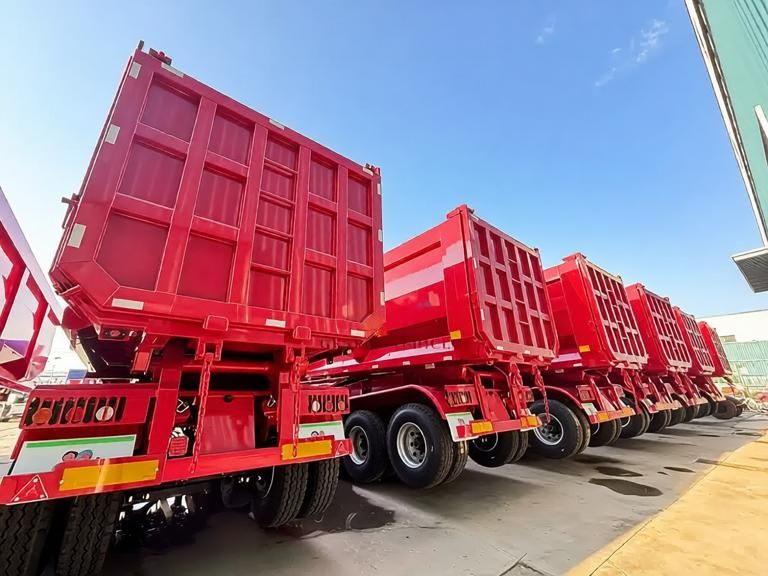
Core Powertrain and Structural Design
Rail Configurations: Fixed, Hinged, and Removable
Side rail systems fall into three broad configurations, each with distinct operational characteristics.
Fixed side rails are welded or bolted permanently to the deck. They offer the highest structural rigidity and load containment but restrict side loading. Fixed rails are common on dedicated bulk and aggregate trailers where side access is not required.
Hinged or drop-side rails can be folded down to deck level for side loading and raised for transport. This configuration suits operations that alternate between forklift-loaded palletized cargo and loose materials requiring containment. The hinge mechanism introduces wear points and requires inspection for pin wear and latch integrity.
Removable side rails, often supplied as a side kit, use stake pockets or a post-and-socket system to secure the rails to the deck. The rails can be removed entirely when the trailer is used as a flatbed, then reinstalled when containment is needed. This is the most flexible configuration but requires storage space for the removed rails and labor for the conversion. Removable side kits are common in North America for flatbed trailers that serve both open-deck and contained-load applications.
Load Transfer and Rated Side Capacity
The critical engineering question for any side rail system is how much lateral load it can resist. Cargo pressing against a side rail generates an outward force that the rail must transfer to the deck and chassis. The rail’s rated capacity depends on its height, the post or stake spacing, the attachment method, and the deck structure it mounts to.
For removable side kits, the load rating is typically expressed as a total lateral load capacity for the rail assembly, with the rating dependent on proper installation. A rail system that is not fully seated in its stake pockets, or that has missing or damaged pins, cannot achieve its rated capacity. For fixed rails on bulk trailers, the side wall thickness and the weld or fastener schedule determine the rating. Fleets should obtain the manufacturer’s rated side load capacity in writing and verify that it exceeds the expected lateral force from the cargo.
The center of gravity of the cargo relative to the rail height also matters. A tall stack of palletized material pressing against a low rail generates a greater overturning moment than a low, dense load. The rail height should be sufficient to contain the cargo’s center of gravity, not just its base.
Technical Specifications
The table below presents typical industry ranges for side rail semi trailer configurations. These are general references, not specifications for any single model. The manufacturer’s rating plate and documentation control the actual limits for a specific trailer.
| Key Parameter | Typical Specification or Range | Operational Significance |
|---|---|---|
| Rail height (fixed/drop-side) | 12–48 inches, depending on application | Must contain cargo center of gravity, not just base |
| Rail configuration | Fixed, hinged drop-side, or removable side kit | Trade-off between containment and side-loading access |
| Side load rating | Manufacturer-specific; obtain in writing | Must exceed expected lateral force from cargo |
| Stake pocket spacing (removable) | Typically 24–48 inches | Closer spacing increases rail load capacity |
| Rail material | Steel, aluminum, or composite | Steel for durability; aluminum for weight savings |
| Deck height (flatbed reference) | ~48–60 inches loaded | Affects forklift approach and loading angle |
| Side kit storage | Required when rails removed | Removed rails need protected storage to prevent damage |
Comparative Advantages TCO and ROI
The commercial case for a side rail trailer versus an open flatbed or a dedicated bulk trailer depends on the fleet’s cargo mix.
Containment versus access. A trailer with fixed side rails contains loose cargo and reduces the risk of load shift, but it requires top or rear loading. A flatbed without rails allows forklift access from both sides but requires load securing with straps or chains for every load. For fleets that carry loose aggregate, scrap, or bulk material, the fixed rail trailer reduces securing labor and load shift risk. For fleets that carry palletized freight, the open flatbed or removable rail configuration offers faster loading.
Convertibility value. A removable side kit allows one trailer to serve both contained-load and open-deck applications. The capital cost of the side kit is lower than a second dedicated trailer, and the fleet avoids the fixed cost of an asset that sits idle when its specific configuration is not needed. The trade-off is the labor and storage burden of conversion and the wear on stake pockets and pins from repeated install and removal.
Maintenance and lifecycle. Fixed rails have no moving parts and require only periodic inspection of welds and fasteners. Hinged and removable systems introduce pins, latches, and sockets that wear and require lubrication and replacement. A fleet that converts frequently should budget for hinge and pin replacement over the trailer’s life.
ROI assumptions. A fleet comparing a removable side kit against a second dedicated trailer would model the side kit cost plus conversion labor against the dedicated trailer’s purchase price, insurance, and registration. If the fleet’s cargo mix requires containment on only a fraction of trips, the side kit’s lower capital cost and shared asset utilization produce a better return. If containment is required on most trips, the dedicated trailer’s convenience and lower conversion labor may offset its higher capital cost.
Heavy Duty Application Scenarios
Side rail semi trailers serve distinct application segments:
-
Construction and demolition debris. Fixed or high drop-side rails contain loose debris and prevent it from shifting off the deck. The rail must be rated for the lateral force of the loaded material, and the deck must be reinforced for the impact of loading by excavator or loader.
-
Aggregate and bulk material. Side rail trailers with fixed walls serve as an alternative to tipper trailers where discharge is by loader rather than gravity. The rail height and side load rating are the primary specification points.
-
Palletized freight with mixed containment needs. Removable side kits allow a flatbed to carry contained loads on some trips and open-deck loads on others. This suits general freight fleets with varied customer requirements.
-
Agriculture and livestock feed. Side rail trailers transport bagged feed, seed, and other agricultural inputs that require containment but not full enclosure. The rail height must suit the bag stack height and the loading method.
Selection and Maintenance Considerations
For fleet managers and procurement teams specifying a side rail semi trailer, the following practices reduce risk and improve lifecycle value:
-
Obtain the rated side load capacity in writing. The rail’s ability to resist lateral cargo force is a safety-critical specification. Ask the manufacturer for the rated capacity and the installation conditions required to achieve it.
-
Match rail height to the cargo’s center of gravity. A rail that contains the base of a tall stack but not its center of gravity does not prevent overturning. Calculate the cargo’s center of gravity height and specify a rail that contains it.
-
Inspect hinge and stake pocket condition at every PM. Wear at pins, latches, and sockets reduces the rail’s load capacity and creates rattle and movement in service. Replace worn components before they fail.
-
Plan storage for removable rails. Removed side kits must be stored where they will not be damaged, bent, or lost. A bent rail will not seat properly in its pockets and cannot achieve its rated capacity.
-
Verify deck and chassis condition under the rail mounting points. The rail transfers load into the deck and frame. Corrosion or cracking at the mounting area compromises the entire system. Inspect these areas during structural inspections.
-
Train operators on proper installation of removable rails. A rail that is not fully seated, or that has missing pins, is a hazard. A pre-trip check of rail security should be part of the driver’s walkaround for trailers with removable or hinged rails.
Conclusion
A side rail semi trailer is a load containment solution whose value depends on matching the rail configuration to the cargo. Fixed rails provide the highest containment and the lowest maintenance, but restrict side access. Hinged and removable systems offer flexibility at the cost of wear points, conversion labor, and storage burden. The engineering decision centers on the rated side load capacity and the rail height relative to the cargo’s center of gravity—two specifications that determine whether the rail actually contains the load or merely borders it. For fleets, the commercial decision is whether the containment benefit justifies the access restriction, or whether a convertible system’s flexibility earns its maintenance and labor cost. The trailer that performs reliably is the one whose rail system is rated for the load it carries, installed correctly every time, and inspected for the wear that repeated use inevitably produces.