

Overview
A side load semi trailer is a trailer designed to allow cargo loading and unloading from the side rather than exclusively through rear doors, serving two distinct equipment categories that are often confused in procurement discussions. The first is the curtainside trailer, which uses a flexible PVC or spring-steel curtain instead of rigid sidewalls to permit forklift access from ground level along the trailer’s full length . The second is the container sideloader, a specialized chassis carrying a hydraulic lifting system that transfers containers between the trailer and the ground without a crane or dedicated container handler .
The procurement problem is that “side load” describes both categories, but they solve different operational problems and carry different capital costs. A curtainside trailer suits palletized freight, building materials, and urban deliveries where loading docks are unavailable; a container sideloader suits ports, rail terminals, and depots where containers must be transferred without a reach stacker. This FAQ addresses the capacity ranges, configuration choices, and selection criteria that determine which side load semi trailer matches the fleet’s cargo and infrastructure.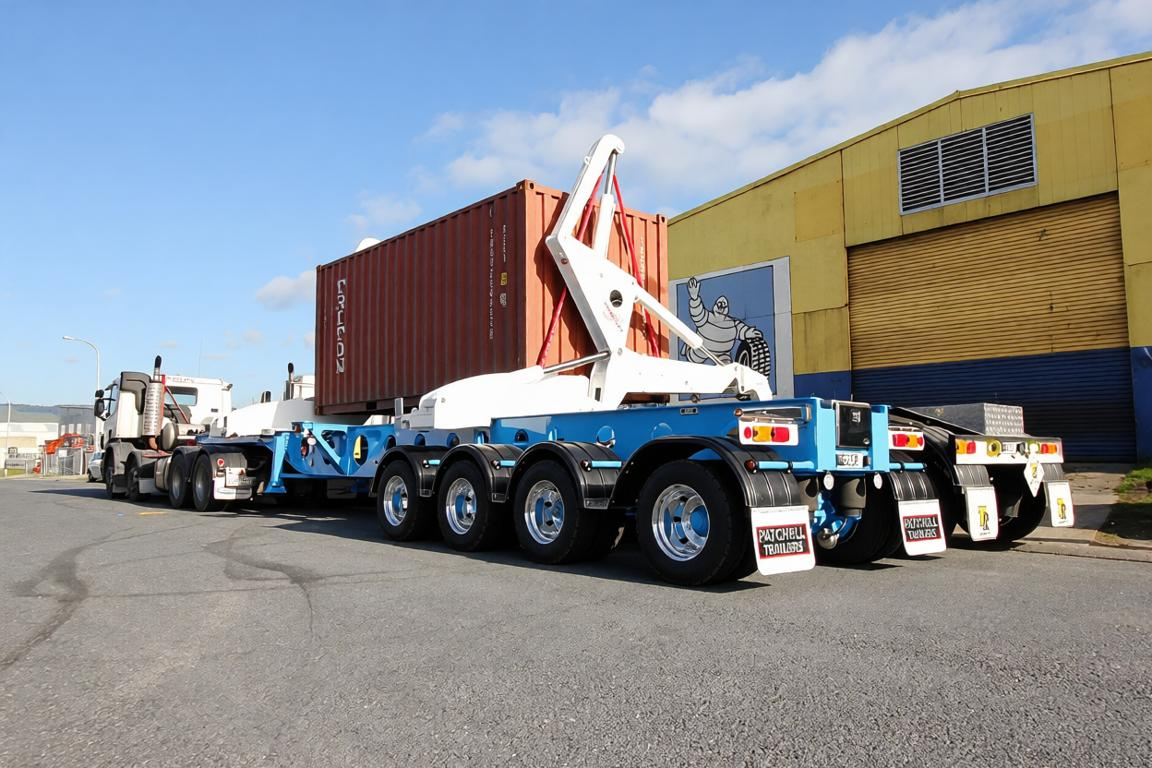
Frequently Asked Questions
What is the difference between a curtainside trailer and a container sideloader?
A curtainside trailer uses a flexible side curtain to expose the cargo bay for forklift access, while a container sideloader carries a hydraulic crane or lifting frame that picks up and sets down containers from the side. Curtainside systems such as the Kinedyne Kin-Slider allow the curtain to be opened in approximately 30 seconds, providing full-length access without requiring the driver to enter the trailer . A container sideloader, by contrast, is a flatbed chassis with a lifting assembly rated for 37 to 42 tons, capable of transferring a 20ft or 40ft container between the trailer deck and the ground without external equipment . A fleet sourcing “side load” capability must first determine whether the cargo is palletized freight or standardized containers, because the two configurations are not interchangeable.
What loading capacity does a container sideloader semi trailer offer?
A container sideloader semi trailer typically carries a lifting capacity of 37 to 42 tons and a trailer payload of 50 to 60 tons, with the lifting system rated separately from the chassis load rating. Sinotruk’s side loader lists a loading capacity of 50 tons with an XCMG MQH37 lifting system rated at 37 tons . Fudeng’s heavy-duty sideloader specifies a maximum lift capacity of 37,000 kg with a maximum working range of 4,000 mm . A used Hammar 160 S sideloader lists a load capacity of 36,160 kg and a gross weight of 45,000 kg . The lifting capacity governs the maximum container weight the system can transfer; the chassis payload governs the total load the trailer can carry on the road. Both figures must be confirmed against the intended container weights.
What capacity does a curtainside semi trailer offer?
A curtainside semi trailer typically carries 40 tons in standard three-axle configuration, with the capacity governed by the axle rating and chassis construction rather than the curtain system. ZW Group’s curtain side semi trailer specifies a payload of up to 40,000 kg with 3 × 13T axles from BPW, FUWA, or ZW . The curtain system itself does not limit payload, but it does affect load security requirements: cargo must be restrained independently because the curtain is not a structural sidewall. Lashing points and internal securing systems are specified separately, and the trailer’s certification for load securing standards (such as Code XL) depends on the curtain and body combination .
How fast can a curtainside trailer be opened for side loading?
A curtainside trailer with a quick-release system can be fully opened in approximately 30 to 45 seconds, compared to several minutes for a traditional side-slat curtain system. Kinedyne’s Kin-Slider uses a full-length vertical multi-latch closure with an all-in-one release, opening and closing in about 30 seconds . Krone’s Comfort Curtain, which uses micro-uprights on a roller guide, opens in less than 45 seconds with approximately 20 kg of pulling force . Traditional curtains with removable side slats require the driver to remove and reinsert each slat, which is slower and carries a risk of injury or lost components . For fleets making multiple side-load deliveries per shift, the opening speed directly affects driver productivity and route time.
What operational limitations should a fleet consider with a container sideloader?
A container sideloader adds significant tare weight, requires a level and stable surface for lifting operations, and demands regular hydraulic system maintenance on the lifting assembly. The trailer’s net weight is substantially higher than a standard container chassis—a Hammar 160 S weighs 8,840 kg before any container is loaded . The lifting stabilizers must be deployed on firm ground, and the working range and gap between trailer and container affect whether the system can operate in confined yards . The hydraulic system, lift cylinders, and control valves are additional maintenance items that a standard chassis does not carry. Fleets should confirm that the yard surfaces and container stacking arrangements at their terminals are compatible with the sideloader’s operating envelope before committing to the configuration.
How does a curtainside trailer compare to a standard dry van for fleet use?
A curtainside trailer trades the dry van’s rigid sidewalls and weather-sealed rear doors for full-length side access, making it suitable for freight that cannot be loaded through a rear dock or that requires forklift access from ground level. Curtainside designs originated in Europe, where loading docks are less common, and are increasingly used in North America for urban and last-mile deliveries to locations without dock infrastructure . The curtain provides weather protection equivalent to a tarp but not the structural security of a dry van; cargo restraint must be engineered rather than relying on the walls. A dry van remains the better choice for high-value freight requiring enclosed security, while a curtainside suits building materials, bagged goods, and palletized freight where side access reduces handling time.
What should a fleet verify before purchasing a used container sideloader?
A fleet should verify the lifting system’s service history, hydraulic component condition, structural integrity of the lifting frame, and the chassis’s brake and suspension condition before purchasing a used container sideloader. A used sideloader listing may describe the unit as “very poor” in technical and visual condition, which indicates that the lifting system and chassis both require assessment . The lifting capacity rating should be confirmed against the manufacturer’s plate, and the hydraulic cylinders, hoses, and control valves should be inspected for leaks and wear. The sideloader’s lifting mechanism is a high-stress system that wears with each container transfer; a unit with an unknown service history carries a repair risk that may exceed the purchase price advantage over a new unit.
Conclusion
Selecting a side load semi trailer starts with the cargo type: curtainside for palletized and non-containerized freight requiring forklift access, container sideloader for standardized containers requiring self-loading capability. Confirm the lifting capacity or payload rating against the actual loads, verify the operating surface and yard constraints for sideloader lifting, and treat the hydraulic system as the primary maintenance cost driver on a container sideloader. The side-access configuration that matches the fleet’s cargo and infrastructure is the one that reduces handling time without introducing a maintenance burden the operation cannot support.