

Overview
A short flatbed semi trailer in China refers to a flatbed configuration shorter than the standard 40ft (12.5m) platform, typically built for 20ft container handling, compact cargo, or applications where a full-length deck is unnecessary or restricted by route geometry. Procurement managers and fleet buyers sourcing from Chinese manufacturers encounter this category when specifying trailers for port shuttle work, urban delivery, or markets where overall length regulations cap the combination.
The procurement problem is not whether Chinese factories can build a short flatbed—they can, across a wide range of capacities and configurations—but whether the buyer can distinguish a standard 20ft container chassis from a purpose-built short flatbed, and whether the export quotation reflects the specification the fleet actually needs. This FAQ addresses the length options, capacity ranges, component choices, and export verification steps that determine whether a short flatbed semi trailer sourced from China meets the fleet’s operational and compliance requirements.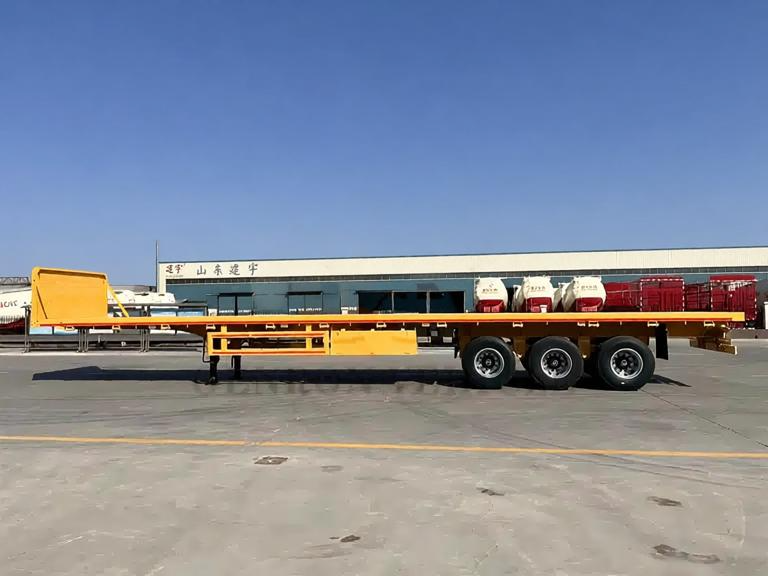
Frequently Asked Questions
What lengths are available for short flatbed semi trailers from China?
Short flatbed semi trailers from China are commonly available in 20ft (approximately 7,000mm) platform lengths, with 8.7m and other intermediate lengths built to order. A standard 20ft flatbed semi trailer from a Chinese manufacturer typically measures around 7,000mm × 2,500mm × 1,570mm, designed to carry one 20ft container or general cargo . A Chinese-made 8.7m flatbed dump semi trailer (a related configuration with a tipping function) measures 8.67m in length with a 31.5-ton design payload . For buyers needing a shorter deck without the container twist locks, manufacturers offer flatbed variants that can be configured with or without the locking system. The length specification should be confirmed against the destination market’s overall combination length limits, not assumed from the container size alone.
What load capacity can a short flatbed semi trailer carry?
A short flatbed semi trailer from China typically carries 20 to 40 tons in standard export configuration, with heavier ratings available through axle and beam upgrades. The 20ft flatbed specifications from Chinese suppliers list capacities in the 20 to 40 ton range for two- and three-axle configurations . A standard 40ft flatbed from the same suppliers lists 30 to 80 tons, illustrating that the shorter deck is generally rated lower because it is built for lighter container and general cargo work . The load capacity is governed by the main beam dimensions, axle rating, and tire capacity, not by the deck length—a short flatbed can be specified with heavier beams and axles if the application requires it, but the buyer must request that specification explicitly rather than assuming the standard 20ft rating applies.
What axle and suspension options are available for Chinese short flatbed trailers?
Chinese short flatbed semi trailers are offered with 2, 3, or 4 axle configurations, using axles from brands including FUWA, BPW, and Chinese domestic manufacturers, with mechanical leaf spring or air suspension. Standard export configurations use 13-ton or 16-ton axles from FUWA or BPW, with 3-axle setups common for 40-ton capacity and 2-axle setups for lighter 20ft applications . Suspension choices include mechanical leaf spring (the default for cost-sensitive export builds) and air suspension for applications requiring ride height control or load leveling . The axle brand and suspension type are among the most consequential specification choices because they determine parts availability in the destination market—a trailer built with FUWA or BPW axles can be serviced through those brands’ distributor networks, while a domestic Chinese axle brand may require sourcing parts from the original factory.
What kingpin and coupling options apply to Chinese flatbed trailers?
Chinese flatbed semi trailers typically use 2-inch (50mm) or 3.5-inch (90mm) kingpins, with JOST brand standard on many export builds and domestic equivalents available at lower cost. The kingpin size must match the tractor’s fifth wheel in the destination fleet; a 2-inch kingpin is standard for most road applications, while 3.5-inch kingpins are used in heavier-duty or certain regional configurations . Landing gear is commonly specified as JOST 28-ton two-speed or a domestic equivalent, with the brand affecting price and parts availability . Buyers should confirm that the kingpin and landing gear brands quoted are the ones specified, because Chinese factories often offer multiple tiers and the base quotation may use domestic components unless the buyer specifies the premium brand.
What is the typical FOB price range for a short flatbed semi trailer from China?
A short flatbed semi trailer from China typically lists at $7,500 to $12,000 FOB for standard export configurations, with the 20ft length generally at the lower end and heavier or premium-component builds at the higher end. Made-in-China listings show a 2/3/4 axle container flatbed starting at $7,500** , while Autoline listings for 3-axle 60-ton flatbeds show prices around **$8,800 to $9,500** . Industry pricing guidance indicates that standard steel flatbeds from China commonly fall in the **$7,000 to $18,000+ FOB range, with heavy-duty beams, air suspension, and premium axles increasing the price . The FOB price excludes ocean freight, insurance, port charges, duties, and inland transport, which can add substantially to the landed cost depending on destination.
What certification and documentation should accompany a Chinese flatbed trailer export?
Chinese flatbed trailer exports should be accompanied by the certificate of origin, commercial invoice, packing list, and bill of lading, with additional certifications depending on the destination market. Some Chinese suppliers list certifications including ISO, CCC, BV, SGS, and CE for their trailers , but the buyer must verify that the specific certificate applies to the exact model being purchased and is recognized in the destination country. For markets requiring vehicle type approval or conformity assessment, the Chinese factory’s domestic certifications may not be sufficient, and the buyer should confirm in writing what documentation the factory can provide for the destination’s registration process. A trailer that arrives without the required conformity documentation may be unusable until the certification gap is resolved.
How should a fleet verify a Chinese flatbed trailer supplier before ordering?
A fleet should verify a Chinese flatbed trailer supplier by confirming the factory’s business license, requesting references from buyers in similar markets, and arranging a pre-shipment inspection by a third party before final payment. The supplier’s listing on a B2B platform is not verification of manufacturing capability; the factory should be able to provide photographs of the production line, a sample specification sheet for the exact model, and contact details for prior export customers. A third-party inspection before shipment should verify the main beam dimensions, axle brand and rating, kingpin size, tire brand and date codes, and the presence of the specified certifications. The inspection cost is small relative to the risk of receiving a trailer that does not match the quotation or cannot be registered in the destination market.
Conclusion
Sourcing a short flatbed semi trailer from China is a specification and verification exercise, not a price comparison. Confirm the platform length against the destination market’s combination limits, specify the axle brand and load rating rather than accepting the base quotation, and verify the certification documentation before shipment. The FOB price is the starting point for landed cost, not the procurement decision—the trailer that arrives with the specified components and the correct documentation is the one that enters service without a certification or parts-availability problem.