

Introduction
Logistics terminals, distribution centres, manufacturing facilities, and freight depots depend on efficient trailer movements to maintain delivery schedules and control operating costs. Congested yards, slow loading cycles, limited labour availability, and trailer positioning risks can all affect overall supply chain performance.
Semi trailer yard equipment refers to the machinery and supporting systems used to move, position, load, unload, and maintain semi-trailers within a controlled industrial or logistics site. It includes powered trailer movers, yard tractors, forklifts, loading ramps, dock equipment, trailer supports, and traffic safety systems.
Unlike highway tractors designed for long-distance transport, yard equipment is selected primarily for frequent short-distance movements, tight manoeuvring spaces, repeated coupling operations, and compatibility with loading docks. The right combination depends on trailer volume, site layout, cargo type, ground conditions, and operating hours.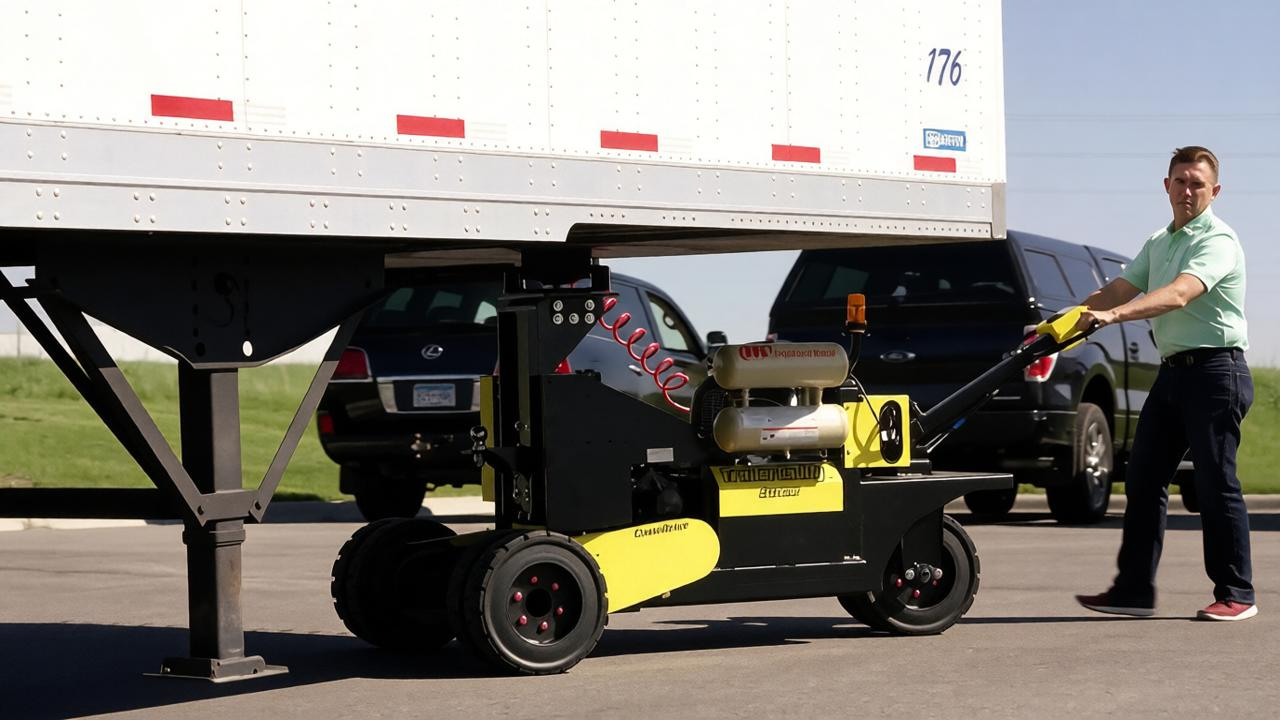
Core Powertrain and Structural Design
Semi trailer yard equipment covers several machine categories, so its powertrain and structural design depend on the equipment's specific function. A powered yard tractor requires an engine or electric drive system, while a loading ramp or trailer support may have no independent propulsion system.
Yard Tractor Engine and Transmission
A yard tractor, also called a terminal tractor or yard truck, is designed to move semi-trailers over short distances within logistics facilities.
Common power configurations include:
-
Diesel engines: Used in applications requiring sustained operation, high utilisation, and established refuelling infrastructure.
-
Electric drive systems: Suitable for facilities with charging infrastructure and operating patterns that allow planned charging.
-
Transmission systems: Designed to deliver controlled low-speed movement, frequent starts, and repeated direction changes.
Important selection factors include rated power, torque delivery, transmission response, braking performance, turning radius, and coupling compatibility.
For electric yard tractors, battery capacity, charging time, motor output, thermal management, and charging infrastructure affect operational availability.
Hydraulic System and Trailer Handling
Hydraulic systems are important in equipment that lifts, adjusts, or positions trailers and cargo.
Depending on the machine design, hydraulic functions may include:
-
Trailer lifting and height adjustment.
-
Loading ramp elevation.
-
Forklift mast lifting and attachment operation.
-
Hydraulic dock leveller movement.
-
Stabiliser and support-leg operation.
Hydraulic pressure and flow rate determine how effectively a system operates under load. Buyers should verify the rated capacity, working pressure, operating speed, and duty-cycle suitability rather than comparing hydraulic specifications in isolation.
Chassis and Structural Durability
Yard equipment operates under repeated loading, turning, braking, and coupling conditions. Its chassis and structural components must withstand these forces throughout the intended service life.
Important structural areas include:
-
Main chassis rails and crossmembers.
-
Fifth-wheel coupling assemblies.
-
Axles, suspension, and wheel hubs.
-
Forklift mast and carriage structures.
-
Ramp frames and support legs.
-
Trailer stands and stabilising equipment.
For yard tractors, the chassis must support the tractor's own weight and the forces transmitted through the trailer coupling. For loading ramps and dock equipment, structural design must account for rated loads, load distribution, and the possibility of uneven positioning.
Operator Safety and Visibility
Yard operations involve pedestrians, moving trailers, reversing vehicles, loading docks, and restricted visibility. Safety equipment should therefore be considered part of the machine specification.
Relevant features may include:
-
Reversing cameras and audible warning devices.
-
Mirrors and appropriate lighting.
-
Seat belts and operator restraint systems.
-
Emergency stops on powered loading equipment.
-
Pedestrian exclusion zones and warning systems.
-
Clearly marked safe operating and loading areas.
The required protective structures and safety systems depend on the equipment category, design, workplace risk assessment, and applicable regulations.
Service Access and Maintainability
Yard equipment often operates for multiple shifts, making maintenance accessibility important.
Buyers should consider access to engine compartments, hydraulic filters, electrical components, battery systems, brake assemblies, and common wear parts. For electric machines, battery diagnostics and charging-system support are particularly important.
A machine with straightforward inspection access and reliable local parts support can help reduce maintenance-related downtime.
Technical Specifications
The correct specifications for semi trailer yard equipment depend on its role. A yard tractor is evaluated by towing capability, manoeuvrability, powertrain, and coupling design. A forklift is assessed by rated lifting capacity, load centre, lift height, and mast configuration. A yard ramp is evaluated by rated load, platform dimensions, gradient, and adjustment range.
The following table summarises the main parameters to compare when selecting different categories of yard equipment.
|
Key Parameter |
Typical Technical Specification |
Operational Significance |
|---|---|---|
|
Yard tractor powertrain |
Diesel or electric drive |
Determines energy source and operating requirements |
|
Trailer handling capacity |
Manufacturer-rated towing or lifting capacity |
Must match the intended trailer or cargo load |
|
Turning radius |
Manufacturer-specified turning dimensions |
Affects manoeuvrability in confined yards |
|
Forklift rated capacity |
Rated load at a specified load centre |
Determines safe pallet and cargo handling capability |
|
Lifting height |
Manufacturer-rated maximum lift height |
Determines suitability for stacking and loading |
|
Loading ramp capacity |
Rated platform load |
Must safely support the loaded vehicle or cargo |
|
Dock leveller capacity |
Manufacturer-rated load capacity |
Determines compatibility with warehouse traffic |
|
Operating environment |
Indoor, outdoor, paved, or uneven surfaces |
Influences tyres, ground clearance, and equipment configuration |
These are specification categories, not universal performance figures. Actual capacities, dimensions, and operating limits vary by manufacturer, model, configuration, surface conditions, and applicable safety requirements.
Comparative Advantages TCO and ROI
Selecting semi trailer yard equipment involves comparing specialised machinery with alternative trailer-handling methods. The main alternatives include using road tractors for yard movements, relying on forklifts for selected cargo-handling tasks, or operating manual trailer-positioning systems.
Dedicated Yard Tractor vs Road Tractor
A dedicated yard tractor is designed for repeated short-distance trailer movements and frequent coupling operations. A conventional highway tractor can perform similar tasks, but its design priorities are different.
|
Comparison Factor |
Dedicated Yard Tractor |
Highway Tractor |
|---|---|---|
|
Primary application |
Short-distance yard movements |
Road freight transport |
|
Manoeuvrability |
Designed for frequent yard manoeuvres |
Depends on road tractor configuration |
|
Coupling frequency |
Suited to repeated trailer changes |
Not primarily designed for continuous yard switching |
|
Operating environment |
Controlled industrial yards |
Public roads and freight routes |
|
Fleet role |
Trailer positioning and staging |
Long-distance transportation |
A dedicated yard tractor may improve trailer movement efficiency in a high-volume facility, but its purchase is not automatically justified for a small yard with limited movements.
Mechanised Handling vs Manual Operations
Mechanised equipment can reduce the physical effort required to move heavy cargo and position trailers. Forklifts, powered ramps, and dock levellers can also help standardise loading procedures.
However, mechanisation introduces purchase costs, maintenance requirements, operator training needs, and energy consumption. The most suitable arrangement is determined by the volume and complexity of daily operations.
Total Cost of Ownership and ROI
A complete cost comparison should include:
-
Equipment purchase price or leasing cost.
-
Fuel or electricity consumption.
-
Charging infrastructure, where applicable.
-
Preventive maintenance and replacement parts.
-
Operator labour and training.
-
Insurance and compliance costs.
-
Downtime and operational disruption.
-
Expected service life and resale value.
For example, assume a distribution centre is considering a dedicated yard tractor to replace some movements currently performed by highway tractors. The financial evaluation should compare the annual cost of the existing process with the purchase, energy, maintenance, and staffing costs of the proposed machine.
The calculation should use actual daily trailer movements, average movement time, operating hours, labour costs, and maintenance records. Any projected savings or payback period will depend on these assumptions and should not be treated as guaranteed.
Heavy Duty Application Scenarios
Semi trailer yard equipment serves a wide range of industrial and commercial environments. The equipment configuration should match the site's traffic volume, cargo characteristics, surface conditions, and loading procedures.
Distribution Centres and Warehouses
Large distribution centres require frequent trailer positioning between staging areas, loading docks, and parking spaces.
Typical equipment includes:
-
Yard tractors for trailer switching.
-
Forklifts for palletised cargo.
-
Dock levellers for connecting warehouse floors with trailer decks.
-
Trailer stands and support equipment.
-
Yard ramps for loading operations without permanent dock facilities.
The main priority is maintaining smooth trailer flow while separating pedestrians from moving vehicles.
Ports and Freight Terminals
Ports and freight terminals handle large volumes of trailers, containers, and transport equipment.
Yard tractors are commonly used for short-distance trailer movements, while forklifts and other specialised handling equipment support cargo transfer.
Selection considerations include high utilisation, visibility, manoeuvrability, braking performance, and the ability to operate under the site's surface and weather conditions.
Manufacturing Facilities
Manufacturers often use semi-trailers to receive raw materials and dispatch finished products.
Yard equipment can support:
-
Moving incoming trailers to unloading areas.
-
Positioning outbound trailers for loading.
-
Handling pallets and industrial materials.
-
Supporting production-related logistics.
-
Maintaining organised trailer staging areas.
The required equipment depends on cargo dimensions, weight, loading frequency, and the layout of production and storage buildings.
Construction and Industrial Sites
Industrial facilities and construction yards may require equipment for moving heavy materials and positioning trailers on different types of surfaces.
In these environments, buyers should consider ground clearance, tyre selection, surface strength, ramp capacity, and the stability of loading areas.
Equipment designed for smooth warehouse floors may not be suitable for uneven outdoor ground.
Agricultural and Regional Logistics
Agricultural depots and regional freight facilities may handle machinery, bulk materials, packaged products, and agricultural supplies.
Equipment selection should account for dust, moisture, uneven surfaces, variable cargo dimensions, and seasonal changes in operating demand.
Selection and Maintenance Considerations
Choosing semi trailer yard equipment requires an assessment of the complete site operation rather than the purchase of an individual machine based only on its advertised capacity.
1. Assess Daily Trailer Movement Volume
Start by identifying:
-
Number of trailer movements per shift.
-
Average distance between parking and loading areas.
-
Number of loading docks.
-
Peak operating periods.
-
Average trailer weight and configuration.
-
Required coupling and uncoupling frequency.
A high-volume distribution centre may justify a dedicated yard tractor, while a smaller facility may use an existing road tractor for occasional movements.
2. Match Equipment to Cargo and Trailer Requirements
Different cargo types require different handling arrangements.
For example:
-
Palletised cargo generally requires appropriately rated forklifts.
-
Heavy industrial equipment may require specialised lifting or loading systems.
-
Trailers without access to permanent loading docks may benefit from suitable mobile yard ramps.
-
Frequent trailer switching may require a dedicated yard tractor.
Always verify rated capacities and operating limits using manufacturer documentation.
3. Evaluate Yard Layout and Ground Conditions
Measure turning areas, loading dock positions, trailer parking spaces, access routes, and overhead clearances.
Check whether the yard has:
-
Adequate turning space.
-
Suitable pavement strength.
-
Appropriate drainage.
-
Clearly separated pedestrian routes.
-
Sufficient lighting.
-
Safe loading and unloading areas.
These factors directly influence equipment size, manoeuvrability, tyre selection, and operating safety.
4. Compare Diesel and Electric Options
Diesel equipment may suit facilities with long operating hours and limited charging infrastructure. Electric equipment may be attractive where charging can be integrated into shift schedules and indoor emissions reduction is a priority.
The comparison should include actual energy use, electricity or fuel prices, charging availability, battery replacement considerations, maintenance support, and expected utilisation.
5. Establish Preventive Maintenance Procedures
Maintenance requirements vary by equipment category.
For yard tractors, inspect:
-
Engine or electric drive system.
-
Transmission and driveline.
-
Brakes and steering.
-
Tyres and suspension.
-
Fifth-wheel coupling.
-
Electrical and warning systems.
For forklifts and loading equipment, inspect:
-
Forks, mast, and lifting chains.
-
Hydraulic hoses and cylinders.
-
Tyres and wheels.
-
Safety interlocks and emergency stops.
-
Structural welds and load-bearing components.
Maintenance should follow manufacturer instructions and applicable workplace safety requirements.
6. Evaluate Supplier and After-Sales Support
Before purchasing, confirm:
-
Availability of spare parts.
-
Local maintenance and repair capability.
-
Warranty coverage.
-
Operator training.
-
Technical documentation.
-
Availability of service technicians.
-
Battery and charging support for electric equipment.
Reliable after-sales support is especially important for facilities where equipment downtime can interrupt loading schedules and freight dispatch.
Conclusion
Semi trailer yard equipment plays an important role in the efficiency of modern logistics terminals, warehouses, manufacturing facilities, and freight depots. Yard tractors, forklifts, loading ramps, dock systems, and trailer support equipment each address different parts of the trailer-handling process.
The best equipment combination depends on trailer movement volume, cargo type, site layout, ground conditions, energy infrastructure, and maintenance capability. By comparing rated capacities, operating costs, safety provisions, and supplier support, businesses can build a yard-handling system that improves operational control while protecting long-term fleet value.