

Introduction
Commercial fleets in New York City face intense competition for customer attention, high operating costs, demanding delivery schedules, and limited opportunities for traditional roadside advertising. A professionally designed semi trailer wrap can turn a working trailer into a mobile advertising surface that communicates a company's brand while traveling through city streets, highways, industrial areas, and distribution centers.
A semi trailer wrap is a large-format printed vinyl film applied to the exterior panels of a trailer. It can display company logos, product images, promotional messages, contact information, and full-color brand graphics. In NYC, businesses commonly consider trailer wraps for logistics fleets, food and beverage distribution, construction suppliers, retail brands, manufacturers, and advertising campaigns.
Unlike a permanent paint job, a vinyl wrap can generally be removed or replaced when branding changes, provided the underlying surface and installation are suitable. The actual service life depends on vinyl quality, printing and lamination, exposure to sunlight and weather, washing practices, and installation workmanship.
For companies evaluating semi trailer wraps NYC, the main purchasing considerations include:
-
Trailer dimensions and exterior panel condition.
-
Vinyl film type, print quality, and protective laminate.
-
Graphic design and brand consistency.
-
Installation location, preparation, and labor.
-
NYC parking, access, and commercial vehicle operating requirements.
-
Maintenance, repairability, and eventual removal.
A successful project requires more than attractive artwork. Material selection, surface preparation, accurate measurements, professional installation, and routine inspection all affect the final appearance and long-term value.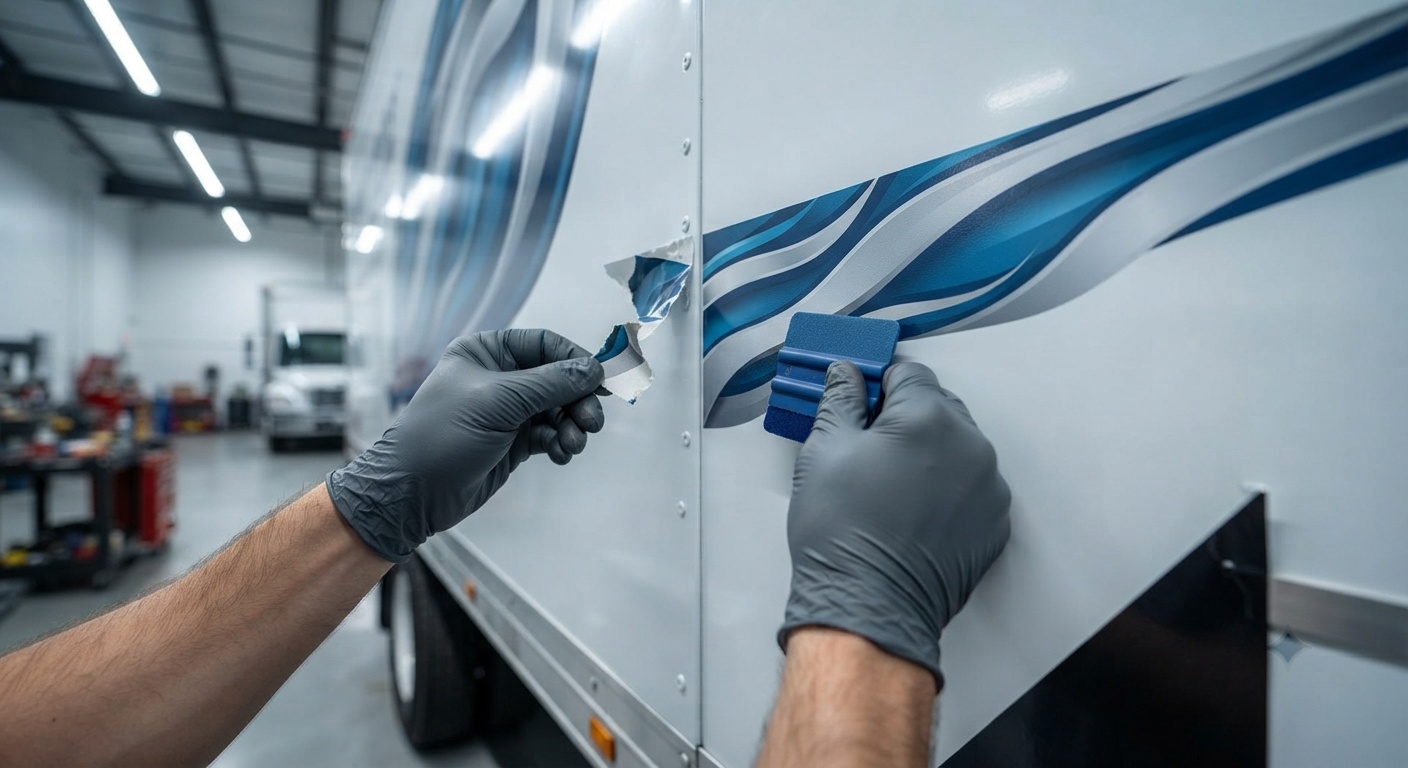
Core Powertrain and Structural Design
A semi trailer wrap does not change the trailer's engine, transmission, payload rating, braking performance, or structural capacity. Conventional semi trailers are unpowered vehicles, and their primary mechanical systems remain independent of the advertising graphics applied to the exterior.
However, the trailer's construction and surface condition directly affect wrap selection and installation quality.
Trailer Body and Exterior Panel Materials
Semi trailers may have exterior surfaces made from painted steel, aluminum, fiberglass-reinforced panels, or other composite materials. Each surface requires an appropriate preparation and vinyl application method.
-
Aluminum panels: Common on commercial trailers because of their relatively low weight and corrosion resistance. Surface oxidation, contamination, and existing coatings must be assessed before installation.
-
Painted steel panels: Can provide a suitable wrapping surface when the paint is firmly bonded, clean, and free from significant corrosion.
-
Fiberglass panels: Often used in enclosed trailer construction. Their surface texture and condition can affect vinyl adhesion.
-
Composite panels: Require material-specific assessment to ensure compatibility with the selected adhesive and installation process.
Damaged paint, rust, loose coatings, oil, and accumulated road grime can reduce adhesion. A professional installer should inspect the trailer before confirming the preparation method.
Vinyl Film and Protective Lamination
The vinyl film is the main material used to create a semi trailer wrap. Commercial vehicle graphics generally use either cast or calendared vinyl, depending on the application and budget.
Cast vinyl is manufactured as a thin film designed to conform to complex surfaces. It is commonly selected for demanding vehicle applications where flexibility and dimensional stability are important.
Calendared vinyl is generally thicker and may be suitable for flatter surfaces and certain shorter-term applications. Its suitability depends on the manufacturer's specifications and the trailer's surface geometry.
A protective laminate is often applied over printed graphics to help protect against abrasion, ultraviolet exposure, moisture, and routine cleaning.
Important material considerations include:
-
Adhesive compatibility with the trailer's existing paint or coating.
-
Film flexibility and conformability.
-
Resistance to outdoor weather exposure.
-
Print durability and color stability.
-
Compatibility with the selected protective laminate.
-
Manufacturer-recommended application and removal temperatures.
The wrap supplier should specify the exact film and laminate combination rather than quoting only a generic description such as premium vehicle vinyl.
Trailer Surface Preparation and Installation
Surface preparation is one of the most important factors affecting wrap performance. Even high-quality vinyl may fail prematurely if applied over dirt, wax, grease, corrosion, or poorly bonded paint.
A typical installation process includes:
-
Inspecting the trailer body, paint, panel joints, rivets, and damaged areas.
-
Cleaning the exterior to remove road film, oil, dust, and other contaminants.
-
Removing or treating unsuitable surface coatings where necessary.
-
Measuring panels and confirming the graphic layout.
-
Printing and preparing the vinyl graphics.
-
Applying the film with appropriate tools and installation techniques.
-
Trimming around panel edges, doors, hardware, and other obstacles.
-
Completing the required post-installation inspection and finishing procedures.
Large semi trailers may require a controlled indoor installation area with sufficient height, length, lighting, and access equipment. The installation environment should follow the vinyl manufacturer's temperature and application requirements.
Structural Durability and Safety
A trailer wrap is a surface treatment, not a structural reinforcement. It cannot repair damaged panels, reinforce a weakened frame, or replace corrosion treatment.
The graphics must also be designed around the trailer's operating features. Door handles, hinges, locking bars, reflective markings, lights, identification plates, and inspection access points should remain functional and visible where required.
Professional installers should avoid covering mandatory safety markings, registration information, reflective conspicuity treatments, or other regulated features. The design must account for applicable federal, state, and local requirements.
Technical Specifications
The technical requirements for semi trailer wraps depend on the trailer's dimensions, panel material, surface condition, design complexity, and intended advertising period. The following table identifies practical parameters to confirm before requesting a quotation. Material specifications and service-life expectations should be verified against the selected manufacturer's product documentation.
|
Key Parameter |
Typical Technical Specification |
Operational Significance |
|---|---|---|
|
Trailer body length |
Common configurations include approximately 48–53 ft in North American freight operations |
Determines graphic coverage and material quantity |
|
Trailer body height |
Configuration-dependent; often around 8–9 ft for enclosed trailers |
Affects access equipment and installation planning |
|
Vinyl material |
Cast or calendared adhesive-backed PVC film |
Determines conformability and application suitability |
|
Protective laminate |
Manufacturer-compatible clear overlaminate |
Helps protect printed graphics from weather and abrasion |
|
Print technology |
Commercial large-format digital printing |
Determines graphic resolution and color reproduction |
|
Surface preparation |
Cleaning, degreasing, and condition assessment |
Influences adhesive performance |
|
Installation area |
Indoor or otherwise controlled application environment |
Helps maintain consistent installation conditions |
|
Expected service life |
Product- and exposure-dependent; confirm manufacturer guidance |
Influences replacement planning and total project cost |
Measuring a Semi Trailer for a Wrap
Accurate measurements are essential for estimating material requirements and preparing the artwork.
A standard enclosed trailer may have large uninterrupted side panels, while a flatbed or specialized trailer may require a different graphic layout.
The installer should measure:
-
Overall usable side-panel length and height.
-
Rear-door dimensions.
-
Front bulkhead dimensions, where wrapping is required.
-
Door frames, hinges, rivets, and other surface obstructions.
-
Existing logos, reflective markings, and required identification areas.
Not every square foot of the trailer can necessarily be covered with uninterrupted vinyl. Panel joints, hardware, curves, and safety markings must be considered when calculating usable graphic area.
Comparative Advantages TCO and ROI
Semi trailer wraps offer a flexible alternative to traditional painted graphics, magnetic advertising panels, and unbranded trailer operation. The most suitable option depends on how frequently the brand changes, how long the trailer will remain in service, and the desired advertising coverage.
Vinyl Wraps vs. Traditional Trailer Painting
Painted graphics can provide a durable branding solution, particularly when incorporated into a new trailer's original finish. However, changing a painted design may require additional surface preparation and refinishing work.
Vinyl wraps offer several practical advantages:
-
Brand flexibility: Graphics can generally be replaced without repainting the entire trailer.
-
Design freedom: Large-format printing supports detailed images, gradients, promotional messages, and complex brand layouts.
-
Fleet consistency: Multiple trailers can use a standardized design system.
-
Campaign changes: Promotional graphics can be updated when business priorities change.
-
Surface protection: Suitable films may help protect the underlying finish from some everyday surface exposure, although they do not eliminate the need for proper maintenance.
Painted graphics may be preferable for certain long-term applications or when the trailer requires a complete refinishing process. Vinyl wraps are often attractive when flexibility and visual customization are priorities.
Full Wraps vs. Partial Wraps
A full trailer wrap covers most of the selected exterior panels with printed or colored vinyl. It provides a large branding area and allows more extensive visual designs.
A partial wrap covers selected sections, leaving some original trailer finish visible. It can be suitable for companies that want prominent branding without covering every panel.
A third option is cut vinyl lettering, which uses individually cut letters, logos, and simple graphic elements rather than a continuous printed film.
|
Advertising Option |
Main Advantage |
Main Limitation |
|---|---|---|
|
Full vinyl wrap |
Extensive branding and visual coverage |
Higher material and installation requirements |
|
Partial vinyl wrap |
Focused branding with less coverage |
Design must work with the exposed trailer finish |
|
Cut vinyl graphics |
Suitable for simple logos and lettering |
Limited suitability for complex photographic designs |
|
Painted graphics |
Integrated finish for long-term branding |
Changes may require more extensive refinishing |
Total Cost of Ownership
The total cost of a semi trailer wrap includes more than the vinyl itself. A realistic project budget should account for design, printing, lamination, installation, surface preparation, and future replacement.
Main cost factors include:
-
Trailer dimensions and number of panels.
-
Full-wrap or partial-wrap coverage.
-
Type and grade of vinyl film.
-
Printing complexity and color requirements.
-
Protective laminate selection.
-
Trailer cleaning and surface repairs.
-
Installation labor and facility access.
-
Removal of existing graphics.
-
Future repair and replacement requirements.
A trailer with extensive corrosion, damaged paint, or complicated panel geometry may require additional preparation and labor. Buyers should request an itemized quotation to understand what is included.
Advertising ROI Example
A fleet operator may evaluate a trailer wrap as a mobile advertising investment.
Assume a company spends $5,000 on design, printing, materials, and installation for one trailer. If the campaign generates five additional qualified customer inquiries per month over 12 months, the total is 60 inquiries.
If the company converts 10% of those inquiries into customers, it gains six customers. Assuming each new customer generates an average contribution margin of $1,000 during the measurement period, the additional contribution is:
6 × $1,000 = $6,000
The simplified campaign contribution after the wrap investment is:
$6,000 − $5,000 = $1,000
This example assumes that all six customers are genuinely attributable to the campaign and that the stated contribution margin is calculated after relevant variable costs. It excludes other marketing expenses, financing, taxes, and the value of repeat purchases.
Actual results depend on trailer mileage, routes, audience exposure, brand recognition, campaign design, customer conversion rates, and the company's sales process. A wrap creates advertising exposure, but it does not guarantee customer inquiries or sales.
Heavy Duty Application Scenarios
Semi trailer wraps are particularly useful for businesses operating commercial fleets across metropolitan areas, regional highways, industrial parks, and distribution networks.
In NYC, trailers may travel through busy commercial districts, warehouse areas, major freight corridors, and surrounding regional markets. Their large exterior surfaces can provide repeated brand exposure during normal transport operations.
Logistics and Transportation Companies
Freight companies can use trailer wraps to display:
-
Corporate logos and brand colors.
-
Website addresses and business contact information.
-
Freight and logistics service descriptions.
-
Company slogans and fleet identification graphics.
Consistent branding across multiple trailers helps create a recognizable fleet identity.
Food and Beverage Distribution
Food distributors and beverage companies often use enclosed trailers for regional deliveries. Wraps can display product packaging, brand imagery, promotional messages, and retail campaign graphics.
Designers should consider frequent loading operations, cleaning schedules, and exposure to moisture or cleaning chemicals. The selected vinyl and laminate should be suitable for the actual operating environment.
Retail and Consumer Brands
Retailers and consumer product companies can use semi trailer wraps for seasonal promotions, product launches, and wider brand campaigns.
A well-designed trailer graphic should communicate its main message quickly. Since vehicles are frequently viewed from a distance or while moving, the design should prioritize:
-
A recognizable logo.
-
A clear central visual.
-
Short, readable messaging.
-
Strong contrast.
-
Limited essential contact information.
Overly complicated graphics can become difficult to understand when the trailer is moving or viewed briefly.
Construction and Industrial Businesses
Construction suppliers, equipment dealers, building-material companies, and industrial manufacturers can use trailer wraps to promote products and services.
Useful graphic elements may include company branding, equipment categories, service areas, and business contact details.
For trailers regularly exposed to construction dust, mud, and rough handling, material selection and maintenance planning are especially important.
Fleet Advertising Campaigns
Some companies use semi trailers as moving advertising assets for a specific campaign or geographic market.
Before starting a campaign, fleet managers should establish:
-
Which trailers will carry the graphics.
-
The routes and geographic areas they regularly serve.
-
The intended campaign duration.
-
Whether the graphics will be permanent or temporary.
-
How campaign performance will be measured.
-
Who is responsible for cleaning, inspections, and repairs.
For NYC operations, the project should also consider where trailers can be safely parked for installation and whether the selected facility can accommodate the trailer's full dimensions.
Selection and Maintenance Considerations
Selecting a semi trailer wrap supplier in New York City requires evaluating design capability, material quality, installation experience, and after-sales support. A low quotation may not include surface preparation, premium laminate, graphic design, or removal of existing vinyl.
How to Choose a Semi Trailer Wrap Provider in NYC
Before choosing an installer, ask for information about previous commercial vehicle projects and the materials proposed for the job.
Important questions include:
-
Experience: Has the provider completed large commercial trailer or fleet-wrap projects?
-
Materials: Which vinyl film and laminate brands and product series will be used?
-
Design: Does the quotation include custom artwork, layout revisions, and print preparation?
-
Installation: Can the facility accommodate the trailer's length and height?
-
Preparation: Are cleaning, paint inspection, and minor surface preparation included?
-
Warranty: What coverage applies to material defects and installation workmanship?
-
Repairs: Can damaged sections be replaced without rewrapping the entire trailer?
-
Removal: What procedures and additional costs apply when the graphics reach the end of their service life?
Requesting photographs of completed commercial trailer projects can help assess the provider's workmanship, especially around rivets, panel edges, doors, and complex surfaces.
NYC Installation Planning
Large semi trailers require sufficient space for cleaning, positioning, and installation. A suitable facility should provide safe access to the trailer's full exterior and the equipment required for working at height.
For NYC-area fleet operators, practical planning considerations include:
-
Confirming that the installation location can accommodate the trailer.
-
Arranging safe vehicle access and parking.
-
Coordinating installation around delivery schedules.
-
Allowing sufficient time for cleaning and surface preparation.
-
Confirming the required temperature and environmental conditions.
-
Planning vehicle availability so the wrap project does not disrupt essential transport operations.
The installation provider should confirm the expected turnaround time after reviewing the trailer dimensions, design complexity, and surface condition.
Maintenance and Cleaning
Proper maintenance can help preserve the appearance and adhesion of a trailer wrap.
Recommended practices include:
-
Washing the trailer with cleaning products approved for the selected vinyl.
-
Avoiding abrasive brushes and aggressive chemicals.
-
Following the manufacturer's guidance for pressure washing.
-
Paying attention to film edges, seams, and areas around hardware.
-
Removing road contaminants before they become difficult to clean.
-
Inspecting graphics regularly for lifting, tearing, or impact damage.
-
Repairing damaged sections before moisture and dirt spread underneath the film.
Pressure washing should be performed carefully. Excessive pressure, unsuitable nozzle angles, or directing water toward film edges can contribute to lifting or damage.
Warranty, Repair, and Replacement
A wrap warranty may cover material defects, print performance, or installation workmanship, but these are not necessarily covered under the same conditions.
Before signing a contract, clarify:
-
The manufacturer's material warranty.
-
The installer's workmanship warranty.
-
Environmental and exposure limitations.
-
Maintenance obligations.
-
Exclusions for collision damage and improper cleaning.
-
Procedures for repairing damaged graphics.
When a section is damaged, a professional installer may be able to replace only the affected panel or graphic area. However, color matching can be difficult if the original vinyl has experienced prolonged outdoor exposure. Keeping the original design files and material specifications can make future repairs easier.
Conclusion
Semi trailer wraps in NYC provide commercial fleets with a flexible way to combine transportation operations and mobile brand advertising. Full wraps, partial wraps, and cut vinyl graphics offer different levels of coverage, design flexibility, and project cost.
The most important purchasing decisions involve vinyl material quality, protective lamination, trailer surface condition, graphic design, installation workmanship, and long-term maintenance. Businesses should also consider NYC installation logistics, vehicle availability, applicable safety requirements, and the provider's warranty and repair capabilities.
For logistics companies, retailers, construction suppliers, and manufacturers, a professionally installed semi trailer wrap can strengthen fleet identity and create repeated brand exposure across normal delivery routes. A detailed quotation, appropriate materials, accurate measurements, and a realistic maintenance plan help protect the investment and keep commercial trailer graphics looking professional throughout their intended service life.