

Overview
The distinction between a semi trailer and a trailer—specifically a full trailer—comes down to one structural fact: whether the trailer’s axles support its entire weight or whether a portion is transferred to the towing vehicle. A semi trailer transfers a substantial part of its weight to the tractor through a fifth wheel coupling, while a full trailer’s axles support the entire weight of the trailer .
For fleet managers and procurement teams, this is not a semantic distinction. The classification determines the braking system requirements the trailer must meet, the coupling hardware it uses, and how it is registered and maintained. This FAQ addresses the definitions, the regulatory consequences, and the operational trade-offs that matter when specifying or evaluating trailers.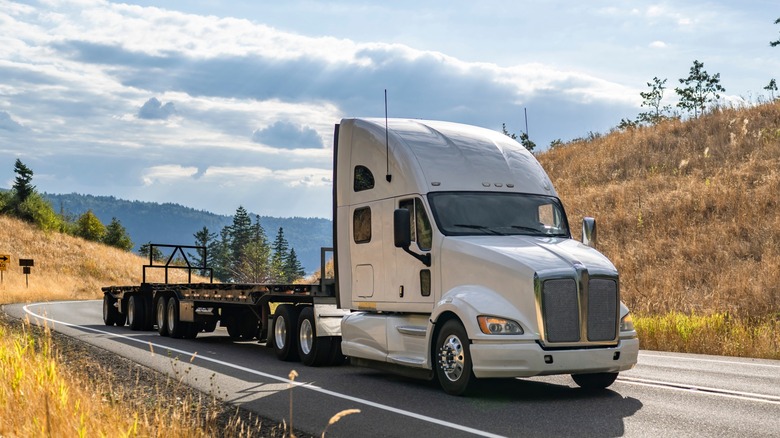
Frequently Asked Questions
What is the legal definition of a semi trailer?
A semi trailer is a trailer so constructed that a substantial part of its weight rests upon or is carried by another motor vehicle . The federal definition in 49 CFR 571.3 uses this weight-transfer language, and the same principle appears in state commercial vehicle codes .
The key element is that the trailer has no front axle of its own. When uncoupled, it rests on landing gear at the front and its own axles at the rear. When coupled, the tractor’s fifth wheel carries the front portion of the trailer’s weight and provides the pivot point for articulation .
What is the definition of a full trailer?
A full trailer is a trailer equipped with two or more axles that support the entire weight of the trailer . It has front and rear axles of its own and connects to the towing vehicle through a drawbar or tongue that transmits horizontal towing force but not significant vertical load.
The distinction matters for braking. Because a full trailer’s axles support the full weight, federal safety standards require it to have ABS on at least one front and rear axle to prevent instability if either axle locks up. A semi trailer, supported at the front by the tractor, is only required to have ABS on one axle .
How does the coupling differ between a semi trailer and a full trailer?
A semi trailer couples through a fifth wheel and kingpin, a load-bearing hitch that transfers both horizontal and vertical forces. The fifth wheel is a horseshoe-shaped plate on the tractor that locks around the trailer’s kingpin, allowing the combination to articulate while the tractor carries the trailer’s front weight.
A full trailer couples through a drawbar or tongue that attaches to the towing vehicle’s hitch. The drawbar transmits the towing force and allows articulation, but it does not carry the trailer’s vertical weight. The full trailer’s own front axle supports that load. This is why a full trailer can be towed by a vehicle without a fifth wheel—a rigid truck, a pickup, or a tractor with a drawbar hitch.
Why are semi trailers more common than full trailers for highway freight?
Semi trailers dominate highway freight because they are easier to reverse and faster to swap between power units. A semi trailer has only one articulation point—the fifth wheel—so backing it follows a predictable path. A full trailer has two articulation points (the drawbar and its own steering axle), which makes reversing more complex .
The swap advantage is equally important. A tractor can drop a loaded semi trailer on its landing gear and pick up an empty one in minutes, without disturbing the cargo. A full trailer’s drawbar coupling is not designed for the same rapid interchange. This flexibility is why one tractor can serve multiple trailers over its service life, and why semi trailers predominate in truckload and less-than-truckload operations .
Does the semi trailer vs full trailer distinction affect maintenance?
Yes. The classification determines the braking system the trailer carries, which in turn affects inspection and parts requirements. A full trailer’s ABS on front and rear axles means additional wheel speed sensors, modulators, and wiring compared with a semi trailer’s single-axle ABS requirement .
The coupling hardware also differs entirely. A semi trailer’s maintenance scope includes the kingpin and upper coupler plate, the landing gear, and the fifth wheel interface on the tractor. A full trailer’s maintenance scope includes the drawbar eye or lunette ring, the front axle steering components, and the hitch on the towing vehicle. The two systems share tires, brakes, and suspension concepts, but the coupling and weight-transfer components are not interchangeable.
How does the weight transfer affect payload and stability?
A semi trailer’s weight transfer to the tractor improves traction on the drive axles, which is advantageous on slippery or snowy roads. The trade-off is that the tractor must be rated for the imposed load, and the fifth wheel position affects how the weight is distributed between the tractor’s steer and drive axles .
A full trailer does not impose vertical load on the towing vehicle, so the towing vehicle’s axle ratings are less constrained by the trailer’s weight. However, the full trailer’s own front axle must be rated for the load it carries, and the drawbar must be strong enough to transmit the towing forces. For fleets, the semi trailer’s weight transfer is usually the preferred arrangement because it allows a lighter trailer for a given payload and improves drive traction, but it requires a tractor with adequate fifth wheel and rear axle capacity.
What should I verify when buying a trailer to confirm its classification?
Verify the axle configuration and the coupling type on the trailer’s data plate and specification sheet. A trailer with a kingpin and landing gear, and no front axle, is a semi trailer. A trailer with front and rear axles and a drawbar is a full trailer.
The regulatory classification should be confirmed with the local motor vehicle authority for registration and inspection purposes. A trailer that is misclassified can create insurance and compliance problems, and the braking system requirements differ between the two categories. The data plate and the manufacturer’s specification are the controlling documents, not the seller’s description or the trailer’s appearance.
Conclusion
The semi trailer vs trailer distinction comes down to weight transfer and axle count: a semi trailer transfers a substantial part of its weight to the tractor and has no front axle, while a full trailer’s axles support its entire weight and it connects through a drawbar. This classification determines the ABS requirements, the coupling hardware, and the maintenance scope. For fleet procurement, the practical takeaway is to confirm the trailer type from the data plate and the coupling configuration, and to ensure that the tractor’s fifth wheel, rear axle rating, and brake system are matched to the trailer’s classification. The federal definitions in 49 CFR 571.3 and the applicable state commercial vehicle regulations remain the controlling references.