

Introduction
Semi trailer truck weight is not a single number but a set of interdependent specifications that determine what a combination can legally and safely carry. The tare weight—the empty weight of the trailer itself—subtracts directly from the available payload. The gross vehicle weight rating (GVWR) defines the maximum loaded weight the trailer is designed to support. The gross combination weight rating (GCWR) caps the tractor and trailer together. And the legal axle and bridge formula limits determine how that weight may be distributed on the road, regardless of what the trailer’s data plate permits.
For fleet managers and procurement teams, weight errors are expensive in both directions. A trailer specified too heavy for the tractor’s GCWR creates an illegal combination. A trailer specified too light for the cargo requires more trips, increasing cost per ton-kilometer. The operational pressures—fuel cost per payload ton, axle load compliance at weigh stations, and bridge formula enforcement—make weight specification a commercial decision as much as an engineering one.
This guide examines the weight specifications that matter for semi trailer selection: tare ranges by trailer type, the regulatory ceilings that govern operation, and the payload calculation that converts these numbers into a usable load capacity.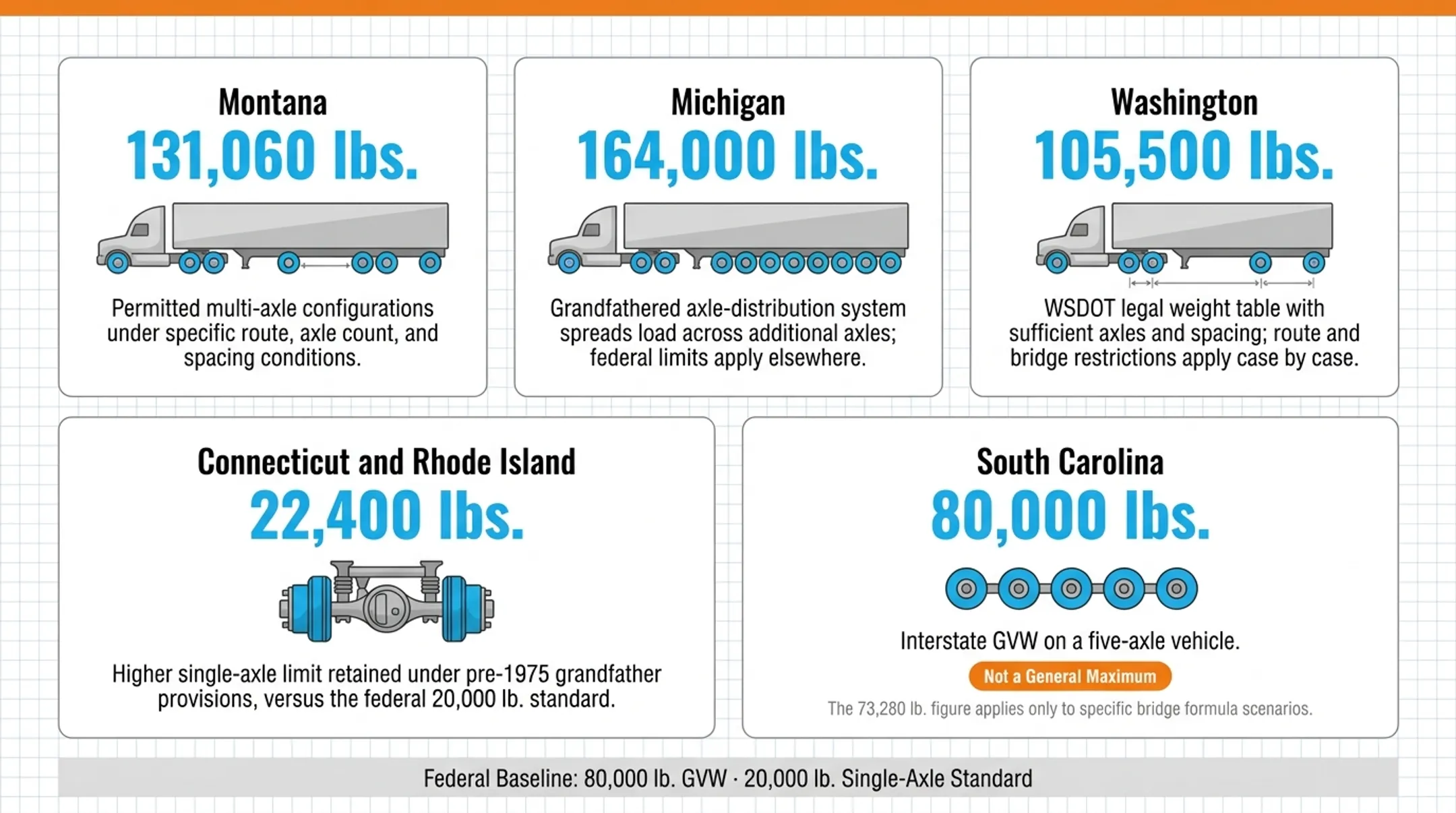
Core Powertrain and Structural Design
Engine and Transmission
A semi trailer has no engine or transmission. Its weight specifications are structural, not powertrain-derived. However, the tractor’s GCWR must accommodate the trailer’s loaded weight plus the tractor’s own weight. A tractor with a 80,000 lb GCWR coupled to a trailer with a 68,000 lb GVWR may be limited by the tractor’s rating if the tractor’s tare weight and the trailer’s loaded weight sum to more than 80,000 lb. The tractor’s engine and transmission must also be rated for the grade performance required at the combination’s maximum weight.
Hydraulic System
Hydraulic systems on semi trailers—landing gear, lowbed gooseneck, dump body lift—add weight to the trailer’s tare. A lowbed with a hydraulic detachable gooseneck carries the weight of cylinders, hoses, a reservoir, and a pump (if self-contained). This is a small fraction of total tare but a factor in precise payload calculations for heavy-haul operations where every kilogram affects permit requirements.
Chassis and Structural Durability
The chassis frame is the dominant contributor to tare weight. Main beam dimensions, cross-member spacing, and deck plate thickness are specified to carry the design payload. A trailer built for 40-tonne payloads will have heavier beams and reinforcement than one built for 25-tonne payloads. This is why tare weight varies by configuration within the same trailer type: a heavy-duty flatbed and a standard flatbed may share a model name but differ by a tonne or more in empty weight.
Suspension type also affects tare. Air suspension systems typically weigh more than mechanical leaf spring systems due to the air springs, height control valves, and associated plumbing. The trade-off is cargo protection and ride height control versus a modest tare penalty.
Technical Specifications
The table below presents representative weight parameters for common semi trailer types. Tare weights are typical ranges; actual figures vary by manufacturer, model, and configuration. Regulatory limits are drawn from published government sources.
Comparative Advantages TCO and ROI
The weight decision is a payload efficiency calculation. Every kilogram of tare is a kilogram of cargo that cannot be carried within a fixed GVWR or GCWR. A fleet operating at the 80,000 lb US federal limit with a tractor tare of 18,000 lb and a trailer tare of 14,000 lb has 48,000 lb of available payload. Reducing trailer tare by 2,000 lb through specification changes—aluminum components, lighter suspension, or a different deck material—increases payload by 2,000 lb per trip without any change to the tractor or the route.
The revenue impact of that payload increase depends on cargo density and trip frequency. For a fleet hauling dense cargo that consistently reaches the weight limit before the trailer is full, a 2,000 lb payload gain translates directly into additional revenue per trip. For a fleet hauling light, high-volume cargo that reaches the trailer’s cubic capacity before its weight limit, tare reduction provides no payload benefit.
A defensible comparison requires stated assumptions. Consider a fleet operating 50 trailers, each making 100 trips per year at an average revenue rate of 0.50 CNY per lb of payload. If a specification change reduces tare by 1,500 lb and the cargo is weight-limited, the additional payload per trip is 1,500 lb, generating 750 CNY per trip and 75,000 CNY per trailer per year. Against a price premium of 30,000 CNY per trailer for lighter components, simple payback is under five months. If the cargo is volume-limited, the same specification change generates no additional revenue and the premium is unrecovered. The decision hinges on the cargo profile, not the trailer specification alone.
Resale value for trailers with standard tare specifications is generally stronger than for specialized lightweight or heavy-duty configurations, because the buyer pool is broader.
Heavy Duty Application Scenarios
-
General freight and dry van operations: A 53 ft dry van with a tare of 13,000–16,000 lb is the standard configuration. Payload is typically limited by the 80,000 lb GVW limit after subtracting tractor and trailer tare. Fleets hauling dense packaged goods benefit from tare reduction; fleets hauling lightweight volume freight do not.
-
Container drayage and port operations: A container chassis tare is relatively low, but the loaded container weight often reaches legal limits before the chassis payload rating is approached. The critical calculation is the container’s gross weight plus chassis tare against the tractor’s GCWR and axle limits.
-
Construction and flatbed haulage: Flatbed tare of 4.5–8.5 tonnes reflects the range from standard to heavy-duty reinforced decks . A trailer specified for steel coils or concentrated loads will be at the upper end of this range, reducing payload for lighter cargo but providing the structural capacity for dense loads.
-
Heavy machinery transport (lowbed): Lowbed tare is significantly higher than flatbed tare due to the reinforced deck, hydraulic gooseneck, and multi-axle configuration. Payload calculations must account for the trailer’s tare, the machinery’s weight, and the axle load limits that apply to the specific route and jurisdiction.
Selection and Maintenance Considerations
Weight specification begins with the regulatory envelope and the cargo profile, not the trailer’s data plate. The first question is: what is the maximum gross combination weight permitted on the routes this trailer will operate? The second is: what is the typical cargo weight and density?
Key considerations include:
-
Verify the tractor’s GCWR against the trailer’s GVWR plus the tractor’s tare. A trailer rated for a high GVWR may exceed the tractor’s GCWR when loaded, creating an illegal combination even if the trailer is within its own rating.
-
Confirm axle and bridge formula compliance, not just total GVW. The US federal 80,000 lb limit is a ceiling, but the Federal Bridge Formula restricts how that weight may be distributed across axles based on spacing . A combination that scales under 80,000 lb at a weigh station may still violate bridge formula provisions on specific routes.
-
Account for accessory weight. Landing gear, spare tire carriers, tool boxes, and aftermarket accessories add to tare and subtract from payload. A trailer specified at the lower end of a tare range may reach the upper end once accessories are installed.
-
Document the tare weight for each unit. A fleet with mixed trailer configurations cannot calculate payload accurately without knowing each trailer’s actual tare. A certified scale ticket at delivery provides the baseline for future payload planning.
Conclusion
Semi trailer truck weight is a specification chain: tare determines available payload, GVWR sets the structural ceiling, GCWR caps the combination, and axle and bridge formula limits govern how the weight may be distributed on the road. A trailer that is legal on paper may be illegal on a specific route if the bridge formula is violated. A trailer that is light enough for one cargo may be too heavy for another.
Commercially, the weight decision is a payload efficiency decision. Tare reduction pays only when cargo is weight-limited. Structural reinforcement pays only when cargo is dense or concentrated. Fleets that specify tare and GVWR against their actual cargo profile, verify axle and bridge formula compliance for their routes, and document each trailer’s certified tare weight make weight decisions that hold up at the scale and on the balance sheet. The trailer that carries the most legal payload on the routes it serves is the right weight.