

Overview
A heavy duty semi trailer is a reinforced platform designed to carry payloads beyond the range of standard commercial trailers, typically from 50 tons to 120 tons or more depending on axle count and configuration. For fleet managers and procurement teams, the challenge is that “heavy duty” is a marketing category rather than a single specification: two trailers marketed under the same label may differ in frame steel grade, axle brand and rating, suspension type, and brake system, and those differences determine whether the trailer survives a mining haul cycle or fails at the frame within a few seasons.
This FAQ addresses the payload classes, structural specifications, axle and suspension choices, and procurement verification steps that matter most when buying a heavy duty semi trailer. Figures are presented as typical industry ranges from published manufacturer data; the trailer’s data plate and the manufacturer’s specification sheet control the specific purchase.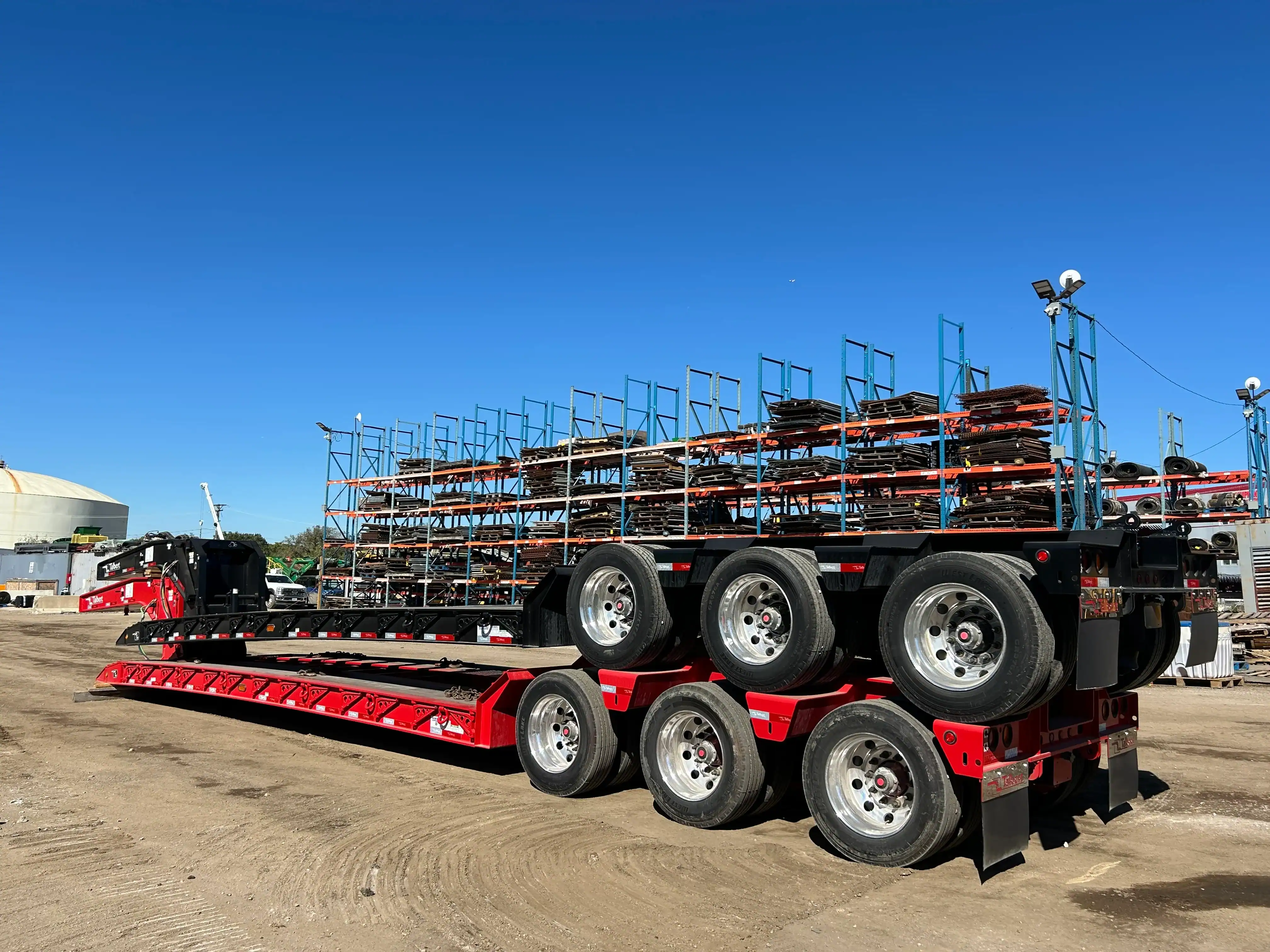
Frequently Asked Questions
What payload capacity does a heavy duty semi trailer typically offer?
A heavy duty semi trailer typically carries 50 to 120 tons, with common configurations falling into three bands: 50–60 tons for 3-axle units, 70–85 tons for 4- to 5-axle configurations, and 100–120 tons for specialized multi-axle or modular designs .
The payload rating is not a single number but a function of axle count, axle rating, tire capacity, and frame design. A 3-axle heavy duty flatbed or fence trailer with 13-ton or 16-ton axles commonly lists a 60-ton payload . A 4-axle lowbed can reach 70,000 to 80,000 kg, and a 5-axle air suspension configuration can list up to 85,000 kg . Modular heavy haulage trailers extend beyond these ranges by adding axle lines, with platform lengths up to 18 meters and extensible designs reaching approximately 30 meters after splicing . The data plate rating is a ceiling; the legal payload on any route is governed by axle load limits and gross combination weight regulations.
What axle brands and ratings are used on heavy duty semi trailers?
The most commonly specified heavy duty axle brands are FUWA and BPW, with axle ratings typically ranging from 13 tons to 16 tons per axle . These are the two names a buyer will encounter most often in Chinese-manufactured heavy duty trailers, and both are supported by global parts networks.
Axle selection should follow the payload and duty cycle, not a default preference. A 60-ton 3-axle trailer with 13-ton axles has limited margin for uneven load distribution; specifying 16-ton axles provides additional reserve for mining and quarrying applications where loads are rarely perfectly balanced . BPW axles are frequently paired with European brake systems such as KNORR-BREMSE with EBS, while FUWA axles are commonly specified with WABCO or domestic brake systems . The axle brand and rating should be confirmed on the specification sheet, not inferred from the trailer’s marketing description.
What frame and steel specifications should I verify?
Verify the main beam height, flange thickness, and steel grade, because these determine the trailer’s bending and fatigue resistance under repeated heavy loads. A common heavy duty specification uses Q345B high-strength steel with a 500 mm main beam height, a 14 mm top flange, and a 16 mm bottom flange .
The steel grade matters as much as the dimensions. Some manufacturers use S690 high-strength steel for the frame, which offers higher yield strength than Q345B and allows a lighter frame for the same load capacity . A heavier flange on a lower-grade steel may provide equivalent static strength but different fatigue behavior under cyclic loading. Buyers should request the steel grade and the main beam dimensions in writing, and should confirm that the frame construction matches the intended duty cycle—a trailer rated for 60 tons in highway service may not have the fatigue margin for continuous mining haul cycles.
What is the difference between mechanical and air suspension on a heavy duty trailer?
Mechanical leaf-spring suspension is simpler, more durable in rough terrain, and easier to repair in regions with limited service infrastructure. Air suspension offers better load distribution, adjustable ride height, and reduced shock loads on the cargo and frame, but requires more complex maintenance and a supply of air system components.
The choice should follow the operating environment and cargo sensitivity. A heavy duty trailer operating on unimproved mine roads or construction sites benefits from the simplicity and impact tolerance of mechanical suspension with multi-leaf springs . A trailer carrying sensitive machinery or operating on paved routes where load distribution and ride quality matter may justify air suspension, particularly with EBS integration . A third option—bogie or steering suspension—is used on modular heavy haulage trailers where axle steering is required to maneuver long combinations through constrained sites . The suspension type should be specified for the route conditions, not selected on the basis of a generic “heavy duty” label.
What brake system specifications matter on a heavy duty semi trailer?
Verify the brake chamber size, brake system brand, and whether EBS or ABS is fitted, because a heavy duty trailer’s braking performance depends on the system’s ability to deliver adequate pressure to every chamber under load. A typical heavy duty specification uses T30/30 spring brake chambers with a 45L air tank, and some configurations pair KNORR-BREMSE EBS with ABS sensors on multiple axles .
The brake system should be matched to the trailer’s gross weight and the tractor’s air supply capacity. A trailer with a larger air tank and higher-capacity chambers requires the tractor to deliver sufficient air volume to refill the system within the brake release cycle. For fleets operating mixed tractor and trailer combinations, confirming that the tractor’s air compressor output is adequate for the trailer’s brake system is a specification check that is often overlooked. EBS provides diagnostic capability and load-proportional braking, but it also requires diagnostic tools and trained technicians when faults occur.
What warranty coverage is typical for a heavy duty semi trailer?
Typical heavy duty semi trailer warranty structures separate the main beam from the body structure and bought-in components. One manufacturer’s published policy offers a ten-year warranty on the main beam and a twelve-month warranty on body structure and welded joints, with axles, braking systems, and hydraulic cylinders covered by their original manufacturers’ terms .
Another manufacturer offers a one-year global warranty on the main beam and structural integrity, with supported after-sales service for wearing parts . The difference between these two positions illustrates why the warranty terms must be read rather than assumed. Buyers should confirm which entity performs warranty repairs in their region, what documentation is required for a claim, and whether labor is covered. Consumables such as tires, brake linings, and seals are typically excluded, as are damages from overloading or lack of maintenance .
What should I verify before accepting delivery of a heavy duty semi trailer?
Before accepting delivery, verify that the data plate matches the ordered specification, the frame dimensions and steel grade are as specified, the axle and suspension brands are correct, and the brake system is complete and functional. A delivery inspection is the buyer’s only opportunity to catch a substitution before the trailer enters service.
The inspection should confirm the main beam height and flange thickness with a tape measure, check the axle nameplates against the purchase order, and verify that the suspension type matches the specification . The brake chambers, air tanks, and valves should be inspected for correct installation and absence of leaks. The kingpin size and landing gear capacity should be confirmed—common specifications are a 2-inch or 3.5-inch kingpin and a 25-ton landing gear capacity . Any discrepancy between the delivered unit and the specification should be documented and resolved before the trailer is accepted.
Conclusion
Heavy duty semi trailer procurement comes down to verifying four things that the “heavy duty” label does not guarantee: the axle brand and rating, the frame steel grade and main beam dimensions, the suspension type matched to the route, and the brake system’s capacity to match the trailer’s gross weight. Payload ratings from 50 to 120 tons describe a category, not a specification, and two trailers with the same nominal rating can differ substantially in the components that determine service life. The trailer data plate, the manufacturer’s specification sheet, and a pre-delivery inspection are the controlling references for any purchase.