

Overview
The “semi trailer tail” is not a single component. In fleet and procurement language, the term refers to three distinct things at the rear of a trailer: the rear impact guard (the underride protection bar required by federal safety standards), the trailer tail fairing (the aerodynamic panels that fold out from the rear doors to reduce drag), and the tail light assembly (the lamps and reflectors that satisfy lighting regulations). Each has its own specification, compliance requirement, and maintenance priority.
For fleet managers and procurement teams, confusing these three items leads to two common errors: ordering a trailer without verifying the rear impact guard’s certification, and assuming that a trailer tail fairing contributes to safety compliance when it does not. This FAQ addresses the dimensions, regulations, and operational considerations for each element of the semi trailer tail.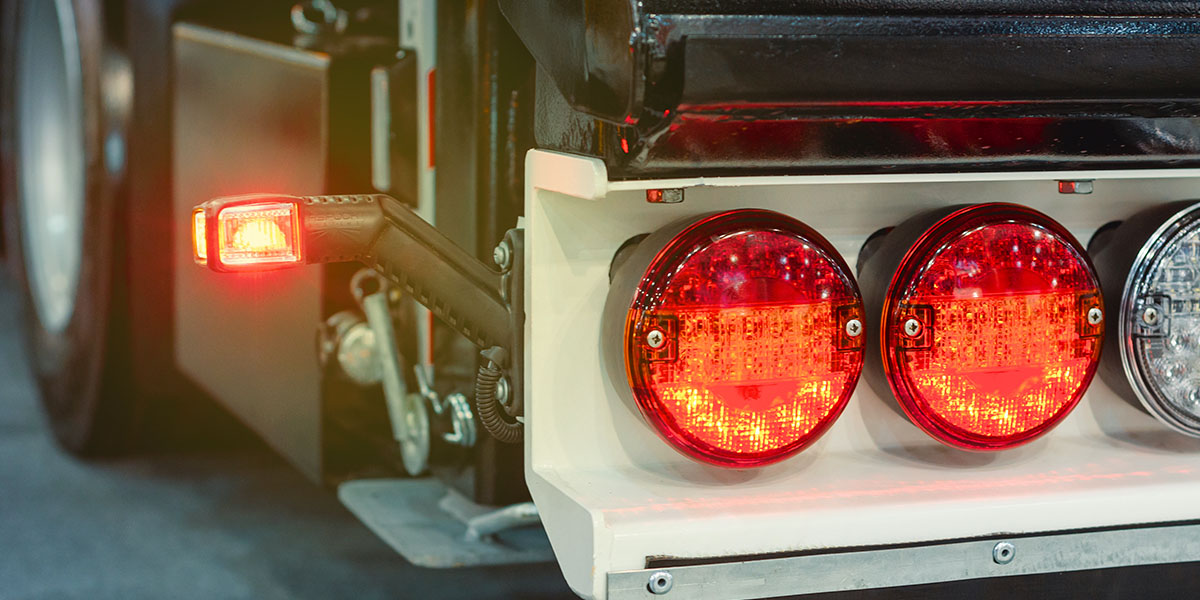
Frequently Asked Questions
What is the FMVSS 223 rear impact guard requirement for a semi trailer?
A rear impact guard on a semi trailer with a GVWR of 4,536 kg (10,000 lb) or more, manufactured on or after January 26, 1998, must meet FMVSS No. 223 and the installed vehicle must meet FMVSS No. 224 . The guard is the primary underride protection device at the trailer’s rear.
The dimensional requirements are specific. The outermost surfaces of the horizontal member must extend to within 100 mm (4 inches) of the trailer’s side extremities, and must not extend beyond them. The bottom edge of the horizontal member must not exceed 560 mm (22 inches) above the ground at any point across its width. The horizontal member must have a cross-sectional vertical height of at least 100 mm (3.94 inches) . A guard that does not meet these dimensions is non-compliant regardless of its apparent strength.
Where is the certification label on a semi trailer rear impact guard?
Every compliant rear impact guard must carry a permanent label on the forward or rearward facing surface of the horizontal member, placed so it does not interfere with the required retroreflective sheeting and remains accessible for visual inspection . The label must include the guard manufacturer’s name and address, the statement “Manufactured in ___” with the month and year, and the letters “DOT” certifying conformity with FMVSS No. 223 .
The label is the fleet’s verification document. A used trailer with a missing or unreadable guard label cannot be confirmed as compliant without further inspection, and a replacement guard without the DOT marking is not a legal substitute. Procurement teams should check the label during the pre-purchase inspection and record it in the maintenance file.
What is a trailer tail fairing and how much fuel does it save?
A trailer tail—also called a boat tail or rear fairing—is a set of collapsible panels mounted to the rear of the trailer that fold out to create a tapered shape, reducing the low-pressure wake and aerodynamic drag behind the trailer . The panels fold back against the doors when the driver needs to open them at a loading dock .
Fuel savings vary by device and operating conditions. Stemco’s TrailerTail is claimed to increase fuel efficiency by an average of 5.5 percent, with fleet users reporting gains of 0.25 to 0.4 miles per gallon . Independent sources describe trailer tails alone achieving 1 to 5 percent fuel savings, with combined skirt and tail installations demonstrating up to 9 percent improvement . The savings are speed-dependent, with the benefit most significant at highway speeds of 60 to 65 mph .
Do trailer tail fairings affect legal trailer length?
Trailer tail fairings can affect legal length, and the rules vary by jurisdiction. The TrailerTail adds approximately four feet to the trailer’s overall length when deployed, which made it illegal in all Canadian provinces at the time of its introduction, while the United States granted an exemption for aerodynamic extensions of up to five feet .
For fleets operating cross-border or in multiple jurisdictions, the fairing’s deployed length should be checked against the applicable length regulations. A trailer that is legal in one market with the fairing deployed may require the fairing to be stowed in another. This is a procurement specification item, not an afterthought—the trailer’s data plate length does not account for the fairing.
What rear lighting does a semi trailer tail require?
A semi trailer must have at least two tail lamps, two stop lamps, two turn signals, two clearance lamps, and two reflectors, one of each type at each side of the rear . If the trailer is 80 inches or more in overall width, it must also have three identification lamps on the rear .
The lamps must be mounted at the correct height and spacing to satisfy FMVSS 108. A common inspection failure is a trailer that has all the required lamps but one is burned out or the wiring has corroded, which is why the rear lighting circuit should be tested at every pre-trip inspection. The tail light assembly is also the first component damaged in a rear-end collision or a dock impact, making it a frequent replacement item.
What should I inspect on the semi trailer tail before buying a used trailer?
Inspect the rear impact guard for certification label and structural condition, the tail lights for function and corrosion, and the rear frame posts and rear bolster for cracks or deformation . The rear of the trailer absorbs dock impacts, loading equipment contact, and road debris, and the structural damage is often hidden behind the guard or the light bar.
The inspection should cover:
-
Rear impact guard: Confirm the DOT label is present and legible, check the horizontal member for bends or cracks at the post attachments, and verify the guard height against the 22-inch limit.
-
Rear frame: Check the rear frame posts and the rear bolster (the transverse member at the bottom rear edge) for cracks, corrosion, and deformation from dock strikes .
-
Lighting: Test every rear lamp function and inspect the connectors for corrosion. A lamp that works intermittently is a roadside violation risk.
-
Trailer tail fairing (if fitted): Check the hinge mechanism and panel condition. A fairing that does not deploy or stow properly is a fuel-efficiency loss and a potential damage source.
What maintenance does a trailer tail fairing require?
A trailer tail fairing requires periodic inspection of the hinge mechanism, panel condition, and mounting hardware. The fairing is exposed to road spray, vibration, and the flexing of every deployment and stow cycle, and a panel that separates at highway speed becomes a road hazard.
The maintenance routine should confirm that the panels deploy fully and stow securely against the doors, that the hinges move freely without excessive play, and that the mounting brackets are tight and free of cracks. For fleets operating in winter-salt regions, the hinge points should be lubricated and the panels cleaned to prevent corrosion from seizing the mechanism. A fairing that is damaged in a dock impact should be repaired or removed rather than left in a partially attached condition.
Conclusion
The semi trailer tail comprises three distinct systems that are often conflated: the FMVSS 223 rear impact guard with its specific height, width, and labeling requirements; the trailer tail fairing that delivers 1 to 5 percent fuel savings at highway speed but may affect legal length; and the rear lighting assembly that must satisfy FMVSS 108. Procurement and maintenance decisions should address each separately—verifying the guard’s certification label, confirming the fairing’s length compliance in every jurisdiction, and testing the rear lamps at every inspection. The guard manufacturer’s label, the fairing manufacturer’s installation instructions, and the applicable FMVSS standards remain the controlling references for every trailer.