

Overview
Semi trailer sizes are defined by three dimensions—length, width, and height—plus the payload capacity and axle configuration that determine what the trailer can legally carry. For procurement managers and fleet operators, the problem is that “standard” semi trailer size varies by region, trailer type, and regulatory jurisdiction, and a specification that works for one route or cargo profile may be non-compliant or uneconomical for another.
This FAQ addresses the size questions that matter most in a purchase or fleet deployment decision. It distinguishes between typical industry ranges and the regulatory or manufacturer specifications that control the final choice.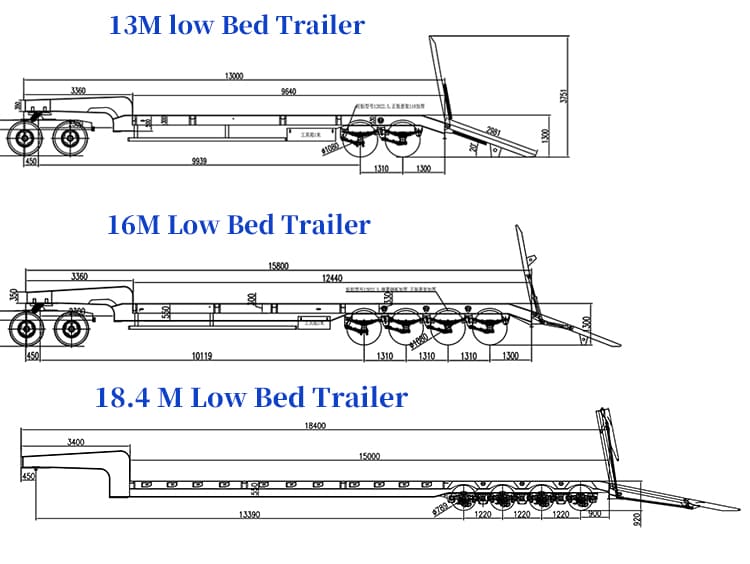
Frequently Asked Questions
What are the standard dimensions of a semi trailer?
The most common semi trailer dimensions in the United States are 53 feet long, 102 inches wide, and approximately 9 to 13.6 feet high, while the European standard is generally 13.6 meters long and 2.55 meters wide. These figures describe the dominant dry van and curtain-side specifications in each market.
Length and width are regulated dimensions with jurisdiction-specific limits, while height is constrained by bridge clearances and axle load distribution. A trailer’s actual dimensions should always be confirmed against its data plate and the manufacturer’s specification sheet. For specialized trailer types—flatbed, lowbed, tank, or car carrier—the length and height ranges differ substantially from the dry van baseline.
How long is a standard semi trailer?
The standard semi trailer length is 53 feet in the United States and 13.6 meters in the European Union. U.S. federal law prohibits states from imposing a semi trailer length limit below 48 feet on the Interstate System, but 53 feet has become the prevailing specification because it maximizes pallet capacity for typical freight.
Individual states may set higher limits or impose axle-spacing restrictions that affect the usable length. Fleets operating across multiple states should verify the kingpin-to-rear-axle distance limit for each jurisdiction, not just the overall trailer length. A trailer that is legal in total length may still violate axle spacing rules in some states.
What is the typical payload capacity of a semi trailer?
Payload capacity ranges from approximately 20 to 60 tons depending on trailer type, axle count, and regional weight regulations, with a standard 3-axle flatbed or dropside semi trailer typically rated for 40,000 to 60,000 kg. Van trailers generally carry lower payloads than flatbeds of similar length because the enclosed body adds tare weight.
Payload is governed by the lowest of three limits: the trailer’s rated capacity, the tractor’s gross combination weight rating, and the legal axle load limits on the operating routes. A trailer rated for 60 tonnes may legally carry far less if the destination jurisdiction restricts axle weights. Buyers should use the trailer data plate rating as a ceiling, not as a guarantee of legal payload.
How wide and tall is a semi trailer?
The standard semi trailer width is 102 inches (8.5 feet) in the United States and 2.55 meters in the European Union, while typical exterior height ranges from roughly 9 to 13.6 feet depending on the trailer type and suspension setting. Height is constrained more by bridge clearances and loading dock compatibility than by a single national standard.
Width limits vary by jurisdiction, and trailers exceeding the applicable maximum require oversize permits. Height is not uniformly regulated but is limited by the practical clearance of the routes served. For high-cube or specialized trailers, the exterior height may exceed the typical range, and route surveys are necessary before deployment.
What axle configurations are available for semi trailers?
Common semi trailer axle configurations are 2-axle, 3-axle, and 4-axle, with 3 axles being the most widely specified for general freight and container hauling. A 3-axle configuration distributes load more effectively than a 2-axle unit and offers a practical balance between payload capacity and maneuverability.
Axle count should follow the cargo profile rather than a default preference. Fleets routinely carrying loads above 60 tonnes should specify a 4-axle or 5-axle configuration for adequate load margin. The axle spacing and the distance from the kingpin to the rear axle group also affect turning behavior and regulatory compliance, and should be confirmed against the target jurisdiction’s rules.
What trailer type is best for my cargo?
The appropriate semi trailer type depends on the cargo’s physical form, loading method, and protection requirements. The main categories and their typical applications are:
-
Flatbed: Open deck for containers, steel, machinery, and oversized cargo that cannot be enclosed.
-
Van/Dry Box: Fully enclosed for general freight and palletized goods requiring weather protection.
-
Dropside/Side Wall: Removable or openable sides for building materials, steel, and bulk cargo loaded by crane or manual handling.
-
Tank: Cylindrical or elliptical vessel for liquids, powders, and hazardous materials.
-
Lowbed: Ultra-low platform for heavy machinery, wind components, and oversized loads, with payloads up to 100 tons in specialized configurations.
Selecting the wrong type creates either underutilized capacity or a cargo that cannot be loaded efficiently. Procurement teams should map the freight mix over the trailer’s expected service life, not just the first contract.
What size trailer should I specify for container transport?
A 40-foot container-capable semi trailer typically measures around 12.4 to 13 meters long and is equipped with twist locks for one 40-foot or two 20-foot containers. The twist lock layout is a critical specification detail: a trailer configured for 40-foot containers may not accept two 20-foot units unless the central locks are positioned correctly.
Fleets engaged in port drayage or intermodal transport should confirm the container sizes the trailer is designed to accept and whether the locks are retractable for flat cargo operation. Deck height also matters for terminal compatibility, as some ports and loading ramps impose height restrictions that affect which trailer specification can be used.
Conclusion
Semi trailer sizes come down to three regulated dimensions—length, width, and axle spacing—plus the payload rating and axle configuration that determine legal capacity. The 53-foot U.S. and 13.6-meter EU lengths are the default baselines for dry freight, but specialized trailer types and cross-border operations require checking each jurisdiction’s limits independently. Procurement decisions should start from the cargo profile and the operating network, not from a generic size chart, and should confirm every dimension against the trailer data plate and current regulations.