

Introduction
Semi trailer parking is a deceptively simple operation that accounts for a disproportionate share of preventable trailer damage and workplace incidents. An uncoupled trailer rests on two landing gear legs and its rear axle group—a stable configuration only when the ground is level and firm, the landing gear is properly deployed, and the parking brake is applied. When any of these conditions fails, the consequences range from bent landing gear legs to uncontrolled trailer movement and serious injury.
For terminal managers, fleet operators, and safety officers, parking is not a passive activity. It is a procedure with defined steps, a site design problem with measurable dimensions, and a maintenance exposure that compounds with every coupling cycle. Trailers parked on soft ground sink. Trailers parked with air suspension deflated may drift as the suspension loses pressure, imposing lateral forces on landing gear that the legs were never designed to withstand . Trailers parked without wheel chocks on even a slight grade can roll if the parking brake releases or fails.
This guide examines the engineering and operational factors that determine safe, efficient semi trailer parking: uncoupling procedure, landing gear and ground interaction, site layout dimensions, and the maintenance practices that protect both equipment and personnel.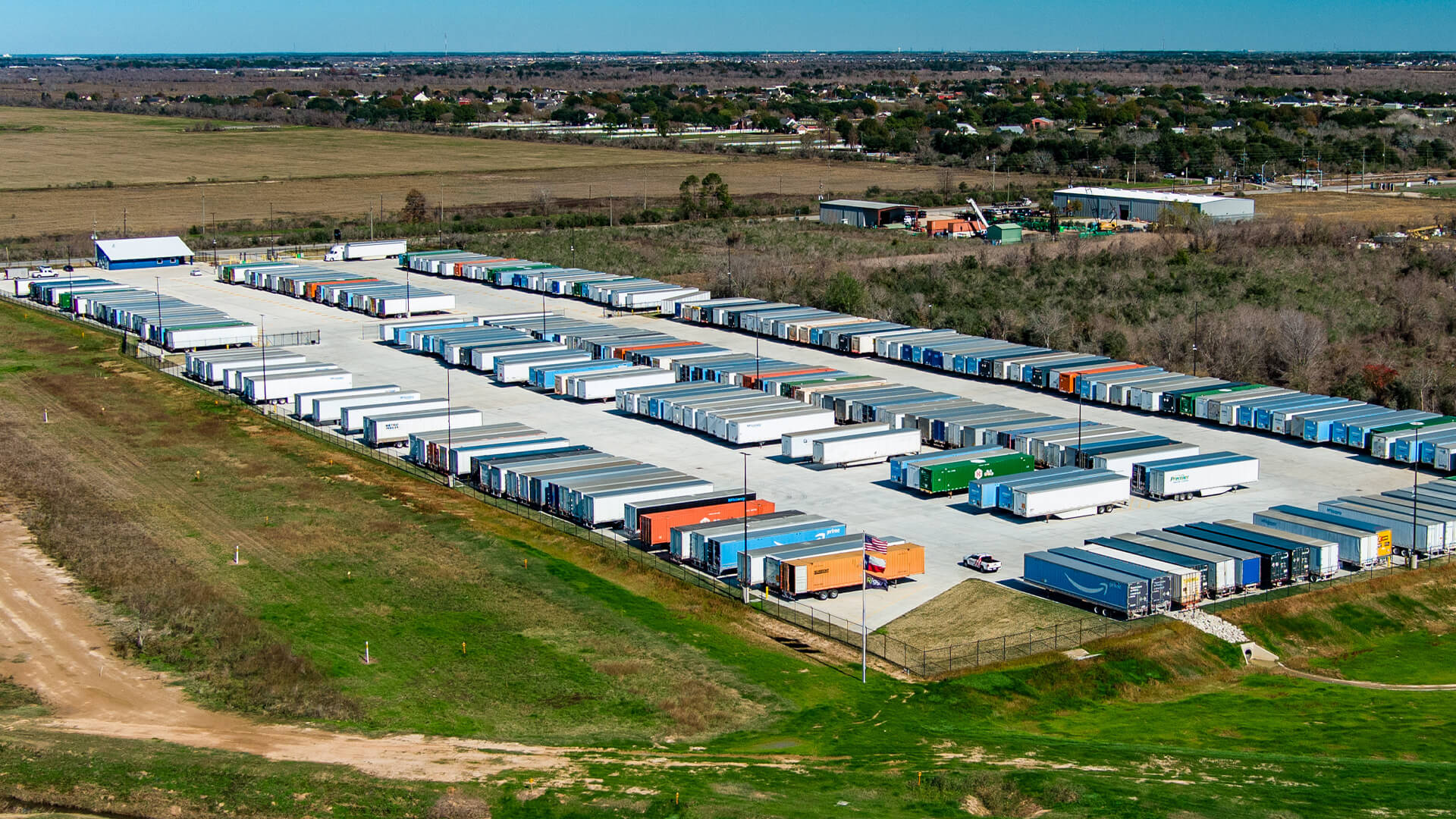
Core Powertrain and Structural Design
Landing Gear and Ground Interaction
The landing gear is the primary support structure for an uncoupled semi trailer. It consists of two telescoping legs mounted to the trailer frame, connected by a cross shaft and operated by a hand crank or, on some configurations, a hydraulic or pneumatic system. The legs must support the trailer’s nose weight—typically 10–15 tonnes for a loaded trailer—while remaining stable against lateral forces.
Ground condition is the critical variable. A firm, level surface is essential for both landing legs to share load equally . On soft ground, one leg may sink, transferring load to the other and causing bending or fracture. JOST, a landing gear manufacturer, notes that paved surfaces are essential for proper function of drift-compensating landing gear feet, and that sand-shoe variants are available for unpaved surfaces where sinking is a risk . For any trailer parked on an unpaved surface, the ground bearing capacity should be verified before uncoupling, and load-spreading pads should be used under the landing gear feet if there is any doubt.
Air suspension interaction is a frequently overlooked hazard. When a semi trailer with air suspension stands for an extended period, air loss from the suspension system causes the rear of the trailer to sink. This angular movement forces the trailer to drift in the direction of travel if the brakes are applied, imposing lateral force on the landing gear that can bend the legs . The practical mitigation is to lower the air suspension before leaving the trailer for extended periods, as recommended in uncoupling best practice guidance . This reduces the height from which the trailer can settle and minimizes the angular drift.
Parking Brake and Wheel Chock Systems
The spring brake parking system on a semi trailer is designed to apply automatically when the emergency air line is disconnected. This fail-safe design means that a trailer disconnected from its tractor should have its parking brake engaged by default. However, the system is not infallible. Kässbohrer’s operating manual warns that the operating brake may slacken after some time, allowing the trailer to perform uncontrolled movements, and that parked trailers must be secured with the parking brake and wheel chocks .
The procedure for uncoupling reinforces this. Best practice guidance from the Institution of Occupational Safety and Health (IOSH) states that the trailer parking brake must always be applied before uncoupling from the prime mover, and that if the trailer moves during uncoupling, the emergency air line (red) should be disconnected immediately and the parking brake checked . Wheel chocks provide the secondary restraint that protects against brake system failure or release. They should be positioned before the parking brake is released during any coupling or uncoupling operation, and removed only after the trailer is securely coupled or the parking brake is confirmed engaged .
Site Layout and Maneuvering Geometry
Semi trailer parking site design must accommodate the swept path of a tractor-trailer combination during entry and exit. The Federal Highway Administration’s truck parking development guidance uses the WB-67 design vehicle—a 74-foot (22.6 m) tractor-trailer—as the standard for site layout. At a 45-degree herringbone angle with 20-foot (6.1 m) slot width, the swept path requires approximately 62 feet (18.9 m) of clearance to enter or exit a slot without striking an adjacent vehicle .
Slot density varies with configuration. A 74-foot slot at 45 degrees with 20-foot width yields approximately 13.5 trucks per acre. A straight back-in configuration with 12-foot slot width roughly doubles density to 26.7 trucks per acre, but is not optimal for all parking areas because it requires more maneuvering space and time per vehicle . For fleet terminals where drivers park their own trailers, the herringbone layout reduces backing and improves throughput. For long-term storage or drop yards, higher-density straight configurations may be acceptable if adequate aisle width is maintained.
Pedestrian safety is a design requirement, not an afterthought. FHWA guidance recommends a clearly striped walkway along the noses of parked tractors, minimum 6 feet (1.8 m) wide, allowing drivers to move between the tractor and the facility without walking in traffic lanes .
Technical Specifications
The table below presents representative parameters for semi trailer parking operations and site design. Values are drawn from published guidance and manufacturer recommendations; actual requirements vary with trailer configuration, site conditions, and local regulations.
Comparative Advantages TCO and ROI
The alternative to a designed semi trailer parking facility is ad hoc parking—trailers dropped wherever space permits, often on unpaved ground or in unmarked areas. The acquisition cost of the latter is zero, but the operational cost is hidden in equipment damage, safety incidents, and inefficiency.
Landing gear damage is the most direct cost of poor parking. A bent landing leg from uneven ground or trailer drift typically requires replacement of the leg assembly or, in severe cases, structural repair to the trailer frame. The repair cost is measurable, but the downtime cost—a trailer out of service during repair—often exceeds it. A fleet that parks 50 trailers regularly on soft ground can expect a predictable rate of landing gear failures that a paved, level parking area would largely eliminate.
Site development costs for a dedicated parking area vary widely by region, land cost, and drainage requirements. A basic paved lot with marked slots, drainage, and lighting is a capital investment, but it reduces per-trailer maintenance exposure and improves driver safety. The payback calculation depends on fleet size and current damage rate. A fleet experiencing five landing gear repairs per year at 3,000 CNY each, plus associated downtime, could justify a significant portion of a parking area upgrade through damage reduction alone.
Safety incident costs are harder to quantify but more consequential. A trailer that rolls in a yard can strike personnel, other trailers, or structures. The regulatory and liability exposure from a preventable incident dwarfs the cost of proper chocking and ground preparation.
Heavy Duty Application Scenarios
-
Fleet terminal and depot parking: High-frequency coupling and uncoupling requires durable, level, paved surfaces and clearly marked slots. Herringbone layouts reduce backing and improve throughput. Pedestrian walkways separate drivers from moving equipment. Landing gear inspection should be part of routine yard checks.
-
Drop yards and trailer storage: Trailers parked for extended periods face air suspension deflation and potential drift. Deflating suspension before leaving and chocking wheels are essential. Ground condition should be verified before dropping, particularly in unpaved storage areas.
-
Port and container terminal parking: High-density stacking and rapid turnover demand straight back-in or pull-through configurations with adequate aisle width. The risk of trailer damage from tight maneuvering is elevated, and landing gear and kingpin inspection should be frequent.
-
Construction site and temporary parking: Unpaved surfaces are common, and landing gear sinking is a primary risk. Load-spreading pads under landing gear feet and avoidance of soft spots are minimum precautions. Trailers should not be left on grades without chocking, even if the parking brake is applied.
Selection and Maintenance Considerations
Safe semi trailer parking is a procedure with defined steps, not an informal habit. The uncoupling sequence should be standardized and trained:
-
Position the trailer on firm, level ground. Verify that both landing gear legs will contact a supporting surface .
-
Apply the trailer parking brake before uncoupling. The spring brake should engage automatically when the air line is disconnected, but verify that it has applied .
-
Lower the landing gear until firm contact is made with the ground, then shift to low gear for final lifting if additional height is needed .
-
Disconnect the air lines and electrical cable, starting with the emergency (red) line. Listen for the parking brake application.
-
Deflate air suspension if the trailer will be parked for an extended period .
-
Position wheel chocks before releasing the tractor brakes and pulling away.
-
Check for landing gear sinking after uncoupling and periodically during storage. If a leg is sinking, reposition the trailer or add load-spreading support.
Maintenance considerations include:
-
Landing gear lubrication and inspection. Grease nipples on the landing gear legs should be serviced at manufacturer intervals. Worn or bent legs should be replaced before they fail under load .
-
Parking brake function check. The spring brake should be tested periodically to confirm it applies and holds. A brake that releases slowly or fails to hold indicates a chamber or valve issue.
-
Wheel chock condition and availability. Chocks should be stored on the trailer or at the parking location and inspected for damage. Missing chocks are a common finding in yard audits.
Conclusion
Semi trailer parking is a safety-critical operation that rewards procedure discipline and site design investment. The engineering fundamentals are straightforward: park on firm, level ground; apply the parking brake and verify its engagement; chock the wheels; and deflate air suspension for extended storage. The site design fundamentals are equally clear: provide adequate slot dimensions for the design vehicle, separate pedestrian and vehicle traffic, and maintain paved or load-bearing surfaces that support landing gear without sinking.
Commercially, the cost of poor parking is borne in landing gear repairs, trailer downtime, and safety incidents. These costs are largely preventable through standardized uncoupling procedures, driver training, and modest site improvements. Fleets and terminals that treat parking as a designed process rather than an afterthought achieve lower equipment damage rates and safer operations. The investment in procedure and pavement is small relative to the cost of a single uncontrolled trailer movement or a bent landing leg on a revenue-generating asset.