

Introduction
The commercial trucking industry depends on specialized semi-trailers for transporting construction materials, machinery, agricultural products, fuel, and general freight. These full-size vehicles feature different frame configurations, axle arrangements, suspension systems, cargo bodies, and coupling designs. Semi trailer scale models reproduce these transportation vehicles in miniature form, allowing collectors and industry enthusiasts to examine recognizable trailer designs without the space and cost required for full-size equipment.
A semi trailer scale model is a miniature replica built to a defined proportional relationship with a real trailer. Common formats include diecast metal models, plastic construction kits, resin replicas, and custom-built display models. Depending on the manufacturer and scale, a model may reproduce details such as landing gear, kingpins, axles, wheels, side guards, cargo compartments, and surface markings.
These models serve several purposes:
-
Collecting: Building collections of miniature commercial vehicles and specialized trailers.
-
Display: Decorating offices, showrooms, workshops, and private collections.
-
Education: Demonstrating trailer configurations, transportation equipment, and vehicle design.
-
Brand promotion: Presenting miniature replicas of commercial vehicles at exhibitions and industry events.
-
Model building: Supporting customization, painting, detailing, and transportation-themed dioramas.
For buyers, the main selection factors are scale accuracy, construction materials, trailer type, level of detail, compatibility with tractor models, and overall manufacturing quality.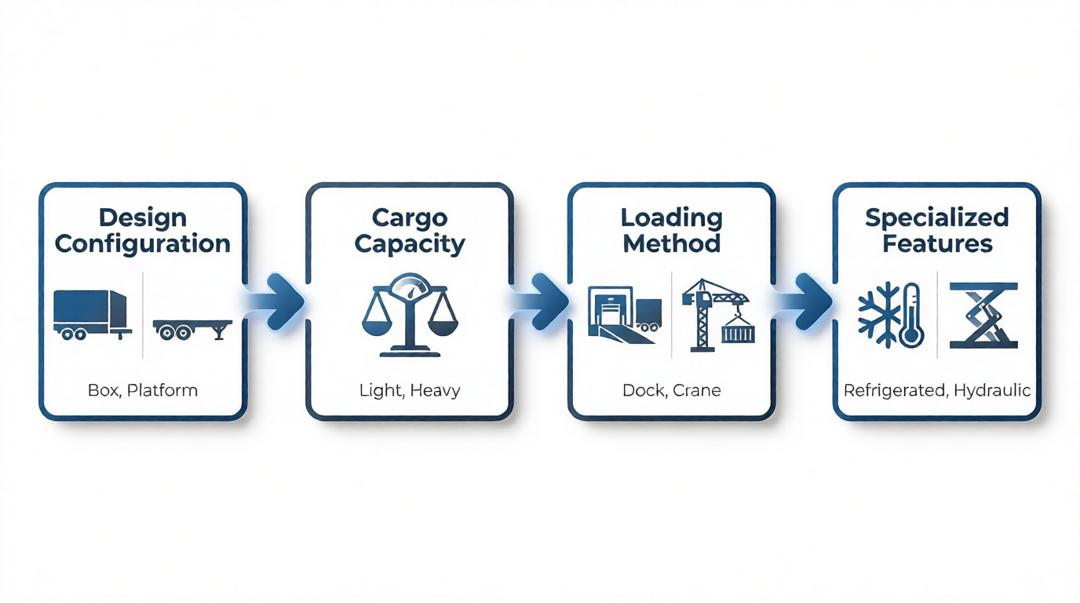
Core Powertrain and Structural Design
A semi trailer is not a powered vehicle, so its scale model does not normally contain an independent engine or transmission. Instead, the model's design focuses on reproducing the trailer's structural components, running gear, coupling geometry, and external features.
Trailer Frame and Structural Layout
The chassis is the primary structural foundation of a full-size semi-trailer. It supports the cargo body and transfers loads through the suspension and axle assemblies to the road.
A scale model may reproduce the following structural features:
-
Main longitudinal chassis rails.
-
Crossmembers and frame reinforcement.
-
Kingpin and fifth-wheel coupling area.
-
Landing gear and support legs.
-
Rear underride protection.
-
Side guards and protective rails.
-
Rear bumper and lighting details.
The level of structural detail depends on the model's scale and intended market. Higher-detail collector models may include separately molded or assembled components, while simpler toys may use a more basic chassis representation.
Axles, Wheels, and Suspension
Axle configuration is one of the most recognizable features of a semi-trailer. Depending on the full-size trailer design, models may reproduce single-axle, tandem-axle, or multi-axle arrangements.
Important details include:
-
Number and position of axles.
-
Wheel and tire proportions.
-
Hub and rim appearance.
-
Suspension components.
-
Mudguards and wheel covers.
-
Tire tread and sidewall detailing.
Some premium models feature rolling wheels and movable axle components. Others use fixed assemblies designed primarily for display.
Axle accuracy is particularly important when reproducing specialized trailers, such as lowbed equipment carriers, heavy-duty flatbeds, and multi-axle transport trailers.
Trailer Body and Cargo Configuration
The trailer body determines the model's overall appearance and identifies its transportation function.
Common semi-trailer scale model categories include:
-
Flatbed trailers: Open platforms used for general cargo, steel products, timber, and machinery.
-
Lowbed trailers: Specialized trailers with a low loading deck for transporting heavy equipment.
-
Box trailers: Enclosed cargo bodies designed to protect freight.
-
Refrigerated trailers: Insulated bodies with a recognizable refrigeration unit at the front.
-
Tanker trailers: Cylindrical or compartmentalized tanks used for liquid transportation.
-
Dump trailers: Tipping bodies designed for bulk materials.
-
Curtain-side trailers: Flexible side curtains that provide access to cargo.
-
Container chassis: Trailer frames designed to carry shipping containers.
Accurate body proportions and recognizable external equipment are essential to producing a convincing miniature replica.
Coupling and Landing Gear Details
The kingpin is the connection point that engages with the fifth wheel on a tractor unit. In a scale model, this feature determines whether the trailer can connect realistically to a compatible miniature tractor.
Landing gear supports the front of a detached semi-trailer. Depending on model quality, the landing gear may be fixed, adjustable, or represented by simplified molded parts.
Collectors who want to display complete tractor-trailer combinations should check the coupling height, kingpin position, fifth-wheel compatibility, and overall proportions before purchasing.
Materials and Manufacturing Quality
The materials used in semi trailer scale models influence their appearance, weight, durability, and price.
Common materials include:
-
Diecast metal: Often used for durable collector models with substantial weight and molded structural details.
-
ABS plastic: Provides a lightweight material suitable for detailed molded components and complex shapes.
-
Resin: Frequently used for specialized or limited-production replicas requiring detailed body shapes.
-
Mixed materials: Combine metal chassis sections with plastic accessories, tires, and external components.
Material quality should be evaluated together with manufacturing precision. A metal model is not automatically more accurate than a plastic or resin alternative.
Surface Finishing and Exterior Details
Paint finish, decals, printed markings, and small accessories contribute significantly to the visual quality of a scale model.
Important finishing details include:
-
Consistent paint coverage.
-
Cleanly applied decals.
-
Accurate trailer proportions.
-
Realistic lighting and reflective markings.
-
Correct wheel and tire appearance.
-
Properly aligned body panels.
-
Neat connections between separate components.
For branded replicas, buyers should also consider licensing and the accuracy of the reproduced logos and vehicle markings.
Service Access and Maintainability
Scale models generally require limited maintenance compared with full-size commercial trailers. However, moving parts, delicate accessories, and exposed surfaces still require proper handling.
Models with detachable components may be easier to inspect and clean, but they can also contain small parts that are vulnerable to loss or breakage.
A practical design should balance detail with durability, especially for models intended for frequent handling rather than permanent display.
Technical Specifications
The technical specifications of semi trailer scale models are different from those of full-size commercial trailers. Instead of payload capacity, engine power, or braking performance, buyers should evaluate scale ratio, model dimensions, materials, weight, axle configuration, and component functionality.
Common scale ratios include 1:18, 1:24, 1:32, 1:43, 1:50, and 1:64. Availability varies by trailer type and manufacturer. A 1:50 model means that one unit of measurement on the miniature represents 50 units on the real vehicle.
|
Key Parameter |
Typical Technical Specification |
Operational Significance |
|---|---|---|
|
Scale ratio |
1:18, 1:24, 1:32, 1:43, 1:50, or 1:64 |
Determines model size and compatibility |
|
Main material |
Diecast metal, ABS plastic, resin, or mixed materials |
Influences weight, durability, and detail |
|
Trailer configuration |
Flatbed, lowbed, tanker, box, dump, or refrigerated |
Determines the model's application and appearance |
|
Axle arrangement |
Single, tandem, or multi-axle representation |
Affects structural accuracy |
|
Coupling design |
Fixed or compatible detachable connection |
Determines tractor-model compatibility |
|
Moving components |
Fixed, rolling, adjustable, or detachable parts |
Influences display and handling functionality |
|
Exterior finish |
Painted surfaces, decals, and printed markings |
Affects visual realism and collectible appeal |
|
Packaging |
Display box, protective case, or model kit packaging |
Influences storage and presentation |
Understanding Scale and Model Dimensions
Scale ratio is one of the most important purchasing specifications.
For example, if a real trailer is 13.6 meters long, its approximate model length would be:
-
1:18 scale: 75.6 cm.
-
1:24 scale: 56.7 cm.
-
1:32 scale: 42.5 cm.
-
1:43 scale: 31.6 cm.
-
1:50 scale: 27.2 cm.
-
1:64 scale: 21.3 cm.
These are illustrative calculations based on a 13.6-meter full-size trailer. Actual model dimensions depend on the real trailer's design and the manufacturer's interpretation.
Buyers should also check width and height rather than relying only on overall length. A tanker, lowbed, and refrigerated trailer may have significantly different proportions even when their lengths are similar.
Comparative Advantages TCO and ROI
Semi trailer scale models can be compared with other miniature transportation products based on realism, durability, display requirements, customization potential, and purchase cost.
Diecast Models Compared with Plastic Models
Diecast models commonly use metal components for the main body or chassis. They may provide a substantial feel and durable construction for regular display.
Plastic models offer flexibility in manufacturing and can reproduce complex shapes and small external details. They are also common in assembly kits and hobby products.
The most suitable option depends on the intended use:
|
Evaluation Factor |
Diecast Model |
Plastic Model |
|---|---|---|
|
Construction |
Metal components, sometimes mixed with plastic |
Primarily molded plastic |
|
Weight |
Generally heavier |
Generally lighter |
|
Detailing |
Depends on casting and finishing quality |
Can support fine molded details |
|
Customization |
May require more preparation for modification |
Often suitable for hobby modifications |
|
Handling |
Can feel substantial but may have delicate accessories |
Lightweight, with some parts vulnerable to breakage |
|
Typical use |
Collecting and display |
Display, kits, and customization |
Neither material guarantees superior accuracy. Buyers should assess the finished product rather than selecting solely by construction material.
Factory-Assembled Models Compared with Model Kits
Factory-assembled semi trailer models are suitable for buyers who want a ready-to-display product. Model kits require assembly and may involve painting, adhesive application, and detailed finishing.
Assembled models generally reduce preparation time. Kits provide greater opportunities for customization and hobby engagement.
For business displays, ready-made models may be more practical. For experienced hobbyists, kits can offer a more interactive building experience.
Total Cost of Ownership
The total cost of ownership of a scale model includes more than its initial purchase price.
Relevant costs include:
-
Initial model purchase.
-
Shipping and import expenses.
-
Display cases or protective packaging.
-
Cleaning and maintenance supplies.
-
Replacement parts, where available.
-
Repair or restoration expenses.
-
Storage and display requirements.
Limited-production models may have different resale prospects from mass-produced models, but future collectible value is uncertain. Buyers should not assume that a model will appreciate simply because it is marketed as a collectible.
ROI for Commercial and Promotional Use
For manufacturers, distributors, and transport businesses, semi trailer scale models may serve as promotional or presentation tools.
A miniature replica can help communicate trailer configurations at exhibitions, customer meetings, and showroom displays. Custom models may also support product demonstrations when showing full-size equipment is impractical.
A basic commercial ROI assessment should consider:
ROI = (Measurable commercial benefit − Total project cost) ÷ Total project cost × 100%
The calculation should use documented benefits, such as reduced display logistics costs or attributable promotional revenue. The initial purchase, customization, shipping, packaging, and replacement costs should all be included.
For private collectors, the main return may be enjoyment, collection completeness, and display value rather than financial income.
Heavy Duty Application Scenarios
Although semi trailer scale models are not working transport equipment, they reproduce the designs and configurations used throughout the commercial vehicle industry. Their applications extend beyond private collecting.
Commercial Trucking and Transportation Displays
Transport companies can use miniature semi-trailer models to represent different vehicle configurations.
Useful display categories include:
-
Flatbed trailers for general cargo transportation.
-
Lowbed trailers for heavy machinery transport.
-
Tanker trailers for liquid logistics.
-
Refrigerated trailers for temperature-controlled freight.
-
Container chassis for intermodal transportation.
A coordinated display of tractor units and compatible trailers can communicate the range of transportation services offered by a business.
Heavy Equipment Manufacturing and Sales
Manufacturers and distributors of construction equipment may use lowbed and flatbed scale models to demonstrate how machinery is transported.
These models can support presentations involving:
-
Excavators and wheel loaders.
-
Bulldozers and road construction equipment.
-
Agricultural machinery.
-
Industrial components.
-
Oversized equipment transportation.
The miniature trailer should have proportions and axle arrangements that reasonably represent the intended full-size transport application.
Logistics and Fleet Management Education
Scale models can be useful teaching aids for explaining basic commercial vehicle configurations.
For example, a training display may compare:
-
A standard flatbed trailer.
-
A lowbed equipment carrier.
-
A refrigerated trailer.
-
A multi-axle heavy-haul trailer.
These comparisons help illustrate differences in trailer body design, axle layout, coupling position, and cargo arrangement.
Exhibitions, Trade Shows, and Showrooms
Miniature semi-trailer replicas can provide an accessible way to present commercial vehicle products at trade events.
Potential uses include:
-
Product launch displays.
-
Dealer showroom decoration.
-
Transportation industry exhibitions.
-
Customer gift programs.
-
Corporate promotional collections.
Custom colors, company logos, and model configurations may make these products more relevant to a particular business.
Private Collecting and Model-Building Projects
Collectors often organize miniature trucks and trailers by manufacturer, trailer category, scale, or transportation application.
Common collection themes include:
-
European and North American commercial vehicles.
-
Heavy-haul and lowbed transportation.
-
Tanker and bulk-material trailers.
-
Construction equipment transport.
-
Classic and contemporary freight vehicles.
For model-building enthusiasts, trailer kits and customizable replicas also provide opportunities to create detailed miniature logistics scenes.
Selection and Maintenance Considerations
Choosing the right semi trailer scale model requires attention to scale, construction, trailer configuration, compatibility, and intended use.
Select the Appropriate Scale
Start by determining where and how the model will be displayed.
A larger scale generally provides more room for visible detail but requires more display space. Smaller scales allow collectors to build broader fleets within a limited area.
Consider the following:
-
Available shelf or display-case dimensions.
-
Compatibility with existing tractor models.
-
Desired level of visible detail.
-
Availability of the required trailer type.
-
Ease of transportation and storage.
Consistency is important for collections. A tractor and trailer with different scale ratios may look disproportionate even when their individual details are accurate.
Confirm Trailer Type and Configuration
Before purchasing, identify the full-size trailer design represented by the model.
Check:
-
Flatbed, tanker, lowbed, box, or other body type.
-
Number and position of axles.
-
Overall proportions.
-
Landing gear arrangement.
-
Coupling compatibility.
-
External accessories and markings.
For specialized replicas, compare the model with reference images of the real trailer configuration.
Evaluate Manufacturing Quality
Inspect product images and technical descriptions carefully.
Important quality indicators include:
-
Accurate proportions.
-
Clean casting or molding.
-
Securely attached components.
-
Consistent paint and decals.
-
Realistic tires and wheels.
-
Neat chassis construction.
-
Reliable packaging.
If the model is intended for frequent handling, prioritize robust assembly and fewer fragile external accessories.
Check Customization Options
Some manufacturers and model suppliers offer customization services, such as:
-
Company colors and logos.
-
Custom trailer markings.
-
Specific axle configurations.
-
Specialized cargo-body designs.
-
Personalized display packaging.
For corporate orders, request a design proof or sample before approving larger quantities. Confirm the minimum order quantity, production lead time, customization charges, and ownership of artwork or branding rights.
Establish Basic Maintenance Practices
Scale models require relatively simple maintenance, but regular care helps preserve their appearance.
Recommended practices include:
-
Use a soft brush or microfiber cloth to remove dust.
-
Avoid abrasive cleaners that may damage paint or decals.
-
Keep models away from prolonged direct sunlight.
-
Store them in a dry environment.
-
Avoid excessive handling of mirrors, landing gear, and other small accessories.
-
Keep original packaging for storage when practical.
-
Check detachable components periodically.
For models with rolling wheels or moving parts, avoid forcing components that are designed for static display.
Evaluate Supplier Reliability and After-Sales Support
Buyers purchasing individual models or commercial quantities should assess the supplier's product information and delivery arrangements.
Important questions include:
-
Does the supplier provide clear scale and dimension information?
-
Are material and construction details available?
-
Can the supplier provide actual product photographs?
-
Are custom colors and logos available?
-
Is protective packaging included?
-
Are replacement parts or repair options available?
-
What are the warranty and return conditions?
-
Can the supplier support repeat orders with consistent specifications?
For commercial projects, sample approval and packaging checks are particularly important because product consistency affects the final display.
Conclusion
Semi trailer scale models provide miniature representations of the commercial trailers used in freight transportation, heavy equipment logistics, industrial distribution, and specialized cargo operations. Their value depends on more than appearance: scale accuracy, trailer configuration, material quality, manufacturing precision, and compatibility with tractor models all influence the final product.
For collectors, the right model should match the desired scale, display space, and collection theme. For manufacturers and transportation businesses, miniature trailer replicas can support showroom presentation, customer communication, and promotional activities.
A careful purchasing decision should balance realistic detailing, construction quality, customization options, packaging, supplier reliability, and total ownership cost. By evaluating these factors, buyers can select semi trailer scale models that meet both display expectations and practical commercial requirements.