

Introduction
Semi trailer reversing techniques are distinct from any other driving skill because the vehicle responds to steering input in a way that contradicts intuition. When a driver turns the steering wheel to the right while backing a semi trailer, the trailer’s rear swings to the left—the opposite of what a car does. This inversion, combined with the trailer’s length and the limited visibility from the cab, makes reversing the most common source of yard accidents, dock damage, and CDL test failures.
The operational pressure is practical: yards are tighter, delivery windows are shorter, and dock spaces are often designed for smaller vehicles than the combinations that must use them. A driver who cannot back into a dock on the first or second attempt blocks the yard, delays other vehicles, and increases the risk of contact damage. The skill gap is measurable: research on reversing assistance systems for semi-trailer vehicles notes that low precision and complex path planning during reversing are persistent problems, with experimental systems reducing reversing time by approximately two minutes compared to unaided maneuvers .
This article examines the geometry that governs trailer tracking, the mirror discipline that enables correction before errors compound, and the recovery techniques that resolve a bad angle before it becomes a jackknife. The focus is on techniques that apply to standard tractor-semi trailer combinations in yard, dock, and street environments.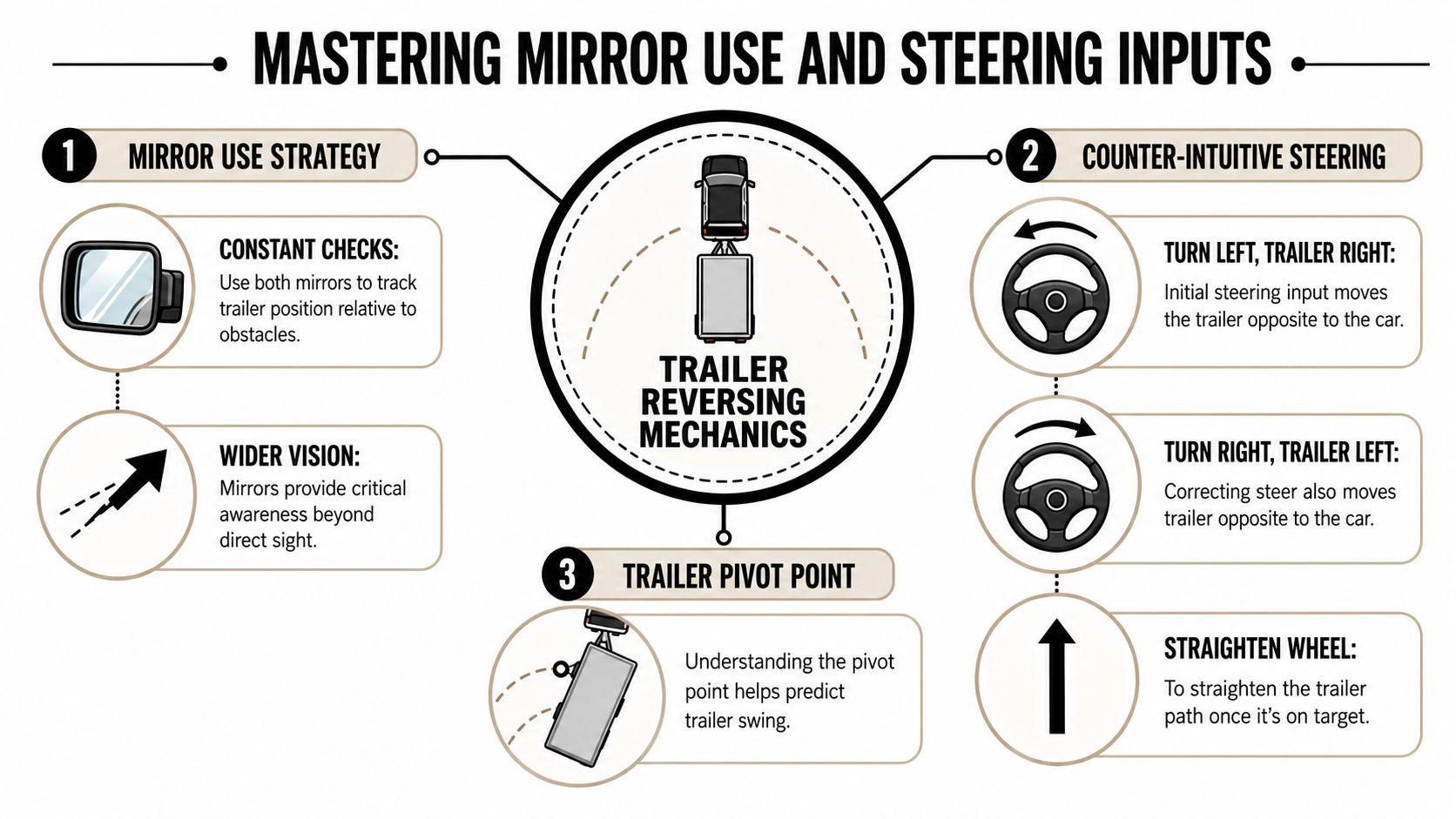
Core Powertrain and Structural Design
The Inverted Steering Geometry
The fundamental rule of semi trailer reversing is that the trailer’s rear moves in the direction opposite to the steering input. To back the trailer to the right, the driver steers the tractor’s cab to the left . This counterintuitive relationship exists because the tractor and trailer articulate at the fifth wheel, and the trailer pivots around that point rather than following the tractor’s front wheels directly.
The geometry has a stability boundary. As the articulation angle between tractor and trailer increases, the system becomes progressively less stable. At a certain angle, the trailer’s rearward motion can no longer be corrected by steering input alone, and the combination begins to fold—the onset of a jackknife. Experienced drivers manage this by making small, deliberate steering inputs and correcting early, before the angle grows beyond recovery . The instinct to crank the wheel harder when the trailer drifts is exactly wrong; it accelerates the approach to the unstable region.
Mirror Discipline and Visual Reference Points
Reversing a semi trailer is a visual task performed almost entirely through the mirrors. The driver’s direct view behind the cab is blocked by the trailer body, and the side windows show only the trailer’s flanks. The mirrors—both the flat glass and the convex spot mirrors—provide the only real-time information about the trailer’s position relative to the target.
A specific failure mode illustrates why mirror discipline matters. When backing to the driver’s side, if the trailer disappears from the passenger-side mirror, the driver has turned too sharply. The trailer is no longer in the field of view that would show its alignment with the target. The correction is to stop, steer back toward the side where the trailer disappeared, and “chase” it back into view . This technique restores the visual reference before the angle becomes too aggressive.
The pre-reverse walkaround is equally important. Before entering the cab, the driver should inspect the area behind the trailer, identify obstacles, and establish a plan for the maneuver. If visibility is limited or the site is complex, a spotter positioned in the driver’s mirror view provides an additional reference .
Offset Backing and Articulation Control
Offset backing—shifting the trailer laterally into an adjacent lane or dock space—is one of the most demanding reversing maneuvers because it requires precise articulation control without the benefit of a straight-line reference. The maneuver involves a deliberate S-curve: steering to initiate the trailer’s lateral movement, then counter-steering to straighten the combination in the new position.
The difficulty is that the tractor and trailer are not following the same path. The trailer’s rear axle tracks inside the tractor’s path during turns, a phenomenon known as off-tracking . In reverse, this relationship inverts: the trailer’s rear can swing wide of the intended path if the articulation angle is not managed. Offset backing requires the driver to anticipate where the trailer’s rear will go based on the current articulation angle, not where it currently is.
Technical Specifications
The table below presents reference parameters relevant to semi trailer reversing geometry and maneuver characteristics. These are typical industry values; actual dimensions vary by tractor wheelbase, trailer length, axle configuration, and fifth wheel position.
Comparative Advantages TCO and ROI
The commercial case for investing in reversing technique training and yard planning rests on accident avoidance and productivity. A reversing incident in a yard or dock typically produces low-speed contact damage: a dented trailer panel, a damaged dock seal, or a bent landing gear leg. The repair costs for these incidents are moderate in isolation, but they accumulate across a fleet and carry indirect costs that are larger than the invoices.
Downtime and yard congestion. A driver who struggles with a backing maneuver blocks the yard for the duration of the attempt plus the pull-forward reset. In a busy distribution center, this delay propagates to other vehicles and dock appointments. The two-minute reduction in reversing time demonstrated by assisted systems represents a direct productivity gain per maneuver, multiplied across daily dock cycles .
Accident and damage costs. Low-speed backing accidents are among the most frequent claims in trucking operations. Repair costs for trailer body damage, dock equipment, and third-party property (fences, bollards, parked vehicles) accumulate. A training program focused on mirror discipline, early correction, and the discipline to pull forward when the angle is wrong reduces both the frequency and severity of these incidents.
Assumptions for a training ROI example. A fleet operating 50 tractors with an average of four dock maneuvers per day would perform roughly 200 backing maneuvers daily. If a targeted reversing training program reduces contact incidents by a conservative 30%, the avoided repair and downtime costs provide a measurable return. The calculation requires actual fleet incident data, not industry averages, but the structure of the case is consistent across operations.
Heavy Duty Application Scenarios
Reversing technique demands vary by operating environment, and the same driver may face all of these in a single shift:
-
Distribution center docks. The most common reversing scenario. Docks are often aligned in rows with limited clearance between trailers. Straight-line backing from a pull-up position is the standard approach; offset backing is required when the approach lane is offset from the dock door. Precision matters because dock seals and levelers are easily damaged.
-
Truck stops and rest areas. Parking spaces are narrow and often occupied by vehicles with varying alignment. Backing into a space between two trailers requires managing the articulation angle carefully and using the pull-up reset if the approach is misaligned.
-
Construction sites and industrial yards. Ground conditions may be uneven, and obstacles (material stacks, equipment, personnel) may not be positioned for convenient backing. A spotter is often necessary, and the driver must be prepared to stop and reassess rather than force a maneuver.
-
Street-side delivery and loading. Reversing from a street into a loading area or alley requires awareness of traffic, pedestrians, and fixed obstacles. The offset backing maneuver is common here, and the cost of a mistake includes third-party liability.
Selection and Maintenance Considerations
For fleet managers and driver trainers, the following practices support safe and efficient reversing across the fleet:
-
Train the pull-up as a standard maneuver, not a failure. The most important recovery technique is the decision to stop, pull forward 15–20 feet, and restart the approach . Drivers who view this as a failure attempt to salvage bad angles, which is when jackknife risk rises. Make the pull-up a routine part of training and reinforce it during yard observations.
-
Enforce the pre-reverse walkaround. The driver should physically inspect the area behind the trailer before beginning the maneuver, identifying obstacles, confirming clearance, and establishing the target position. This takes less than a minute and prevents the most common cause of backing accidents: unseen obstacles.
-
Specify mirror configurations that support reversing. Convex spot mirrors provide wide coverage but distort distance. Flat glass provides accurate alignment reference. Fleet specification should ensure both are present, properly adjusted, and in good condition.
-
Consider reversing assistance systems for high-turnover fleets. Camera-based and sensor-fusion reversing aids are commercially available and have demonstrated measurable reductions in reversing time . These systems do not replace driver skill, but they provide an additional reference layer for less experienced drivers.
-
Audit yard geometry against actual vehicle dimensions. A dock that was designed for 48-foot trailers may be difficult or impossible to access with 53-foot combinations. Before blaming driver technique, verify that the yard layout is compatible with the fleet’s equipment.
Conclusion
Semi trailer reversing is a skill built on three foundations: understanding the inverted steering geometry, maintaining disciplined visual reference through the mirrors, and recognizing when to reset rather than salvage a bad angle. The geometry is fixed by the vehicle’s design—the trailer will always track opposite to the steering input, and the articulation angle will always have a stability boundary. What the driver controls is the speed of approach, the size of the steering inputs, and the willingness to pull forward when the situation calls for it. For fleets, the engineering and commercial decision is to treat reversing as a trainable, measurable skill rather than an innate talent, and to provide the yard geometry, mirror configuration, and recovery discipline that allow drivers to perform it consistently. The cost of a pull-up is seconds; the cost of a jackknife or a dock strike is measured in downtime, repairs, and safety exposure.