

Introduction
Semi trailer repair encompasses the corrective and preventive work required to restore or maintain the structural, braking, suspension, and electrical systems of an unpowered freight vehicle. Unlike tractor maintenance, which centers on the powertrain, trailer repair is dominated by wear items and fatigue-prone structures: brake chambers, slack adjusters, suspension bushings, landing gear, and the chassis welds that carry load between the fifth wheel and the axles.
For fleet managers, repair cost is a predictable line item that becomes unpredictable when deferred maintenance compounds. A brake chamber that receives routine stroke inspection is a scheduled replacement; a brake chamber that receives no attention until it fails is a roadside event with downtime cost several times the parts invoice. Structural repair is even more consequential. A fatigue crack at a suspension hanger weld, if caught early, can be repaired under a qualified welding procedure. If allowed to propagate into the main beam, the same crack may render the trailer a total loss or require engineering certification beyond the capability of a standard repair shop.
This guide examines the primary repair categories for semi trailers—structural and chassis repair, brake system service, and suspension maintenance—with the inspection thresholds and service intervals that determine whether repair remains economical.
Core Powertrain and Structural Design
Chassis and Structural Repair
The semi trailer chassis is a welded steel structure subjected to cyclic loading over millions of load cycles. Fatigue cracking is the dominant failure mode, and it occurs at predictable locations rather than randomly. Finite element analysis of semi trailer chassis frames identifies critical welded connections including the front bolster to main I-beam, the longitudinal reinforced beam at the traction pin mounting bracket, the transverse reinforced beam to main I-beam, and suspension hanger connections to the main I-beam . These are the zones that inspection should prioritize.
Repair decisions depend on crack location, severity, and material. For heat-treated or high-strength chassis rails, industry guidance recommends replacement rather than repair or straightening, because welding and heat input can degrade the material’s properties in ways that are difficult to verify without metallurgical testing . For mild steel structures, qualified welding procedures under standards such as AS/NZS 1554 provide a framework for repair, but the welder must be certified for the position and technique, and the procedure must account for the fatigue sensitivity of the repaired joint .
A repair that merely fills a crack without addressing the stress concentration that caused it will fail again. Reinforcing the chassis rail web at suspension hanger connections, adding cross-bracing at suspension mounting positions, and ensuring load distribution plates are adequate are structural improvements that reduce the likelihood of recurrence rather than simply restoring the pre-failure condition .
Brake System Repair and Service
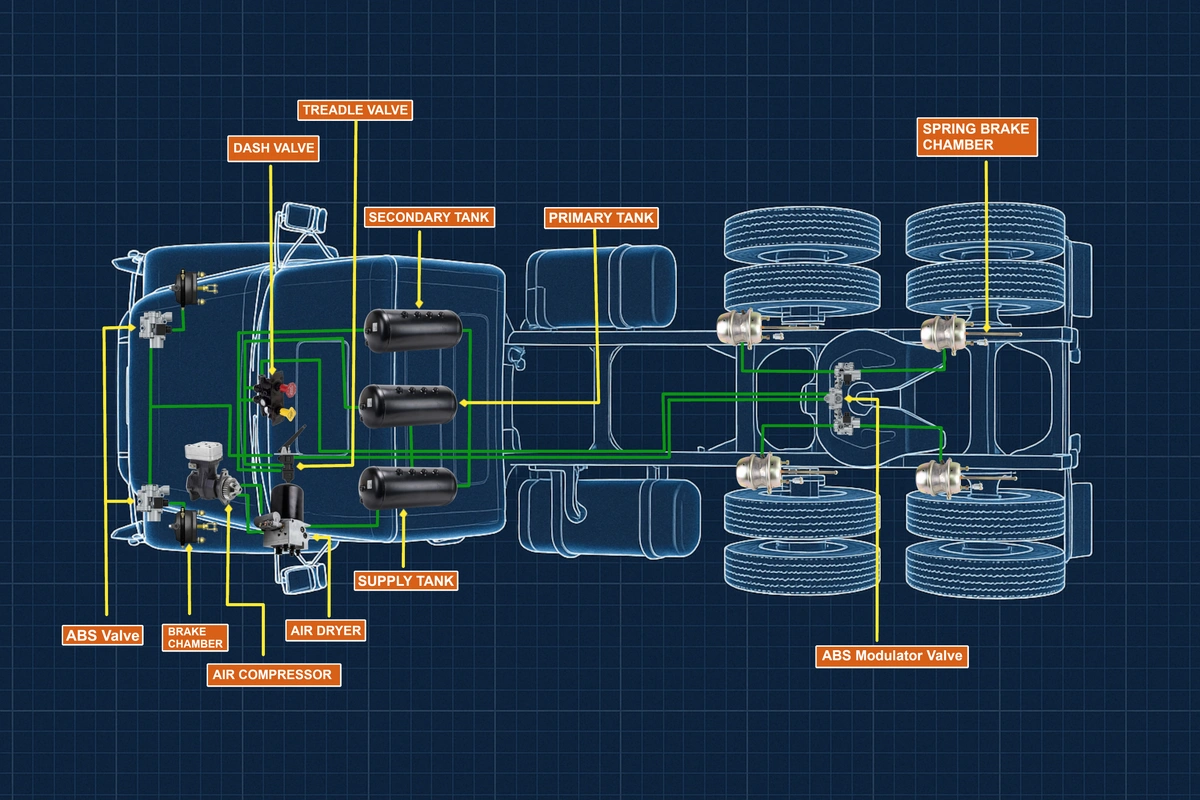
Brake repair is the most frequent service category for semi trailers after tires. The pneumatic system requires attention to both the foundation brakes—drums, shoes, discs, pads—and the control system—chambers, valves, slack adjusters, and air lines.
Pushrod stroke is the primary wear indicator for drum brakes. As lining wears, the chamber pushrod extends further to apply the brake. When stroke exceeds the adjustment limit, braking force diminishes and the chamber may bottom out. The repair decision is not always chamber replacement; slack adjuster re-indexing or lining replacement may restore correct stroke. However, a chamber that has been run beyond its stroke limit may have a damaged diaphragm or return spring and should be inspected internally or replaced.
Air system contamination is a common root cause of repeat brake failures. Oil or moisture carried from a failing compressor or air dryer into the trailer system attacks chamber diaphragms and valve seals. A repair shop that replaces chambers without investigating air quality will see the same failure return. The trailer’s air system should be checked for contamination whenever multiple chambers show premature diaphragm failure.
Suspension Repair and Alignment
Suspension repair encompasses both mechanical leaf spring systems and air suspension. For leaf spring suspensions, U-bolt integrity is a critical and frequently neglected item. U-bolts should never be reused after removal, must be the correct grade, and must be re-torqued after the suspension settles under load—typically at 500 miles and periodically thereafter . A loose U-bolt allows the axle to shift, producing misalignment and irregular tire wear that the operator may misattribute to tire quality.
Air suspension repair centers on air springs, height control valves, and trailing arm bushings. Air spring failure causes include suspension misalignment, fatigue, and age-related rubber degradation . A height control valve that fails to maintain ride height will cause the trailer to sit unevenly, imposing abnormal loads on one side of the suspension and accelerating bushing wear. Bushing wear in the trailing arm or equalizer allows axle movement under load, producing the same misalignment symptoms as a loose U-bolt. Pry bar inspection between the trailing arm and hanger is a practical method for detecting bushing movement before it becomes visible as tire wear .
Technical Specifications
The table below presents representative repair thresholds and service parameters for semi trailer systems. Values are typical industry references; actual limits vary by manufacturer and regulatory jurisdiction.
| Key Parameter | Typical Technical Specification | Operational Significance |
|---|---|---|
| Kingpin wear limit | 1/8 in (0.125 in) maximum diameter reduction | Beyond limit, fifth-wheel jaws cannot grip securely; kingpin replacement required |
| Brake pushrod stroke limit | Varies by chamber type; typically 2 in (51 mm) for standard stroke chambers | Exceeding limit reduces braking force and may indicate lining wear or chamber fault |
| Brake lining minimum | 1/4 in (6.4 mm) remaining on both shoes | Below this, braking performance degrades and drums may be damaged |
| U-bolt re-torque interval | 500 miles after installation, then periodic | Prevents axle shift and misalignment from settling |
| Chassis crack inspection zones | Front bolster weld, suspension hanger welds, cross-member intersections | Fatigue cracks initiate at weld toes and geometric discontinuities |
| Air system contamination check | Whenever multiple chambers fail prematurely | Oil/moisture from tractor compressor or dryer attacks diaphragms and seals |
| Suspension bushing inspection | Pry bar check at every PM interval | Detects wear before it produces irregular tire wear |
| Structural welding standard | AS/NZS 1554 or equivalent qualified procedure | Ensures repair does not introduce new fatigue initiation points |
Comparative Advantages TCO and ROI
The semi trailer repair decision is fundamentally a repair-versus-replace calculation, applied at the component and system level. For wear items—brake chambers, bushings, seals, lights—repair (replacement) is almost always economical because the component cost is low relative to the labor and downtime of a full system replacement. For structural components, the calculation is more complex.
A cracked main beam that requires engineering certification and qualified welding may cost several thousand currency units to repair properly, with no guarantee that the repair will achieve the original fatigue life. A replacement trailer of comparable specification may cost tens of thousands. The repair is economically favorable if the trailer has remaining service life in other systems and the repair is performed to a standard that restores structural integrity. It is unfavorable if the trailer is near end of life or if the crack indicates a systemic design or overload issue that will produce additional failures.
Repair cost data for semi trailers provides a benchmark for budgeting. A study of semi-trailer repair and maintenance costs in a forestry context found trailer maintenance averaged approximately $0.073 per kilometer for the trailer portion of the combination, with tires and rims accounting for 34% of trailer repair cost, maintenance 24%, and brakes and air system 15% . These proportions are context-specific but illustrate that brake and air system work is a significant but not dominant repair category—structural and tire costs typically exceed it.
A defensible ROI example requires stated assumptions. Consider a fleet with 20 trailers experiencing an average of three brake-related repair events per trailer per year at 1,200 CNY each. Annual brake repair cost is 72,000 CNY. If a preventive brake inspection program—including pushrod stroke measurement at every PM, air system contamination checks, and slack adjuster lubrication—reduces event frequency by 40% and shifts half of the remaining events from roadside to scheduled repair (lower labor rate, no downtime premium), the annual saving could exceed 30,000 CNY against a program cost of technician training and inspection time. The calculation excludes the revenue value of avoided downtime, which typically exceeds the repair invoice.
Heavy Duty Application Scenarios
-
Long-haul highway fleets: The dominant repair categories are brake wear, tire replacement, and structural fatigue from accumulated mileage. Chassis crack inspection at suspension hanger welds should be scheduled at defined mileage intervals, not left to discovery during annual inspection. Air system contamination is a recurring issue on high-mileage tractors with aging compressors.
-
Container drayage and port operations: High-frequency coupling and short trips accelerate landing gear wear, kingpin wear, and brake chamber cycling. The repair profile shifts toward coupling interface components and brake adjustment rather than structural fatigue, though port roads in poor condition can induce suspension damage.
-
Construction and rough-terrain haulage: Impact loading from unpaved surfaces accelerates suspension bushing wear, U-bolt loosening, and structural cracking at cross-member connections. Repair intervals shorten and inspection frequency must increase. Leaf spring breakage is more common in this duty cycle than in highway service.
-
Heavy-haul and lowbed operations: Structural repair becomes the dominant concern due to concentrated loads and multi-axle configurations. The kingpin and upper coupler plate experience loads that approach design limits, and wear limits must be monitored closely. Welding repairs on these trailers require engineering review because the consequences of repair failure are more severe.
Selection and Maintenance Considerations
Repair quality depends on three factors that fleet managers control: who performs the work, what procedure they follow, and how the result is verified.
-
Welder qualification and procedure: Structural welding on semi trailer chassis must be performed by welders qualified for the material and position, following a documented procedure. For carbon steel structures, AS/NZS 1554 provides the framework; for high-strength quenched and tempered steels, AS/NZS 1554.4 applies . A shop that cannot produce a qualified procedure and certified welder should not be entrusted with chassis repair.
-
Manufacturer repair guidance: Repair decisions should begin with the manufacturer’s instructions. If the manufacturer prohibits repair of a specific component or provides a procedure, that guidance takes precedence over general industry practice. If the manufacturer cannot provide guidance, engineering certification may be required for structural repairs .
-
Air system diagnosis before brake replacement: Repeat brake chamber failures indicate a system problem, not a chamber problem. Check air quality, dryer function, and compressor condition before replacing the same component a third time.
-
Suspension alignment after repair: Any suspension repair that involves U-bolt removal, hanger replacement, or bushing replacement should be followed by axle alignment verification. A repaired suspension that is out of alignment will produce tire wear that the operator may attribute to the repair itself.
Conclusion
Semi trailer repair is a discipline of catching wear before it becomes failure and repairing structure before it becomes scrap. The engineering priorities are clear: inspect chassis welds at the known fatigue-critical locations, measure brake stroke rather than waiting for symptoms, and verify suspension alignment after any repair that disturbs axle position. The commercial priorities follow directly: qualified welders and documented procedures for structural work, air system diagnosis before parts replacement, and scheduled inspection intervals that convert roadside emergencies into planned maintenance events.
Fleets that treat repair as a diagnostic activity rather than a parts-swapping exercise achieve lower repeat-failure rates and longer trailer service life. The repair invoice is not the total cost of a failure; the downtime, the secondary damage, and the risk exposure are. A trailer that receives a proper repair once is cheaper to own than a trailer that receives the same inadequate repair three times.