

Overview
Semi trailer dimensions are governed by a combination of regulatory limits, trailer type, and axle configuration, and the numbers that matter most to a fleet buyer are not always the overall length and width printed on a spec sheet. The United States generally works with 53-foot length and 102-inch width, the European Union applies 13.6-meter length and 2.55-meter width, and Australia regulates the distance from the articulation point to the rear of the trailer rather than a single overall length figure.
This FAQ addresses the dimension questions that directly affect procurement, route planning, and regulatory compliance. It distinguishes between overall dimensions and axle spacing limits, because a trailer that is legal in total length can still violate kingpin-to-axle rules in specific jurisdictions.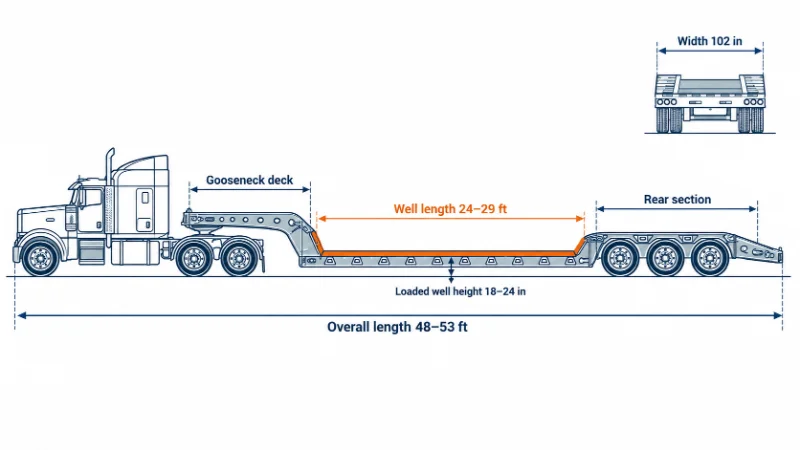 Frequently Asked Questions
What are the standard semi trailer dimensions?
The standard semi trailer dimensions in the United States are 53 feet long, 102 inches wide, and roughly 9 to 13.6 feet high, while the European Union standard is 13.6 meters long and 2.55 meters wide. These figures describe the dominant dry van and curtain-side specifications in each market.
Length and width are regulated dimensions with jurisdiction-specific limits, while height is constrained more by bridge clearances and loading dock compatibility than by a uniform national standard. A trailer’s actual dimensions should always be confirmed against its data plate and the manufacturer’s specification sheet, particularly for specialized trailer types such as flatbed, lowbed, or tank configurations where the ranges differ substantially.
How long is a semi trailer in the United States?
The maximum semi trailer length on the U.S. Interstate System is 53 feet, and this has become the prevailing specification for dry van and refrigerated trailers. Federal regulation caps semitrailer length at 53 feet on the Interstate System and four-lane divided highways .
Individual states may set different limits under grandfathered provisions. For example, Louisiana, Oklahoma, and Texas allow semi trailers up to 59 feet 6 inches, while Arizona, Kansas, and New Mexico permit 57 feet 6 inches . California generally limits semi trailers to 48 feet, though 53-foot trailers may operate without a permit by conforming to a kingpin-to-rearmost axle distance of 38 feet . Procurement teams operating across multiple states should verify both the overall length limit and any axle-spacing condition attached to it.
How long is a semi trailer in Europe?
The standard semi trailer length in the European Union is 13.6 meters, with the regulatory framework allowing a semi trailer length of 12.00 meters plus the front overhang under type-approval rules . The 13.6-meter figure reflects the practical combination of the regulatory body length and the front projection geometry.
EU regulations also control the front fitting radius of the semi trailer, which must not exceed 2.04 meters measured from the kingpin axis . This dimension governs how the trailer nose interacts with the tractor cab and is a specification detail that should be confirmed when ordering for EU operation. As with length, exceptions for indivisible loads require national permits rather than a different type-approval specification.
How wide is a semi trailer?
The maximum semi trailer width is 102 inches (8.5 feet) in the United States and 2.55 meters in the European Union, with a conditional EU allowance to 2.60 meters for vehicles fitted with insulated bodywork having walls at least 45 mm thick .
U.S. federal regulation limits vehicles and loads to 102 inches in width on the Interstate System and four-lane divided highways . Some states have historically maintained different limits, and Hawaii permits certain roads to accommodate trailers up to 108 inches wide . Any trailer exceeding the applicable state maximum is classified as oversized and requires an oversize permit, which may impose route restrictions or escort requirements. Procurement teams should confirm the width limit for every state in the intended operating network.
How does Australia regulate semi trailer dimensions?
Australia regulates semi trailer dimensions through articulation-point distances rather than a single overall length figure. Under the general limits, the distance from the front articulation point to the rear overhang line must not exceed 9.5 meters, and the distance from the articulation point to the rear of the trailer must not exceed 12.3 meters .
From 1 August 2026, the Heavy Vehicle National Law Amendment Act 2025 raised the allowable semi trailer combination length from 19 meters to 20 meters under specified conditions. The amended limits include a point-of-articulation-to-rear-overhang-line distance of up to 10.5 meters and an articulation-point-to-rear-of-trailer distance of up to 14.5 meters for eligible semitrailers . Trailers intended for the 20-meter allowance require federal approval or an in-service modification approved by an Approved Vehicle Examiner .
What is the kingpin-to-rear-axle distance and why does it matter?
The kingpin-to-rear-axle distance is the horizontal measurement from the center of the kingpin to the center line of the trailer’s rear axle group, and it is a separate regulatory limit from overall trailer length. A trailer can be legal in total length but illegal in its axle spacing, which affects turning behavior and off-tracking.
Several U.S. states attach axle-spacing conditions to their length allowances. California permits 53-foot semi trailers without a permit if the kingpin-to-rearmost axle distance is 38 feet or less . Wisconsin allows 53-foot trailers with a kingpin-to-rear-axle distance of 41 feet measured to the center of the rear tandem assembly . Indiana allows 53-foot trailers with a kingpin-to-rearmost axle distance of 40 feet 6 inches . Buyers should request this dimension on the specification sheet and verify it against every jurisdiction in the operating network.
What height limits apply to semi trailers?
Semi trailer height is generally constrained by bridge clearances rather than a single uniform national standard, with typical exterior heights ranging from approximately 9 to 13.6 feet for standard van trailers. Unlike length and width, height is not subject to a consistent federal limit in the United States, and clearance restrictions vary by route.
Operators should conduct route surveys for any trailer whose overall height approaches the lowest bridge clearance on the intended route. High-cube and specialized trailers may exceed the typical range, and the combination of trailer height and tractor fifth wheel height determines the final operating height. The trailer data plate and the manufacturer’s specification sheet remain the controlling references for exterior height.
Conclusion
Semi trailer dimensions come down to three regulated variables: overall length, overall width, and axle spacing relative to the kingpin. The 53-foot and 102-inch U.S. standards and the 13.6-meter and 2.55-meter EU standards are the default baselines, but state and national exceptions mean that a single “standard” dimension does not guarantee compliance across an operating network. Procurement teams should verify both the overall dimensions and the kingpin-to-axle distance for each jurisdiction, and should treat the trailer data plate and current regulation text as controlling rather than generic spec sheets.