

Overview
A semi trailer jack stand—also called a trailer stabilizing jack or dock trailer support—is a portable, height-adjustable steel support placed under the rear or front of an uncoupled semi trailer to prevent it from upending during forklift loading or unloading. When a trailer is not coupled to a tractor, the landing gear supports the front, but the rear frame can lift off the ground if a forklift enters with a heavy load and the trailer’s center of gravity shifts rearward. The jack stand provides the fixed support that OSHA’s powered industrial truck standard references as a necessary safeguard.
For fleet managers and warehouse operators, the procurement decision involves two numbers that are often confused: static capacity (the load the stand holds when stationary) and lifting capacity (the load it can raise). A stand rated for 50,000 lb static may lift only 5,000 lb, and using it to lift beyond that rating is a failure risk. This FAQ addresses the capacity ranges, OSHA requirements, and placement practices that determine whether a jack stand does its job or becomes a hazard.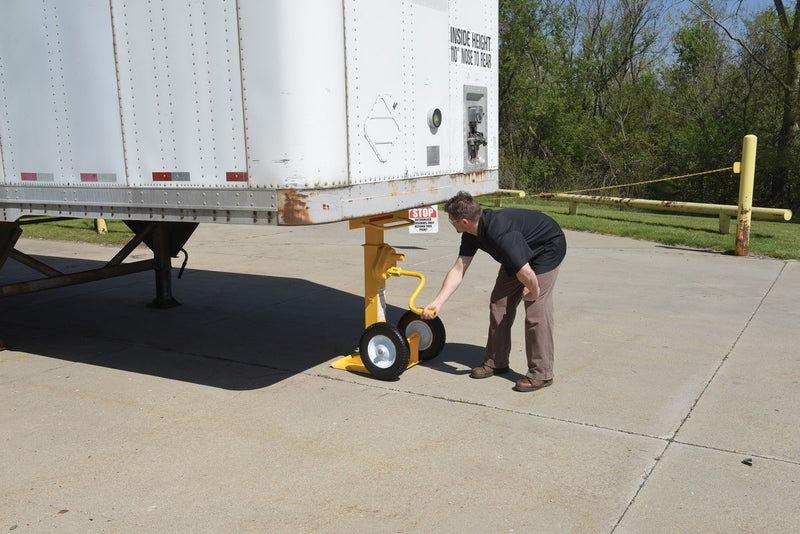
Frequently Asked Questions
What is the typical static and lifting capacity of a semi trailer jack stand?
A standard semi trailer jack stand typically has a static capacity of 50,000 lb and a lifting capacity of 5,000 lb, while heavy-duty models reach 100,000 lb static and 40,000 lb lifting . The Beacon BSJ series, for example, lists a 50,000 lb static capacity with a 5,000 lb lifting capacity across its models, with prices ranging from approximately $205 to $296 .
The gap between static and lifting capacity is significant and often misunderstood. Static capacity is the load the stand supports once the trailer is resting on it; lifting capacity is the load the screw or ratchet mechanism can raise. A 50,000 lb static stand with a 5,000 lb lift capacity is designed to be positioned under a trailer that is already at or near the correct height, not to jack a loaded trailer up from the ground. Attempting to lift beyond the rated capacity can strip the screw thread or collapse the stand.
What does OSHA require for semi trailer jack stands?
OSHA’s powered industrial truck standard, 29 CFR 1910.178(k)(3), states that “fixed jacks may be necessary to support a semi trailer and prevent upending during loading or unloading when the trailer is not coupled to a tractor.” OSHA has clarified that this language is advisory rather than mandatory, but the agency strongly recommends following the trailer and jack manufacturer’s instructions on the appropriate number and placement of jacks .
The practical implication is that OSHA does not specify a particular jack type or a required number of stands, but the employer still has a general duty to provide a safe workplace. If an uncoupled trailer upends during loading and injures an operator, the absence of jack stands will be treated as a recognizable hazard that the employer failed to control. Many jack stand manufacturers reference the OSHA standard in their product documentation as the basis for the equipment’s intended use .
How many jack stands should I use under a semi trailer?
Use two jack stands, one on each side of the trailer frame, for routine loading and unloading support. OSHA’s 2008 interpretation letter addressed this directly: when asked whether two stands (one on each side) are sufficient or whether one stand in the middle is adequate, OSHA responded that its standard does not specify the number or placement, but it recommends following the manufacturer’s instructions .
The two-stand arrangement provides lateral stability that a single center stand cannot. A single stand under the center of the trailer may support the vertical load, but it does not prevent the trailer from rocking side to side as the forklift moves inside. The two-stand configuration resists both the vertical and the lateral forces that loading generates. For trailers with a sliding tandem or unusual frame configuration, the trailer manufacturer’s guidance on support points should be consulted.
Where should jack stands be placed under a semi trailer?
Place jack stands under the rear frame rails or the rear crossmember, on a hard, level surface, positioned so the trailer’s weight is transferred directly through the stand to the ground. The stand should contact a structural member, not the trailer’s floor or sheet metal.
The surface condition is as important as the placement. A stand placed on soft ground, gravel, or a slope can sink or tip, defeating its purpose. WorkSafe Queensland’s guidance for heavy vehicle immobilization specifies load-rated support stands on a hard level surface under the correct support points before anyone works underneath . If the dock apron is sloped or the pavement is deteriorated, a pad under the stand base can distribute the load and reduce the risk of settlement. The stand’s base plate—typically 13.5 to 16 inches in diameter or a triangular configuration—is designed for this load distribution .
What is the difference between a jack stand and the trailer’s landing gear?
The landing gear is the permanent, crank-operated support at the front of the trailer that holds the trailer when uncoupled. The jack stand is a separate, portable device used at the rear of the trailer (or at additional support points) to provide stability that the landing gear does not.
The landing gear supports the front of the trailer and is designed for the trailer’s static weight. It does not prevent the rear of the trailer from lifting when a forklift enters with a heavy load. The jack stand’s role is to provide a fixed support at the rear so the trailer cannot pivot upward around the landing gear. Some fleets also use jack stands under the landing gear area to prevent the landing gear from sinking into soft ground, but the primary purpose is rear-end stabilization during loading .
How do I choose between a screw-type and a ratchet-type jack stand?
Choose a ratchet-type jack stand for faster height adjustment and a screw-type for finer height control and a more compact mechanism. The Beacon BSJ series uses a spin-top screw adjustment with a service range of 44 to 51 inches . The TJ50 series uses a ratchet screw with a service range of 39.5 to 51 inches and a pipe handle for leverage .
The ratchet design allows the operator to raise the stand quickly to the trailer frame and lock it in position with a pawl, while the screw design allows continuous adjustment within the range. For high-frequency dock operations, the ratchet’s speed advantage matters. For occasional use or where the trailer height varies, the screw’s continuous adjustment is adequate. Both types should be inspected for bent locking pins, worn ratchet teeth, and damaged base plates before each use.
What maintenance does a semi trailer jack stand require?
Inspect the jack stand before each use for bent or cracked welds, deformed uprights, worn locking pins or ratchet teeth, and damaged base pads. A stand that has been overloaded or dropped may have stress fractures that are not visible without close inspection.
The inspection should focus on the weld joints where the upright meets the base—the highest-stress area—and on the locking mechanism that prevents the stand from collapsing under load. The screw thread or ratchet teeth should be free of packed dirt and heavy rust, and the mechanism should operate smoothly through its full range. A stand with a bent pin, chipped ratchet tooth, or cracked weld should be removed from service rather than repaired, because the failure mode is a sudden collapse under load. Light surface rust is cosmetic; deep pitting that reduces the section thickness is not.
Conclusion
Semi trailer jack stand selection comes down to three checks: matching the static and lifting capacities to the task (50,000/5,000 lb for routine dock support, 100,000/40,000 lb for heavy-duty applications), placing two stands on a hard level surface under the rear frame rails, and inspecting the welds and locking mechanism before every use. OSHA’s advisory language does not specify the equipment, but the agency’s recommendation to follow manufacturer instructions means the manufacturer’s capacity and placement guidance becomes the de facto standard of care . The jack stand is a low-cost safety device that prevents a high-consequence event—an uncoupled trailer upending with a forklift inside—and the inspection that catches a bent pin or cracked weld is cheaper than the incident it prevents.