

Introduction
An ABS light on a semi trailer indicates that the trailer’s anti-lock braking system has detected a fault and disabled anti-lock function. The service brakes will still apply, but the trailer’s wheels are no longer protected against lockup during emergency braking or on slippery surfaces. On wet roads or loose gravel, a trailer without functioning ABS can swing out of line under hard braking, creating a jackknife risk that the tractor’s ABS alone cannot prevent.
The warning lamp itself is a federally mandated component. On trailers manufactured on or after March 1, 1998, the trailer must be equipped with an ABS malfunction lamp, and a defective or missing lamp is a recordable violation under 49 CFR 393.55(e) . This is not an out-of-service condition in every case, but it feeds the Vehicle Maintenance BASIC in CSA scoring and appears on the inspection report regardless of whether the ABS system itself is otherwise functional. For fleet managers, the lamp is a compliance item as much as a diagnostic signal.
This guide examines the isolation procedure that separates tractor from trailer faults, the power circuit that supplies the trailer ABS ECU, the sensor and tone ring failures that are the most common root causes, and the repair discipline that prevents repeat violations.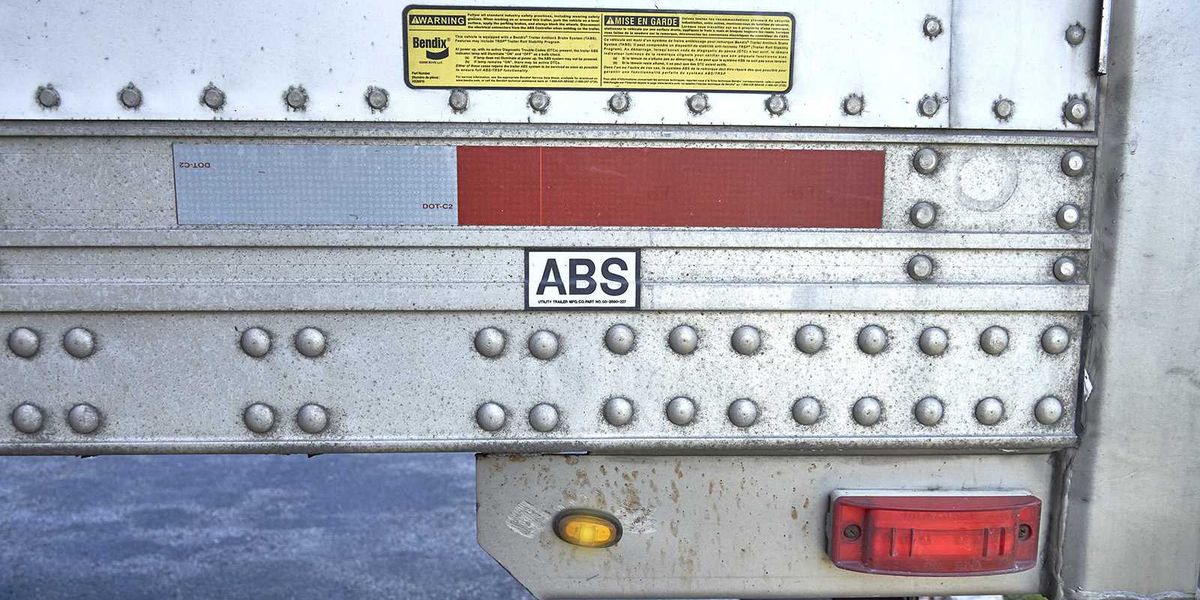
Core Powertrain and Structural Design
Engine and Transmission
The trailer ABS lamp has no relationship to the tractor’s engine or transmission. Its power source is the tractor’s electrical system, delivered through Pin 7 of the SAE J560 primary connector. Since 1998 for trailers, this pin has been standardized to supply continuous power to the trailer’s ABS ECU when the ignition is switched on . The American Trucking Associations specifies that under a 10-amp load at 20°C ambient temperature, the voltage at the ABS circuit must be at least 12.5 volts measured at the end of the seven-conductor cord . If Pin 7 voltage falls below this threshold, the trailer ECU may log a power fault and illuminate the lamp even when the ABS components themselves are sound.
Hydraulic System
Most heavy-duty semi trailers use pneumatic (air) brake systems, not hydraulic. The ABS system interfaces with the air system through modulator valves that regulate pressure to each wheel end. Air system integrity is therefore as relevant to ABS function as electrical continuity. A modulator valve that is stuck or contaminated can produce a wheel speed fault that mimics a sensor failure.
Chassis and Structural Durability
The wheel speed sensor and tone ring are the ABS system’s primary data sources. The sensor is mounted at each wheel end, reading the passing teeth of the tone ring as the wheel rotates. Sensor faults are the most frequent cause of trailer ABS lamp illumination. Common failure modes include:
-
Contamination on the sensor tip from grease or metal debris, which weakens the signal.
-
Scoring from the sensor rubbing against the tone ring, often caused by wheel bearing play or improper installation.
-
Tone ring damage: missing teeth, cracks, or grease contamination from a leaking wheel seal can produce a wheel speed fault even with a perfect sensor .
Sensor wiring is equally vulnerable. Harness chafe points where cables pass suspension components, corroded weatherpack pins, and water intrusion inside connectors can interrupt the signal intermittently, producing a lamp that comes on mid-shift and sometimes clears .
Technical Specifications
The table below presents representative parameters for semi trailer ABS diagnosis and power supply. Voltage limits are drawn from published industry standards; component specifications vary by manufacturer.
Comparative Advantages TCO and ROI
The alternative to systematic ABS diagnosis is lamp reset without repair. Clearing the code without addressing the fault produces a temporary dark lamp, but the ABS module re-tests every sensor above activation speed—typically 4 to 10 mph—and the fault re-triggers within minutes . The fleet gains a false clean bill and loses the diagnostic information that would have identified the failing component. The roadside violation still counts if the lamp re-illuminates before inspection, and the trailer operates without anti-lock protection in the interval.
The cost consequence is twofold. First, the recordable violation feeds the CSA Vehicle Maintenance BASIC regardless of whether the lamp was cleared last week . Second, a trailer without functioning ABS brakes like a truck from decades past in wet or panic-stop conditions—the risk is invisible until it is needed.
A defensible cost comparison requires stated assumptions. Consider a fleet of 30 trailers experiencing an average of three ABS-related repair events per trailer per year. If each event costs 500 CNY in diagnostic labor and parts when approached systematically, the annual cost is 45,000 CNY. If 30 percent of those events are repeat visits caused by clearing codes without repair, the fleet incurs an additional 13,500 CNY in unnecessary labor—plus the downtime of the trailer being unavailable while the fault is re-diagnosed. A structured diagnostic protocol that isolates the fault before any repair eliminates the repeat category.
Isolation testing is the highest-return diagnostic step. Dropping the trailer and observing whether the dash lamp extinguishes takes approximately 10 minutes and immediately determines whether the fault is on the tractor or the trailer . A technician who starts under the trailer without this step may spend an hour on the wrong vehicle.
Heavy Duty Application Scenarios
-
Long-haul highway fleets: Sensor and wiring faults from accumulated mileage and weather exposure are the dominant causes. The lamp may illuminate intermittently as harness chafe points open and close with vibration. Systematic harness inspection at PM intervals and sensor resistance testing at brake service catch these faults before they become roadside violations.
-
Container drayage and port operations: High-frequency coupling and short trips stress the SAE J560 connector and the Pin 7 power circuit. Corroded or worn pins at the connector face can drop voltage below the 12.5V threshold, causing the trailer ECU to log a power fault. Connector inspection at every PM is essential .
-
Construction and rough-terrain haulage: Vibration and impact loading accelerate sensor and tone ring damage. Wheel bearing play from heavy loads can change the sensor air gap, producing intermittent faults that appear only under load. Sensor gap verification should accompany every bearing inspection .
-
Cold climate operations: Temperature cycling loosens connector terminals and can cause ice accumulation in the connector face. Dielectric grease application and connector cap discipline prevent moisture ingress that leads to intermittent wheel speed faults.
Selection and Maintenance Considerations
ABS diagnosis begins with isolation, not component replacement. The sequence should be:
-
Drop the trailer and observe the dash lamp. If the lamp extinguishes, the fault is on the trailer. If it remains on, the fault is on the tractor .
-
Verify Pin 7 power at the trailer connector. Measure voltage under load against the 12.5V minimum. A low reading indicates resistance in the tractor circuit, the seven-conductor cord, or the connector pins—not an ABS component fault .
-
Retrieve the blink code or scan tool fault. The ECU stores the specific fault—sensor BU1, modulator valve, power fault—which directs the technician to the correct wheel end or circuit.
-
Inspect the sensor and tone ring at the coded wheel. Check for contamination, scoring, and missing teeth. Verify sensor resistance and air gap. Repair the fault, not the lamp .
-
Clear the code, road test, and verify lamp cycle. Drive above ABS activation speed to allow the ECU to re-test every sensor. Confirm the lamp performs its self-test at key-on and remains dark. Document the repair against the trailer asset .
Key maintenance practices include:
-
Test sensor resistance at brake service. A sensor reading outside the typical range indicates an internal fault that will eventually illuminate the lamp .
-
Inspect harness routing at suspension flex points. Chafed or abraded insulation on sensor leads is a common source of intermittent faults .
-
Verify connector pin condition, not just cleanliness. Worn or spread pins at the SAE J560 connector cannot carry the ABS load current reliably, even if they appear clean.
-
Treat the external lamp as a required component. A missing or non-functional trailer ABS lamp is a recordable violation regardless of whether the ABS system itself is functioning .
Conclusion
An ABS light on a semi trailer is a diagnostic signal and a compliance item, not a maintenance inconvenience. The engineering priorities are clear: isolate tractor from trailer before opening a parts catalogue, verify Pin 7 voltage against the 12.5V standard, retrieve the stored fault code rather than guessing at components, and repair the identified fault before clearing the lamp.
The commercial priorities follow: a systematic diagnosis eliminates repeat visits, protects the fleet’s CSA score, and restores the anti-lock function that protects the trailer from swing-out under hard braking. Fleets that train technicians on the isolation procedure and voltage-drop testing achieve lower diagnostic labor cost and fewer repeat ABS events than those that treat the lamp as a reset-and-release item. The trailer that passes the self-test and stays dark is not merely compliant—it is equipped with the braking stability that the regulation intended.