

Overview
A semi trailer brake shoe is the curved metal carrier that holds the friction lining and presses it against the brake drum when the S-cam expands the assembly. For fleet maintenance teams, the brake shoe is both a wear item and a diagnostic indicator: the lining thickness determines when replacement is due, but the wear pattern across the shoe and between axle-mates reveals problems elsewhere in the brake system—slack adjusters, cam bushings, return springs, or chamber balance.
This FAQ addresses the wear limits, replacement criteria, and inspection practices that matter most in semi trailer brake maintenance. Lining thickness limits follow North American regulatory requirements; the specific shoe and lining manufacturer’s specification controls the actual replacement decision for a given axle.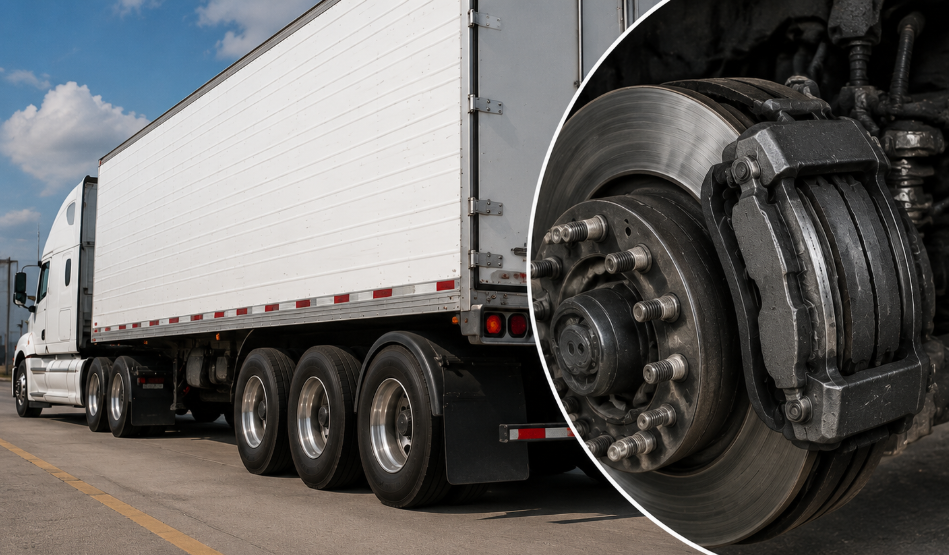
Frequently Asked Questions
What is the minimum legal brake lining thickness for semi trailer brake shoes?
The minimum legal brake lining thickness for non-steering axle brakes on an air-braked commercial vehicle is 6.4 mm (1/4 inch) measured at the shoe center, or the wear indicator if the lining is so marked . Semi trailer axles are non-steering positions, so this limit applies to every trailer brake shoe.
This is an out-of-service threshold, not a recommended replacement point. A lining at 6.4 mm has already consumed most of its service life and may not provide adequate braking force on a downgrade or in a panic stop. Professional fleet practice is to schedule replacement before the lining reaches the legal minimum, using the inspection interval to plan the reline rather than waiting for a roadside violation. The 1/4-inch limit applies to drum brakes; disc brakes have a different threshold of 3.2 mm (1/8 inch) on non-steering axles .
When should semi trailer brake shoes be replaced?
Replace semi trailer brake shoes when the lining reaches the manufacturer’s minimum thickness, when rivet heads are exposed or close to the friction surface on a riveted lining, or when the drum shows scoring damage that indicates metal-to-metal contact. Thickness measurement through the inspection hole or with the drum removed is the primary criterion; the decision is made by measurement, not by a calendar .
Three checks should be used together: lining thickness at the thinnest point, chamber pushrod stroke, and the position of any wear indicator . A lining that measures above the minimum but shows an abnormal wear pattern—tapered across the width or concentrated at one end—should not simply be replaced and forgotten; the underlying cause must be investigated. Meritor’s service guidance recommends relining when lining thickness reaches 0.25 inch (6.3 mm) at the thinnest point, which aligns closely with the FMVSS limit .
What is the difference between a riveted and a bonded brake lining?
Riveted linings fasten the friction material to the shoe with rivets, while bonded linings use adhesive to attach the material directly to the shoe platform. The distinction affects usable lining thickness and failure behavior.
A riveted lining can flex slightly between rivet points, making it more tolerant of drum imperfections, and it can be relined in a shop. However, the usable thickness stops at the rivet head—once the lining wears down to the rivets, metal-to-metal contact begins . Riveted linings remain common on heavy-duty S-cam drum brakes. A bonded lining uses the full thickness of the friction material and spreads pressure more evenly, but the adhesive can weaken under sustained overheating, and bonding cannot be performed in the field . The correct choice is the construction the brake group was designed for, not a universal preference.
Why do the two brake shoes on the same wheel wear unevenly?
A small wear difference between the two shoes on the same wheel is normal and built into the design. Depending on the direction of drum rotation, one shoe is pulled into the drum surface by friction force while the other is pushed away from it, so the leading shoe typically wears faster than the trailing shoe .
The difference becomes a fault when the gap widens noticeably. Common causes include a binding shoe pin or bushing, a fatigued or broken return spring, a cam roller off its seat, a worn cam shaft bushing, a sticking slack adjuster, or a torn chamber diaphragm . A wear difference between the two sides of the same axle—left versus right—usually points to a force imbalance on the chamber, valve, or adjustment side rather than a shoe problem. In either case, replacing the shoe without correcting the cause produces the same wear pattern on the new lining.
What drum conditions require replacement rather than reuse?
A brake drum must be replaced, not machined, when it has a crack that extends through the drum wall or runs from the open face toward the back plate. This is an immediate out-of-service condition that does not require measurement—a cracked drum can shatter under a hard stop .
Other conditions that condemn a drum include exceeding the maximum allowable inside diameter stamped on the drum, deep scoring that can be felt with a fingernail (indicating metal-to-metal contact from a lining worn too far), blue or purple discoloration from overheating, and hard spots (martensite) on the friction surface . Fine, evenly distributed heat checking—short hairline lines from normal heating and cooling—is not a defect and does not impair brake performance as long as the drum is within dimensional tolerance . The distinction between heat checking and a true crack is the single most consequential judgment in drum inspection.
Should brake shoes be replaced on one wheel or both sides of the axle?
Replace brake shoes on an axle-pair basis whenever the linings on both sides show similar wear, and whenever one side is being relined due to normal wear. The two wheel ends on the same axle operate under the same duty cycle and should produce balanced braking force; replacing one side and leaving a partially worn set on the other creates a force imbalance that can cause pulling and uneven future wear.
This is consistent with the general principle that brake work on one hub should be matched on the partner hub on the other side of the axle to ensure even braking on both sides . If one side failed prematurely due to a distinct cause—a leaking wheel seal that contaminated the lining, or a mechanical fault unique to that wheel end—the axle-mate should still be inspected and its condition assessed before deciding whether a single-side replacement is acceptable. In most fleet situations, the labor to access the second wheel end is small relative to the cost of a return visit.
What should be replaced along with the brake shoes during a reline?
A reline should include return springs, cam rollers, and cam shaft bushings in addition to the shoes and linings. Meritor’s service guidance recommends replacing springs, rollers, cam bushings, and anchor pins at each reline to help ensure maximum lining life .
The return springs are critical to correct brake adjustment and release; a fatigued spring allows the shoes to drag or fail to retract fully, which accelerates lining wear and can overheat the drum. Cam rollers and bushings wear together with the shoe and affect how evenly the S-cam applies force to both shoes. Inspecting the drum at every shoe change is also essential—the drum surface condition determines whether the new lining will seat properly or inherit the wear pattern of a damaged drum . Using OEM-specification components as a system, rather than mixing brands and grades, helps maintain the brake group’s designed performance.
Conclusion
Semi trailer brake shoe maintenance comes down to three practices: measuring lining thickness against the 1/4-inch legal floor and replacing before it is reached, reading the wear pattern as a diagnostic signal rather than a nuisance, and servicing the axle pair and the associated springs and bushings as a set. The shoe itself is a simple component, but its wear reflects the condition of the entire foundation brake. Fleets that treat the reline as a system service—drum inspection included—get longer lining life and fewer roadside violations than those that replace the shoe alone.