

Introduction
Semi trailer accessories encompass the components and systems that support the trailer’s primary functions without being part of its structural core: electrical connectors, lighting, safety devices, cargo control hardware, and auxiliary power equipment. For fleet managers, accessories occupy an ambiguous position in the maintenance budget—too small to command dedicated engineering attention, yet collectively responsible for a disproportionate share of roadside inspection failures and unscheduled repairs.
The operational pressures are tangible. Electrical connector corrosion is the most common accessory-related fault on semi trailers, and it develops silently until a light fails or an ABS warning appears . A connector left to corrode until failure has usually been marginal for weeks, producing intermittent faults that drivers may not report until a roadside inspection grounds the trailer. The cost of prevention—cleaning and dielectric grease at scheduled intervals—is a fraction of the cost of a roadside repair or an out-of-service violation.
This guide examines the accessory categories that most directly affect fleet reliability: electrical connectors and wiring, safety and visibility equipment, and cargo control hardware. It focuses on the engineering context that determines whether an accessory performs as a durable system component or a recurring expense.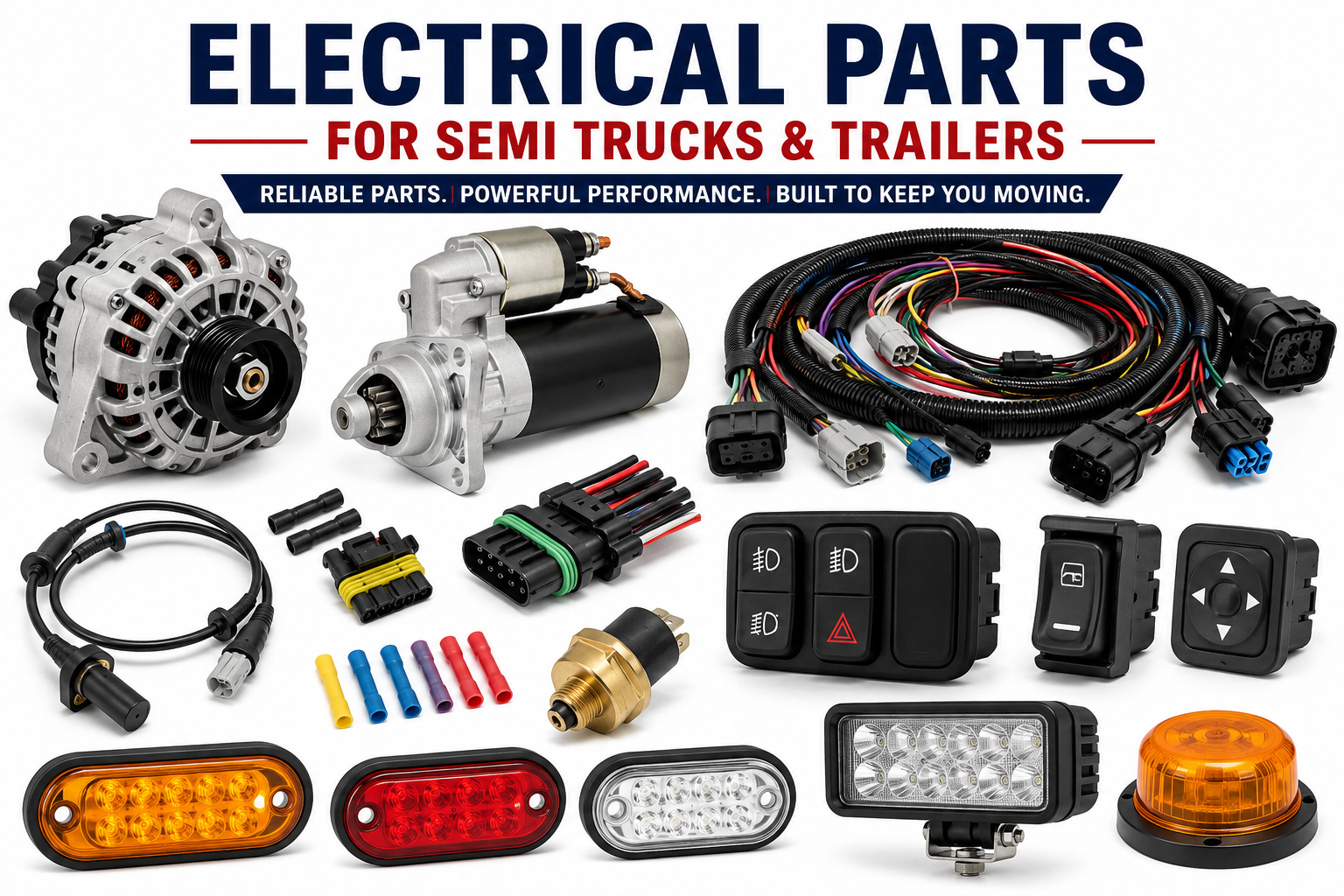
Core Powertrain and Structural Design
Engine and Transmission
Semi trailer accessories have no relationship to the tractor’s engine or transmission. The relevant interface is electrical: the tractor supplies 12-volt power through the SAE J560 connector to the trailer’s lighting and ABS circuits . Pin 7 (blue, 10 AWG) provides continuous ABS primary power, allowing the trailer’s anti-lock braking system to maintain readiness even when stationary. Pin 4 (red, 10 AWG) supplies stop lamp signal and ABS secondary power . Loss of either circuit triggers ABS warnings and may compromise braking performance under emergency conditions.
Hydraulic System
Hydraulic accessories on semi trailers are limited to specialized configurations: landing gear on some heavy-duty units, lowbed gooseneck operation, and dump body lift. For standard flatbed and van trailers, the relevant accessory systems are pneumatic (air lines for brake supply) and electrical. Air line accessories—gladhands, seals, and shut-off valves—deserve the same inspection discipline as electrical connectors, because air system contamination from a failed seal or a worn gladhand can attack brake chamber diaphragms throughout the trailer.
Chassis and Structural Durability
Accessory mounting points are often the weakest link in the system. A mud flap bracket that fatigues and separates sends the flap into the road, creating a hazard for following vehicles. A light bracket that corrodes through drops the lamp assembly onto the trailer deck or the highway. Corrosion is the common failure mechanism for most accessory mounting hardware, and it accelerates in winter-salt and coastal environments .
The electrical connector itself is the most exposed accessory on the trailer. It is cycled open at every uncoupling, stored facing the weather, and subjected to road spray, salt, and temperature cycling. Corrosion begins as a white or green powdery deposit on the pins—an electrical insulator that blocks signal transmission . In controlled testing, standard 7-way connectors exposed to brine spray showed significant corrosion within 120 hours, roughly equivalent to field exposure in a winter season .
Technical Specifications
The table below presents representative specifications for common semi trailer accessories. Values are drawn from published standards and industry references; actual requirements vary by manufacturer and application.
| Key Parameter | Typical Technical Specification | Operational Significance |
|---|---|---|
| SAE J560 pin 1 (ground) | White, 8 AWG, 40A continuous duty | Carries full return current; corrosion causes multiple simultaneous faults |
| SAE J560 pin 4 (stop/ABS secondary) | Red, 10 AWG, 40A continuous duty | Stop lamp signal and ABS backup power; critical for braking safety |
| SAE J560 pin 7 (ABS primary/aux) | Blue, 10 AWG, 40A continuous duty | Continuous ABS ECU power; loss triggers ABS warning |
| Connector voltage (SAE vs ISO) | 12V nominal (SAE J560); 24V nominal (ISO 1185) | Standards are physically similar but electrically incompatible |
| Connector current rating | 40A at 6–28V DC | Supports lighting and ABS loads; exceeds requires auxiliary connector |
| Corrosion onset (standard connector) | ~120 hours brine spray exposure | Indicates need for sealed connectors or dielectric grease in harsh environments |
| Mud flap ground clearance | ≤50% of rear axle wheel diameter (jurisdiction example) | Insufficient clearance allows debris escape; excessive causes flap damage |
| Cargo control working load limit | 5,400 lb (2,450 kg) for 2-inch ratchet strap (typical) | Must match cargo weight and restraint angle requirements |
Comparative Advantages TCO and ROI
The accessory decision that most directly affects total cost of ownership is connector specification and maintenance. The standard SAE J560 connector meets the minimum requirements of the standard, but sealed connectors and scheduled maintenance significantly extend service life. Phillips Industries testing found that upgrading to sealed connections costs approximately 10 percent more than standard products, but recovers that premium quickly through reduced maintenance and replacement frequency .
A defensible cost comparison requires stated assumptions. Consider a fleet of 50 trailers, each experiencing two connector-related electrical faults per year at an average diagnostic and repair cost of 600 CNY. Annual cost is 60,000 CNY. If a scheduled connector maintenance program—cleaning, pin inspection, and dielectric grease application at each PM interval—reduces fault frequency by 50%, the annual saving is 30,000 CNY against a labor cost of perhaps 10–15 minutes per trailer per PM. The calculation excludes roadside inspection failures and the downtime cost of a trailer held out of service.
Pin condition determines whether cleaning is sufficient or replacement is required. Pins that are worn short, recessed below the housing face, spread, or heat-discolored cannot be restored by cleaning—they require connector or terminal replacement . A fleet that replaces connectors at the first sign of pin wear avoids the repeat visits that consume technician time and erode driver confidence.
Cargo control accessories follow a different economic logic. Ratchet straps, load bars, and winches are consumable items with defined working load limits. A strap that has been cut, abraded, or exposed to UV degradation may fail under load, releasing cargo onto the road. Replacement at defined intervals is cheaper than the liability exposure of a cargo loss incident.
Heavy Duty Application Scenarios
-
Long-haul highway fleets: Electrical connector corrosion from road spray and salt is the primary accessory failure mode. Sealed connectors, dielectric grease, and scheduled pin inspection are the appropriate defenses. Mud flaps with anti-sail brackets maintain spray suppression geometry at highway speed.
-
Container drayage and port operations: High-frequency coupling accelerates mechanical wear on connector pins and strain relief. Pins that are spread or bent from rough coupling cause intermittent faults that vibration makes worse . Inspection of pin condition—not just cleanliness—is essential at every PM.
-
Construction and rough-terrain haulage: Mud flap durability and cargo control hardware are the priority accessories. Impact loading from unpaved surfaces accelerates bracket fatigue. Cargo straps exposed to abrasion and UV require frequent inspection.
-
Cold climate operations: Temperature cycling loosens connector terminal tension over time. Ice accumulation in the connector face can prevent full seating. Connector caps kept closed when disconnected and dielectric grease application prevent moisture ingress.
Selection and Maintenance Considerations
Accessory selection begins with the operating environment, not the price list. A connector that performs adequately in a dry climate may corrode rapidly in a winter-salt region. A mud flap that survives highway service may fail in a construction yard where it contacts curbs and debris.
Key selection and maintenance practices include:
-
Specify sealed connectors for harsh environments. The 10 percent premium for sealed connections is recovered quickly in reduced maintenance and replacement frequency . For fleets operating in coastal or winter-salt regions, sealed connectors are the default specification, not an upgrade.
-
Inspect pin condition, not just cleanliness. Corrosion cleans up; worn, spread, recessed, or heat-damaged pins do not . A connector with these conditions is at the end of its service life and should be replaced rather than cleaned.
-
Protect the harness at flex points. The cord between the nose box and the chassis takes the most flex and pull. A failed strain relief allows conductors to break internally while insulation remains intact—producing the “works when I wiggle it” fault that static inspection cannot find .
-
Match cargo control hardware to the load. Ratchet straps and load bars have defined working load limits. A strap rated for 5,400 lb used at an angle reduces its effective capacity. Inspect straps for cuts, abrasion, and UV degradation before each use.
Conclusion
Semi trailer accessories are small components with outsized influence on fleet reliability and compliance. The engineering priorities are clear: specify sealed electrical connectors for harsh environments, inspect pin condition rather than just cleanliness, and protect harness routing at flex points. The commercial priorities follow: the cost of preventive maintenance on accessories is a fraction of the cost of roadside failures and out-of-service violations.
Fleets that treat accessories as engineered systems rather than commodity purchases achieve lower electrical downtime and fewer repeat repairs. The connector that is cleaned and greased at every PM rarely reaches the failure stage. The mud flap with proper bracketing stays in position and does its job. The cargo strap that is inspected and replaced at defined intervals does not fail on the road. Accessories are not glamorous, but they are the components that determine whether a trailer completes its service life without avoidable interruptions.