

Overview
A semi trailer brake chamber is the pneumatic actuator that converts compressed air pressure into the mechanical force that applies the foundation brakes. For fleet maintenance teams, the brake chamber is a safety-critical component whose failure modes range from a slow air leak that degrades braking performance to a dragging brake that overheats the wheel end and can start a fire .
This FAQ addresses the identification, inspection, and replacement questions that matter most in semi trailer maintenance. Stroke limits and identification markings follow North American regulatory and industry standards; the chamber’s stamped type and the applicable FMVSS or CVSA criteria control the specific inspection decision.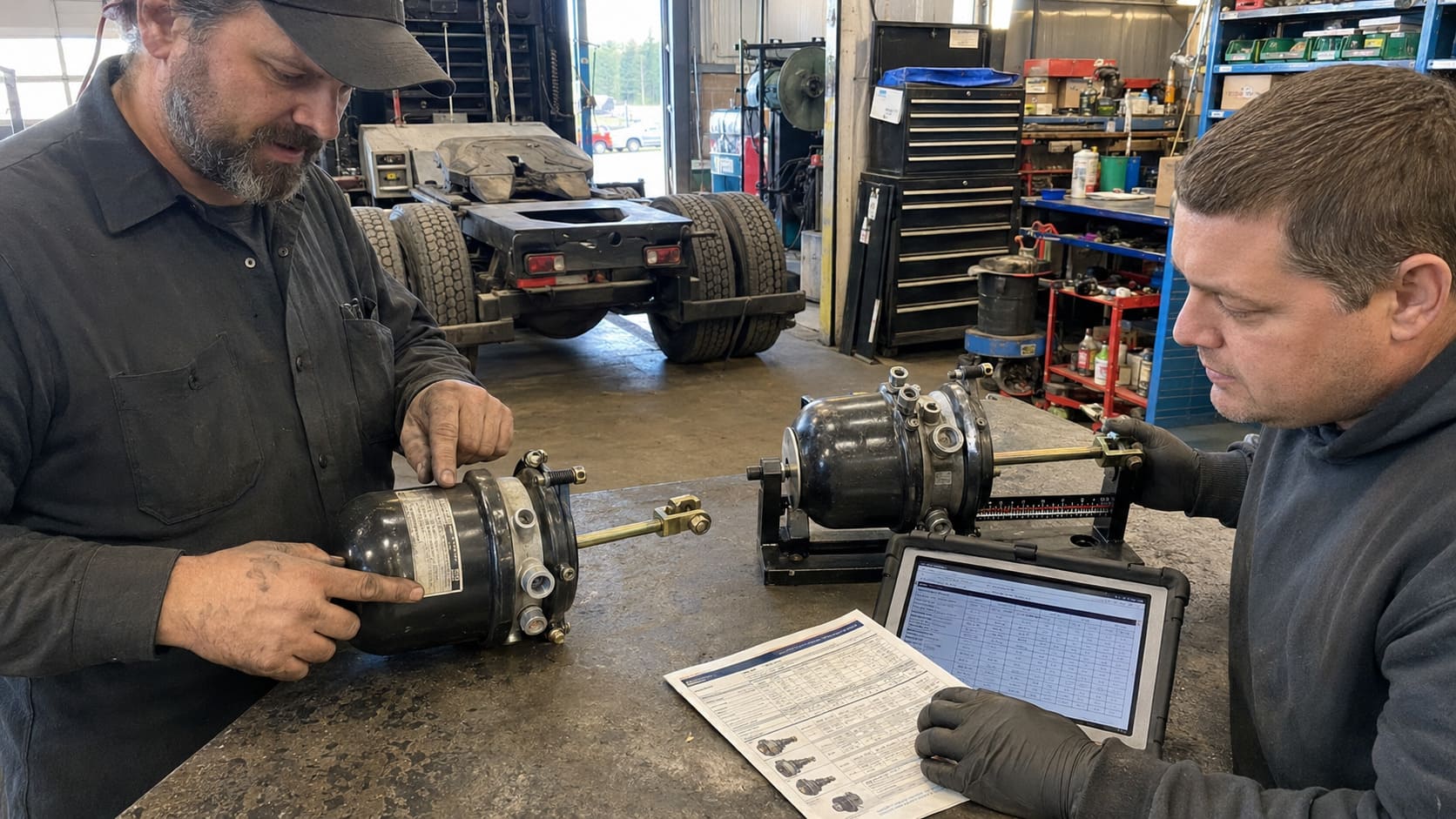
Frequently Asked Questions
What is the maximum pushrod stroke for a semi trailer brake chamber?
The maximum pushrod stroke depends on the chamber type and whether it is a standard or long-stroke design. For the common type 30/30 chamber, the maximum pushrod stroke is 2 inches (51 mm) regardless of whether a manual or automatic slack adjuster is fitted, with 1.5 inches being a typical reading after proper adjustment with new linings .
The FMVSS 393.47(e) adjustment limits for standard-stroke chambers are 1¾ inches for type 16, 20, and 24, and 2 inches for type 30 . Long-stroke variants carry higher limits: 2 inches for types 16, 20, and 24 LS, and 2½ inches for type 30 LS . A stroke at or near the limit means a serious loss of brake force and requires immediate inspection of the foundation brake, slack adjuster, and chamber before the vehicle returns to service. Measurement should be taken with the engine off, reservoir pressure at 90 to 100 psi, and the service brakes fully applied .
How do I identify a long-stroke brake chamber?
Long-stroke brake chambers are identified by at least two of three SAE J1817 methods: trapezoid-shaped stroke tags showing the rated stroke, square-shaped air ports or a square embossment on the pressure cap, and service instructions stamped or embossed on the chamber body . The absence of a recognizable long-stroke marking requires the inspector to treat the chamber as a standard type.
This identification matters because long-stroke chambers have higher adjustment limits than standard chambers of the same nominal size. A type 24 standard chamber has a 1¾-inch limit, while a type 24 long-stroke chamber has a 2-inch limit . Misidentifying a long-stroke chamber as standard, or the reverse, leads to either unnecessary out-of-service violations or a brake operating beyond its safe stroke. Inspectors should be prepared to accept one, two, or all three of the J1817 identifiers, as tags may be missing or markings obscured by corrosion .
What are the most common causes of semi trailer brake chamber failure?
The most common causes of brake chamber failure are moisture ingress and internal corrosion, diaphragm leakage, and a torn pushrod dust boot that allows water and road debris to enter the chamber . These are progressive failures; the chamber rarely fails without warning.
The failure sequence is predictable. A torn rod boot lets water and mud reach the internal spring and diaphragm, causing corrosion that degrades the return spring and diaphragm from the inside . A continuous hissing sound at the chamber indicates diaphragm leakage, which reduces braking force and, on spring chambers, can cause the parking brake to drag or fail to release . External body corrosion is an early warning that the internal components are at risk. A chamber with a leaking diaphragm, a broken spring, or excessive stroke that cannot be corrected by adjustment should be replaced rather than repaired .
Should I replace one brake chamber or both on the same axle?
Replace brake chambers on an axle-pair basis whenever the two chambers show similar age, corrosion, or stroke values. The two chambers on the same axle operate under the same duty cycle and environmental conditions, so they age at similar rates; replacing one and leaving the other creates a risk of brake imbalance between the two wheel ends .
This is not a universal rule for every situation. If one chamber fails prematurely due to a distinct cause—such as impact damage or a manufacturing defect—and the axle-mate is demonstrably healthy, a single replacement may be acceptable. However, when corrosion and stroke values are close between the two chambers, the safer and more economical decision is to renew both. A brake imbalance caused by mismatched chamber response is difficult to diagnose from the driver’s seat and can produce pulling, uneven lining wear, and reduced stopping performance.
What is a proactive replacement schedule for semi trailer brake chambers?
A practical proactive replacement schedule based on fleet operating data is: years 1–3, replace the failed chamber but inspect others closely; years 4–6, for trailers in cold-weather areas using road salt, replace all chambers during the first brake job; and years 6 and beyond, replace all chambers if one fails or during scheduled brake lining replacement .
This schedule reflects the finding that brake chamber fires often occur without warning in trailers over six years old, and that a single brake chamber fire can cost up to $400,000—far exceeding the cost of preventive replacement . Fleets with shorter trade cycles can reduce risk by specifying high-quality chambers upfront, while long-term fleets should prioritize preventive replacement to avoid catastrophic losses. Warranty coverage typically does not extend to corrosion-related failures or fire damage, so the financial argument for proactive replacement rests on avoided losses rather than warranty recovery .
What should I check during a brake chamber inspection?
A brake chamber inspection should cover pushrod stroke, rod boot condition, body corrosion, and air leakage at the clamp band and ports. Stroke measurement is the primary diagnostic; a lengthening stroke indicates lining wear and shows the health of both the brake and the automatic slack adjuster before the chamber itself is at fault .
The inspection sequence should confirm:
-
Stroke measurement: Engine off, 90–100 psi, service brakes applied. Compare against the type-specific FMVSS limit, with a target of at least 6 mm below the limit in good practice .
-
Rod boot: A torn or missing dust boot is the entry point for water and mud; it must be sound at every inspection .
-
Body corrosion: External rust indicates internal moisture exposure and an elevated risk of spring or diaphragm failure .
-
Air leakage: Use soapy water at the clamp band and port area to detect leaks that are not audible .
-
Axle balance: Compare stroke and response between the two chambers on the same axle .
Conclusion
Semi trailer brake chamber maintenance comes down to three practices: knowing the chamber type and its stroke limit before measuring, treating a torn rod boot and body corrosion as early warnings rather than cosmetic issues, and replacing chambers on an axle-pair basis when age and condition suggest they will fail together. The chamber is a safety item whose failure consequences—dragging brakes, wheel-end fires, and brake imbalance—far exceed its unit cost. Fleet inspection programs should include stroke measurement at every major service and a documented replacement schedule that accounts for the trailer’s age and operating environment.