

Introduction
A semi trailer auction is a channel where fleets, dealers, and contractors buy used trailers through competitive bidding rather than negotiated sale. The appeal is the possibility of acquiring equipment below retail asking price; the risk is that the competitive format compresses the time available for inspection and paperwork review, and the winning bid is not the total cost. Auction values for semi trailers have been trending upward, with year-over-year gains reported in the range of 8 to 11 percent depending on the segment, while inventory has declined for more than a year . That combination—tight supply and rising prices—makes disciplined bidding more important, not less.
The operational pressure on auction buyers is that the hammer price is only the first line of the cost worksheet. Auction houses charge a buyer transaction fee or buyer's premium on top of the hammer price; one published schedule for an Australian auction lists an 8.5 percent transaction fee with a minimum per lot, subject to GST . Tiered fee structures are also common, with rates declining on higher-value lots but administrative and online-bidding fees added on top . A buyer who budgets from the hammer price alone will discover a material shortfall at settlement.
This guide examines the fee structure that converts a bid into a landed cost, the inspection priorities that separate a sound trailer from a cosmetic one, and the title and paperwork risks that can leave a purchased trailer unable to be registered or operated.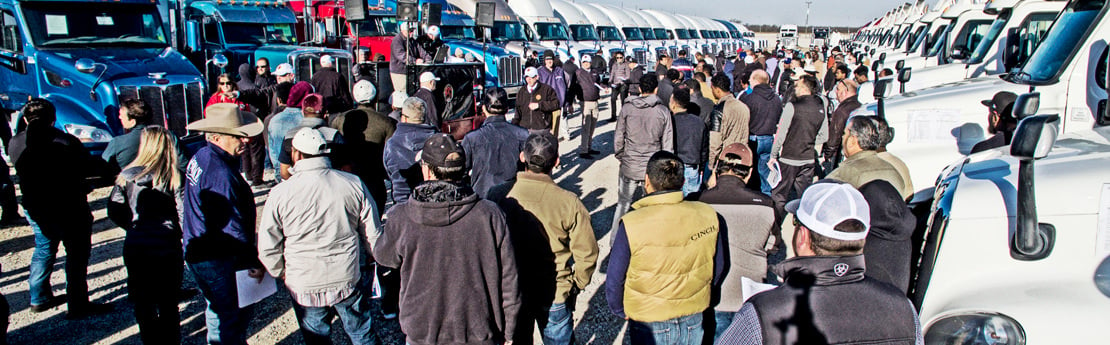
Core Powertrain and Structural Design
Engine and Transmission
A semi trailer has no engine or transmission, so auction inspection focuses on structure and running gear. The tractor that moves it is a separate asset and outside the scope of the trailer purchase. What matters at auction is whether the trailer can be legally operated and whether its structural condition supports the load it will carry.
Hydraulic System
Standard dry van and flatbed trailers have no hydraulic system beyond landing gear. Specialized trailers—dump trailers, lowbeds with hydraulic goosenecks, car haulers—require hydraulic inspection that may not be possible at an auction yard. A dump trailer's lifting cylinder piston rod should be smooth and free of vertical scratches or rust spots; a scratched rod can lead to seal failure and a repair bill that consumes a quarter of the vehicle's price . Where the auction does not permit lifting the body or operating the hydraulic system, the buyer must decide whether the risk is acceptable or whether to bid only after a third-party inspection.
Chassis and Structural Durability
The frame and underbody are the first inspection priority. Look for rust, cracks, weld marks, or previous damage, with particular attention to welds, crossmembers, and the upper coupler assembly . Surface rust is common on older trailers and often cosmetic; deep corrosion, flaking steel, or perforated sections indicate structural weakening. Frame deformation may not be immediately visible, but indicators include doors that do not close properly, irregular tire wear patterns, or a trailer that does not track straight behind the tractor .
Repairs are not automatically disqualifying, but sloppy welds or illogical reinforcement plates warrant closer scrutiny or rejection. Professional repairs documented in the maintenance records are a different proposition from field repairs that conceal damage .
Technical Specifications
The table below presents the auction cost and inspection parameters that determine whether a winning bid is a sound purchase. Fee structures vary by auction house, region, and event; buyers must confirm the applicable terms on the specific sale.
Comparative Advantages TCO and ROI
The auction decision is a total cost versus retail convenience comparison. A retail dealer or private seller offers the opportunity to inspect at leisure, negotiate, and verify paperwork before payment. An auction compresses those steps into a pre-bid inspection window and a settlement deadline, and adds buyer fees on top of the hammer price.
A defensible cost worksheet requires stated assumptions. Consider a trailer with a hammer price of 100,000 CNY. At an 8.5 percent buyer fee, the settlement cost is 108,500 CNY before transport, immediate repairs, and registration . If the trailer requires brake chambers, tires, and suspension bushings at an estimated 15,000 CNY, the effective acquisition cost is 123,500 CNY. A retail unit at 120,000 CNY with a documented maintenance history and the ability to inspect without time pressure may be the better value despite the higher headline price. The auction advantage exists only when the hammer price plus fees plus catch-up maintenance is materially below the retail alternative.
Inventory conditions affect the calculation. Used semi trailer inventory has declined for more than a year, and auction values have risen . Tight supply means more bidders competing for fewer units, which pushes hammer prices toward or above the retail equivalent. The buyer who assumes auctions are always cheaper has not checked the current market.
Title and paperwork carry a cost that is easy to overlook. A trailer without a clean title cannot be registered or legally operated. Some states have bonded title processes that allow a buyer to establish ownership when documentation is missing, but the process involves a VIN inspection, a surety bond, and a state application, with a bond period of three to five years before a standard title is issued . That delay is a real cost—the trailer sits idle while the paperwork is resolved.
Heavy Duty Application Scenarios
-
Fleet expansion at volume: Auctions can supply multiple units of similar configuration, which suits fleets standardizing on a trailer type. The trade-off is that each unit must be inspected, and the fleet must have the maintenance capability to address the catch-up work that auction units often require.
-
Specialized or low-volume equipment: A lowboy, tanker, or dump trailer that is scarce in the retail market may appear at auction. The buyer must weigh the scarcity value against the limited inspection opportunity and the hydraulic or structural risks that are harder to assess in a yard .
-
Dealer and reseller inventory: Dealers buying at auction must account for the buyer fee, transport, reconditioning, and resale margin. The economics are tighter than for an end-user fleet that captures the trailer's productive value directly.
-
Title-defective units: A trailer with a missing or defective title may be priced at a discount. The buyer must factor in the bonded title process, the bond period, and the risk that the state will not issue a title if ownership cannot be established .
Selection and Maintenance Considerations
Auction buying begins with the pre-bid inspection and the full cost worksheet, not the opening bid. The first question is: what is the total settlement cost including buyer fees, transport, and anticipated repairs? The second is: can the title be transferred cleanly and the trailer registered in the operating jurisdiction?
Key considerations include:
-
Confirm the buyer fee and settlement terms before bidding. The fee may be a flat percentage, a tiered structure, or a combination with administrative and online-bidding charges. The settlement deadline and accepted payment methods are also part of the bid decision .
-
Inspect in person or commission an independent inspection. Auction houses typically permit pre-bid inspection and recommend it. If the buyer cannot attend, a third-party inspector with a written condition report is the alternative . Photos and listing descriptions are not a substitute.
-
Check the frame, brakes, tires, and floor systematically. Look for cracks at welds and suspension hangers, confirm air lines hold pressure and lining has at least 1/4 inch remaining, check for even tire wear, and walk the floor for soft spots .
-
Verify the title and paperwork before bidding. Confirm that the title is clean, the seller is the legal owner, and there is no lien history. If the title is missing or defective, understand the bonded title process and timeline in the buyer's state before committing .
-
Budget for catch-up maintenance. Auction trailers are sold as-is, and the buyer should assume that brakes, tires, and suspension components may need attention within the first year. The repair allowance is part of the bid price, not an unexpected cost after the fact.
Conclusion
A semi trailer auction is a procurement channel, not a discount guarantee. The engineering priorities are clear: inspect the frame for cracks and corrosion at welds and suspension hangers, verify brake system function and tire wear patterns, and confirm that the title can be transferred cleanly. The commercial priorities are equally clear: calculate the total settlement cost including the buyer fee, transport, and a catch-up maintenance allowance, and compare that total against the retail alternative before bidding.
Fleets that treat the auction as a disciplined acquisition process—with a pre-bid inspection, a written cost worksheet, and title verification—can find sound equipment at competitive prices. Fleets that bid on the hammer price alone discover the buyer fee, the repair bill, and the title problem after the gavel falls. The trailer that passes inspection, registers cleanly, and carries its load without immediate repair is the one that was bought with a cost worksheet rather than a hope.