

Overview
A standard 53-foot semi trailer fits 26 standard 48×40-inch GMA pallets when loaded straight, but the count rises to 28 pallets when pinwheeled and 30 pallets when the pallets are turned sideways so the 40-inch side runs along the trailer length. The exact number depends on the pallet size, the loading pattern, and the weight limits, not on the trailer length alone.
For fleet managers and logistics planners, the pallet count is a cube-planning figure, not a payload guarantee. A trailer that can physically hold 30 pallets may be limited to fewer by the 45,000-pound payload ceiling or by the axle weight limits on the route. This FAQ addresses the pallet counts for the dominant trailer types, the loading patterns that change them, and the constraints that reduce the count below the floor-space maximum.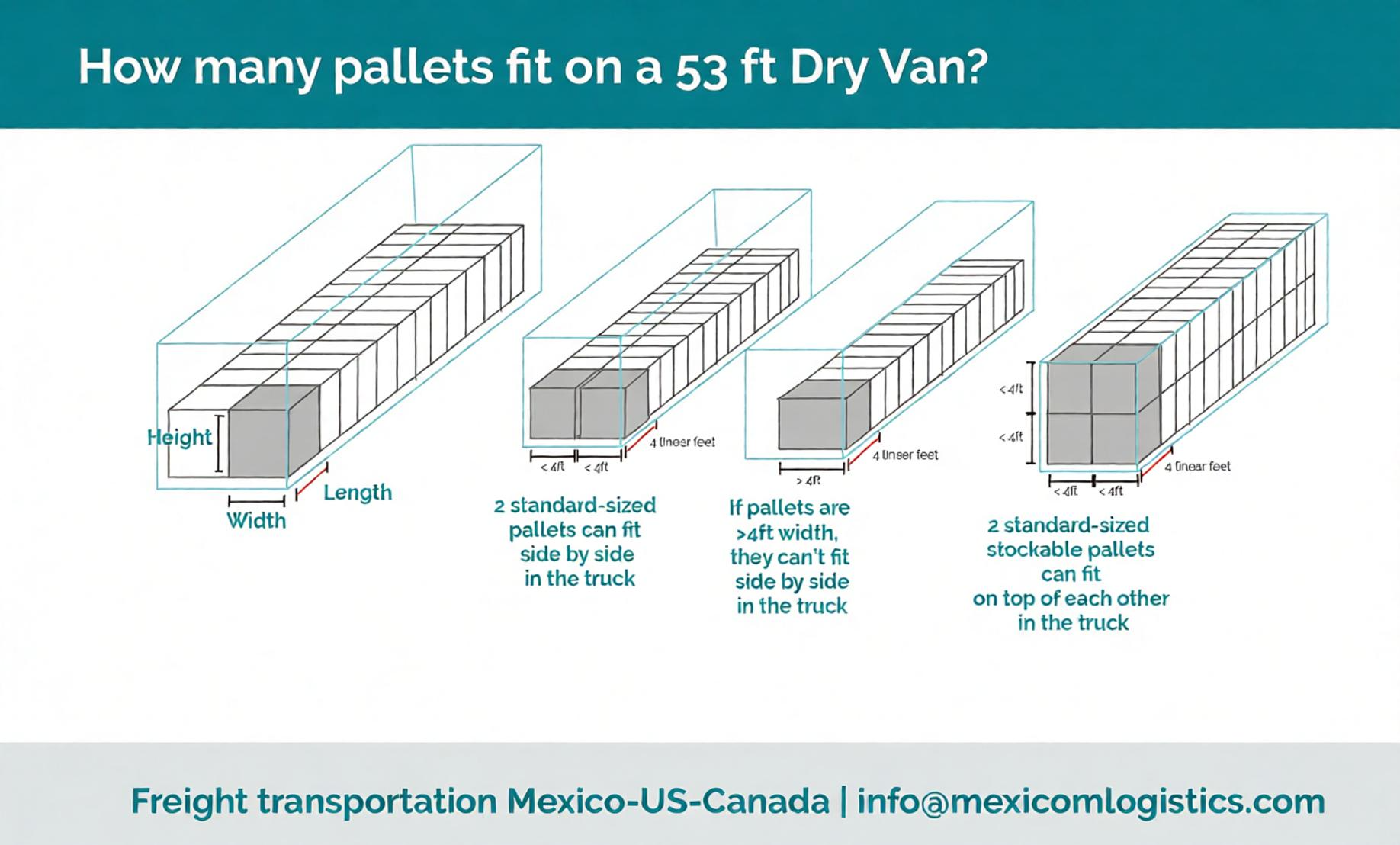
Frequently Asked Questions
How many standard GMA pallets fit in a 53-foot semi trailer?
A 53-foot semi trailer holds 26 standard 48×40-inch GMA pallets in a straight load, 28 pallets in a pinwheel arrangement, and 30 pallets when the pallets are turned 90 degrees so the 40-inch side runs along the trailer length. The straight load aligns 13 pallets lengthwise in two rows; the turned load fits 15 pallets lengthwise in two rows, using the trailer floor more efficiently.
The turned configuration adds four pallets without changing the trailer, which can reduce the number of trips for light freight. However, the straight load is faster to unload at the dock, and the turned load may leave less room for door clearance or load restraint. Fleets should confirm the layout against the actual cargo weight and the dock’s forklift access before standardizing on one pattern.
How many Euro pallets fit in a 13.6-meter European semi trailer?
A standard 13.6-meter European semi trailer fits 33 Euro pallets (1200×800 mm) in a single layer, arranged in three rows of 11 pallets each. This is the common baseline for European road freight, and it reflects the trailer’s internal width of approximately 2.48 meters and internal length of 13.6 meters.
The 33-pallet count assumes the pallets are loaded in the standard orientation with the 1200 mm side across the trailer width. If the cargo can be double-stacked, the count rises to 66 pallet positions, but the trailer’s payload of around 24 tons may become the binding constraint before the floor space is fully used, depending on product density.
How many pallets fit in a 28-foot pup trailer?
A standard 28-foot pup trailer accommodates 14 standard pallet positions on its floor, with a payload capacity of up to 22,500 pounds. This is the common specification for LTL doubles operations, where the trailer is paired with a second pup to provide more cube than a single 53-footer for light freight.
The 14-pallet count is a floor-space figure and assumes single-layer loading. Specialized pup trailers with internal elevator systems can increase the pallet count by using the space between the axles for vertical stacking, but these are not standard equipment. For routine doubles operation, the 14-position baseline is the planning figure.
Does double-stacking increase the pallet count?
Double-stacking can double the pallet positions from 26 to 52 in a 53-foot trailer, or from 33 to 66 in a 13.6-meter European trailer, but only if the cargo height and weight allow it. The trailer’s interior height of approximately 110 inches limits the combined stack height, and the cargo must be stable enough to support a second layer.
Stacking is practical for light, uniform cartons and boxed goods, but it is not appropriate for liquids, tall items, or loads that cannot bear weight on top. The weight limit may also bind before the stacked positions are filled: a 53-foot trailer with a 45,000-pound payload caps out at roughly 30 pallets if each loaded pallet weighs 1,500 pounds. The decision should be modeled against both the height and the weight limit for the specific freight.
What factors reduce the pallet count below these figures?
The pallet count drops below the floor-space maximum when pallet dimensions differ from the standard, when weight limits bind before the floor is full, or when load securement and door clearance require leaving space empty. A non-standard pallet size changes the number of pallets that fit across the width and along the length, and the calculation must be redone for that footprint.
Weight is the most common constraint for dense freight. A trailer that can physically hold 30 pallets may be limited to fewer if the total payload approaches the 45,000-pound ceiling or the axle weight limits. Door clearance and load bars can also consume a pallet position at the rear. Fleets should calculate both the cube and the weight utilization for their actual product mix rather than relying on the floor-space count alone.
What is the pallet capacity of a refrigerated semi trailer?
A refrigerated semi trailer typically fits 26 standard pallets in a 53-foot configuration, the same floor-space count as a dry van, but the interior height is reduced by the ceiling insulation and air chute. The reduced height can limit double-stacking and may lower the effective pallet count for tall cargo.
The reefer’s insulation also reduces the internal width slightly, and the air chute along the ceiling must remain unobstructed for cold air to reach the rear of the load. A reefer loaded to the full 26-pallet count with tall pallets may block the air chute, causing a temperature failure even though the unit is running correctly. The pallet layout in a reefer should account for the airflow path, not just the floor dimensions.
How do I calculate pallet count for a non-standard pallet size?
Calculate the count by dividing the trailer’s internal length by the pallet’s length along the trailer and the internal width by the pallet’s width across the trailer, then multiplying the two results and checking the alternate orientation. The higher of the two orientations is the maximum floor-space count.
The calculation should use the trailer’s internal dimensions, not the external length and width, because wall thickness and door framing reduce the usable floor space. For a 53-foot trailer with an internal length of approximately 52 feet 6 inches and an internal width of approximately 8 feet 2 inches, the floor-space count is derived from the actual fit. The result should then be compared against the weight limit to determine which constraint binds for the specific cargo.
Conclusion
Pallet counts in a semi trailer come down to three variables: trailer length, pallet size, and loading pattern. A 53-foot trailer fits 26–30 standard GMA pallets in a single layer depending on orientation, while a 13.6-meter European trailer fits 33 Euro pallets and a 28-foot pup fits 14 pallets. Double-stacking can double those figures if height and weight permit, but dense cargo often hits the payload limit before the floor space is exhausted. Fleets should confirm the layout and weight against the specific trailer’s interior dimensions and legal axle limits rather than planning from a generic count.