

Introduction
Transporting bulk cement efficiently requires more than a high-capacity trailer. Cement is a fine, abrasive powder that must remain dry, protected from contamination, and easy to discharge at the destination. For cement producers, construction-material distributors, logistics companies, and industrial fleet operators, equipment selection directly affects delivery productivity, product quality, maintenance costs, and vehicle utilization.
A bulk cement semi trailer is a specialized road transport trailer equipped with an enclosed tank and a pneumatic discharge system. It is designed to carry dry cement and compatible powdered materials from manufacturing plants, distribution terminals, and storage facilities to construction sites, concrete batching plants, and industrial customers. Compressed air fluidizes the powder inside the tank and helps move it through discharge pipes into receiving silos.
Unlike a conventional flatbed or general-purpose tanker, a cement tanker trailer must manage several engineering requirements simultaneously: pressure-vessel integrity, powder flow, air supply, structural strength, axle loading, and safe unloading. A well-matched configuration can reduce material losses, limit moisture exposure, and improve the efficiency of repeated loading and delivery cycles.
The most important purchasing considerations include tank capacity, allowable gross vehicle weight, tank construction, compressor performance, discharge layout, suspension, braking equipment, and local road regulations. These factors should be evaluated together rather than selecting a trailer based on tank volume alone.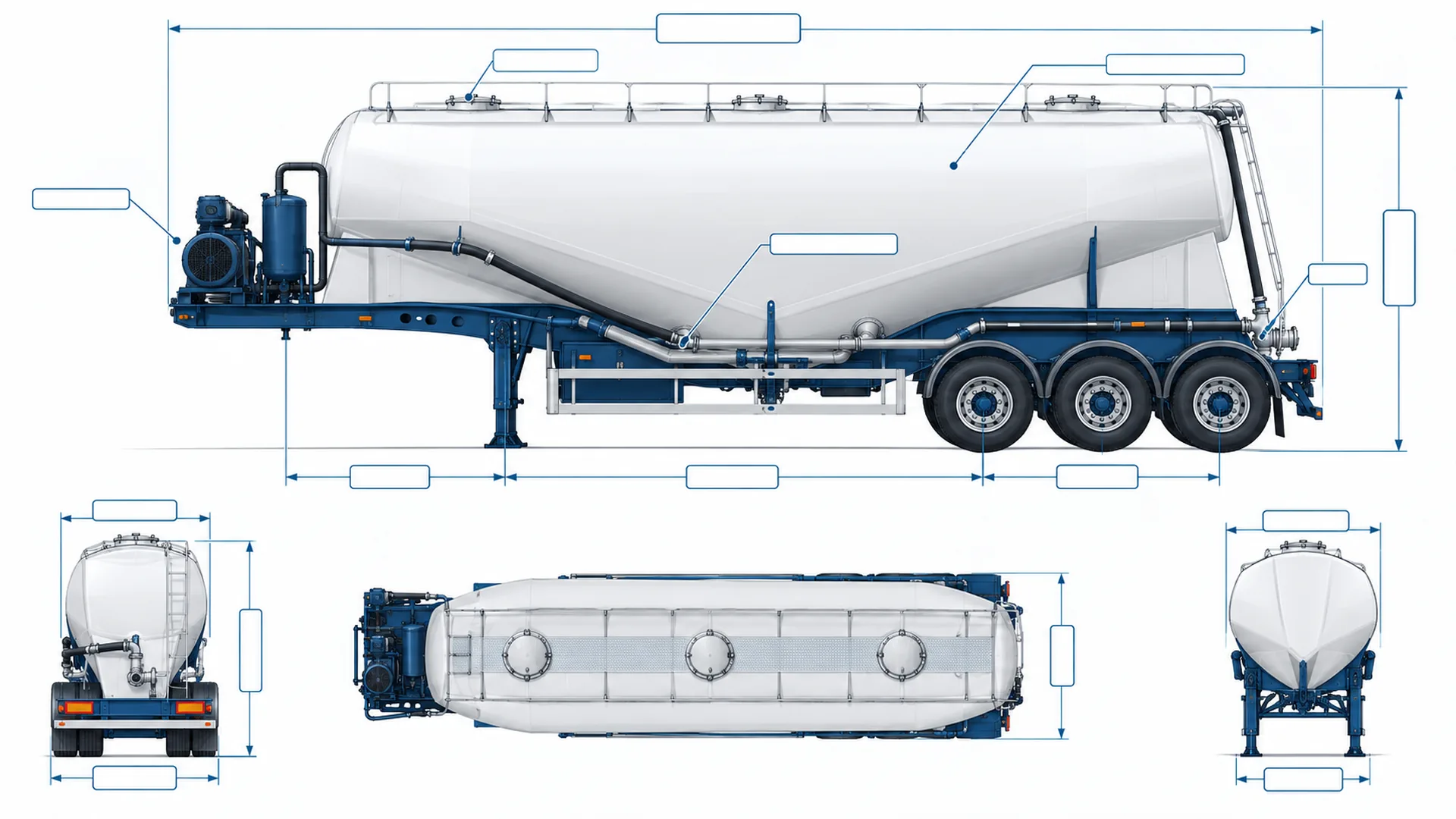
Core Powertrain and Structural Design
A bulk cement semi trailer is generally an unpowered vehicle. It receives its road-driving power from the tractor unit, while its pneumatic unloading system may use a tractor-driven power take-off (PTO), an independent engine, or another compatible power source, depending on the design.
Tractor Compatibility and Pneumatic Power Source
The tractor unit provides the traction, electrical supply, and braking connection required for normal road operation. Its engine and transmission must be suitable for the combined operating weight, road gradient, travel distance, and expected delivery frequency.
The pneumatic unloading system has a separate function from road propulsion. It supplies compressed air to the tank's aeration and discharge arrangements. Common configurations include:
-
PTO-driven compressor systems: The compressor receives mechanical power from the tractor through a power take-off arrangement.
-
Independent diesel compressor systems: A separate engine powers the compressor, allowing unloading without relying on the tractor's PTO configuration.
-
Other manufacturer-approved power arrangements: These may be used where the trailer and tractor have specific mechanical or electrical compatibility requirements.
The appropriate option depends on the tractor specification, unloading frequency, operating environment, maintenance resources, and customer preference. Before purchasing, buyers should confirm the required PTO speed, power rating, connection arrangement, compressor capacity, and operating instructions.
Pneumatic Discharge System
The pneumatic discharge system is the defining functional component of a bulk cement semi trailer. It uses compressed air to support powder movement and transfer cement through discharge pipelines into a storage silo.
A typical system includes:
-
Air compressor and associated drive system
-
Air receiver and air-treatment components, where specified
-
Aeration pads or fluidizing elements
-
Discharge valves and pipelines
-
Pressure monitoring and protective devices
-
Connections for the receiving silo
Aeration is the controlled introduction of air into the powder to reduce resistance to flow. This allows cement to move toward the discharge outlet more consistently. The effectiveness of the system depends on tank geometry, powder characteristics, air distribution, moisture conditions, and the receiving facility.
Compressor capacity should not be assessed in isolation. The required air delivery, operating pressure, pipeline diameter, discharge distance, and receiving silo arrangement must be considered as one system. A compressor that is poorly matched to the tank or unloading conditions can result in slow discharge, excessive operating time, or unnecessary energy consumption.
Tank Structure and Material Selection
The tank is the primary load-bearing container for the transported powder. It must maintain structural integrity under road vibration, payload loading, and the pressure conditions specified for the pneumatic discharge system.
Common construction materials include carbon steel and aluminum alloy.
Carbon steel tanks are widely used where structural durability, repairability, and initial purchase cost are important. Their disadvantages may include greater tare weight and the need for appropriate corrosion protection.
Aluminum alloy tanks can reduce empty trailer weight, potentially allowing a greater legal payload under applicable gross-weight limits. However, aluminum construction may involve a higher purchase price and requires careful consideration of material thickness, structural design, fatigue resistance, and repair capability.
Tank geometry also influences operational performance. Conical sections, internal flow arrangements, and outlet positioning help direct powder toward discharge points. The tank must be designed specifically for its intended pressure and material-handling duty rather than adapted from an ordinary liquid tanker.
Chassis, Axles, and Suspension
The chassis supports the tank and transfers vertical, braking, and dynamic loads to the tractor and road surface. Its design must account for the tank's tare weight, maximum payload, axle distribution, and expected road conditions.
Common configurations include tandem-axle and tri-axle arrangements, although the correct choice depends on the target market and legal weight limits.
Important structural components include:
-
Main longitudinal beams and crossmembers
-
Kingpin and fifth-wheel connection
-
Axle assemblies and suspension
-
Landing gear
-
Wheel and tire assemblies
-
Rear support structure and discharge equipment mounting points
Air suspension is commonly selected for commercial heavy-duty trailers because it can provide suitable ride characteristics and load distribution when correctly configured. Mechanical suspension may also be appropriate for certain operating conditions and cost requirements.
Axle capacity, tire load ratings, wheelbase, kingpin position, and suspension geometry must be coordinated. An incorrectly distributed load can increase tire wear, affect braking stability, and create regulatory problems even when the tank's nominal volume appears suitable.
Structural Durability and Operator Safety
Bulk cement semi trailers operate under repeated loading, road vibration, pressure cycles, and abrasive material exposure. Long-term durability therefore depends on more than the nominal strength of the tank material.
Manufacturing quality, weld integrity, corrosion protection, structural reinforcement, and inspection access all influence service life.
Safety-related equipment should include the protective devices and operating controls required by the applicable design and jurisdiction. Depending on the trailer configuration, these may include pressure-relief protection, pressure gauges, emergency shutoff arrangements, secure access equipment, and suitable ladder and platform provisions.
Operators should receive training on safe pneumatic unloading, pressure monitoring, hose connection, and isolation procedures. The tank must never be operated beyond its approved pressure limits. Any inspection, repair, or maintenance involving a pressurized tank must follow the manufacturer's instructions and applicable safety regulations.
Service Access and Maintainability
The trailer should provide practical access to compressor components, valves, air lines, filters, discharge pipes, suspension parts, and braking equipment.
Accessible components reduce inspection time and make routine maintenance easier. Buyers should also check whether replacement parts are readily available in the destination market, particularly for compressor systems, discharge valves, aeration components, and specialized tank fittings.
A design with complicated or difficult-to-reach components may increase downtime even if its initial purchase price is attractive.
Technical Specifications
Bulk cement semi trailer specifications vary according to tank design, manufacturer, payload requirements, axle configuration, and destination-market regulations. The following table presents common engineering considerations rather than official specifications for a particular model.
|
Key Parameter |
Typical Technical Specification |
Operational Significance |
|---|---|---|
|
Tank capacity |
Common commercial configurations may range from approximately 25–60 m³ |
Determines volumetric carrying capacity and compatibility with delivery requirements |
|
Tank material |
Carbon steel or aluminum alloy |
Affects tare weight, durability, corrosion protection, and payload potential |
|
Axle configuration |
Commonly 2 or 3 axles |
Influences load distribution and legal road-weight compliance |
|
Suspension |
Air suspension or mechanical suspension |
Affects ride characteristics, maintenance, and suitability for road conditions |
|
Discharge system |
Pneumatic unloading with aeration and discharge valves |
Determines powder transfer efficiency and unloading compatibility |
|
Compressor arrangement |
PTO-driven or independently powered |
Must match the tractor, unloading duty, and required air delivery |
|
Operating pressure |
Manufacturer-specified design and working limits |
Determines safe operating conditions for the tank and pneumatic system |
|
Braking system |
Air brakes, with ABS or other required electronic controls where applicable |
Supports braking performance and compliance with local regulations |
Tank capacity and payload are not interchangeable. A larger tank does not automatically mean a higher legal carrying capacity. Cement density, tank geometry, trailer tare weight, axle ratings, tractor capacity, and local gross vehicle weight restrictions all affect the actual payload.
For example, a volumetric tank may have sufficient internal space to hold a certain quantity of cement, but the resulting loaded weight may exceed the legal limit. Buyers should therefore calculate the required volume and payload separately before confirming a configuration.
Compressor performance should also be evaluated against the actual unloading system. Relevant parameters include air delivery, operating pressure, drive power, discharge pipeline dimensions, and expected unloading distance. The manufacturer's approved operating range should take priority over generic industry assumptions.
Comparative Advantages TCO and ROI
A bulk cement semi trailer offers a more specialized transport solution than general-purpose cargo equipment. Its main advantage is the ability to carry dry powdered cement in a sealed tank and transfer it pneumatically into storage silos without relying on individual bags or manual bulk handling.
Compared with bagged cement transport, bulk delivery can reduce packaging requirements and handling labor at facilities designed for silo storage. It can also support larger-volume deliveries and more consistent material transfer. However, the receiving customer must have suitable unloading connections and storage infrastructure.
Compared with a conventional flatbed trailer, a cement tanker offers better protection against moisture, dust exposure, and material loss during transportation. A flatbed may be more versatile for mixed cargo, but it is not a direct substitute for a purpose-built pneumatic cement trailer.
Total cost of ownership (TCO) should include more than the initial trailer price. Major cost categories include:
-
Initial purchase price and financing costs
-
Tractor fuel consumption during transport
-
Compressor fuel or energy consumption during unloading
-
Tire replacement and suspension maintenance
-
Brake-system inspection and repair
-
Compressor, valve, and pipeline maintenance
-
Tank inspection and corrosion protection
-
Downtime and lost delivery opportunities
-
Insurance, registration, and regulatory compliance costs
A useful way to evaluate operating economics is to calculate cost per delivered tonne.
For example, assume a fleet operates one trailer for 250 delivery days annually, carrying an average of 30 tonnes per trip and completing two trips per day. Annual transported volume would be:
250 × 30 × 2 = 15,000 tonnes.
If an alternative configuration reduces operating expenses by an assumed USD 1 per delivered tonne, the theoretical annual operating-cost difference would be USD 15,000. This is an illustrative calculation, not a guaranteed saving. The actual result depends on purchase price, payload legality, route conditions, compressor consumption, maintenance, delivery volume, and utilization.
The comparison should also account for expected service life and resale value. A lighter trailer may improve payload potential where weight restrictions are the limiting factor, while a simpler steel configuration may offer lower initial cost or easier local repair. The best investment is the configuration that achieves the required legal payload and unloading productivity at an acceptable lifecycle cost.
Heavy Duty Application Scenarios
Bulk cement semi trailers are primarily used in industries that require regular transportation of dry cement or compatible powdered materials. Their configuration should reflect the distance between loading and unloading facilities, the material characteristics, and the receiving site's infrastructure.
1. Cement manufacturing and distribution
Cement plants use bulk tankers to transport finished cement to regional distribution terminals, warehouses, and customer facilities. High delivery frequency makes compressor reliability, tank capacity, and maintenance access important purchasing factors.
2. Concrete batching plants
Ready-mix concrete facilities receive bulk cement for storage in silos before mixing it with aggregates, water, and other approved materials. Trailer discharge connections must match the plant's receiving system, including pipeline layout and connection dimensions.
3. Infrastructure and road construction
Large infrastructure projects may require continuous cement deliveries to concrete production facilities. Long transport routes and demanding schedules make legal payload, tractor compatibility, compressor performance, and service support particularly important.
4. Precast concrete manufacturing
Precast factories use cement as a core production material. Reliable bulk deliveries help maintain production continuity and reduce the need for frequent bagged-material handling.
5. Industrial powder transportation
Depending on the tank material, lining, seals, and discharge configuration, some trailers may be suitable for other compatible dry bulk powders. However, cement equipment should not automatically be assumed suitable for every powdered material. Material compatibility, contamination risks, abrasiveness, density, and applicable transport regulations must be checked before use.
The duty cycle influences the most suitable configuration:
-
Short-distance, high-frequency deliveries: Prioritize unloading reliability, compressor serviceability, and maneuverability.
-
Long-distance transportation: Evaluate tare weight, aerodynamic characteristics, axle configuration, tire durability, and tractor fuel consumption.
-
High-volume cement distribution: Balance tank volume against legal payload and receiving silo capacity.
-
Challenging road conditions: Pay particular attention to chassis strength, suspension design, tire selection, and corrosion protection.
Selection and Maintenance Considerations
Selecting a bulk cement semi trailer requires coordination between the transport operator, tractor supplier, trailer manufacturer, and receiving facility. A technically suitable trailer must also comply with the regulations of the country where it will be registered and operated.
How to Select the Right Configuration
Before requesting a quotation, define the following requirements:
-
Required payload: Establish the target legal carrying weight, not just the desired tank volume.
-
Tank capacity: Match internal volume to cement density, delivery frequency, and receiving silo capacity.
-
Tank material: Compare steel and aluminum based on tare weight, budget, repair resources, and corrosion exposure.
-
Axle configuration: Confirm axle ratings, tire specifications, and local axle-load limits.
-
Compressor system: Determine whether a PTO-driven or independent power arrangement is more suitable.
-
Discharge configuration: Confirm outlet quantity, pipeline diameter, hose connections, and unloading distance.
-
Tractor compatibility: Check fifth-wheel height, kingpin dimensions, electrical connections, pneumatic connections, and PTO requirements.
-
Destination-market compliance: Verify braking, lighting, registration, pressure-vessel requirements, and road-weight regulations.
Buyers should request a complete technical drawing, tank design information, axle and suspension specifications, compressor documentation, and details of the safety devices. Where the tank is subject to pressure-vessel regulation, the relevant design approval, manufacturing documentation, inspection records, and conformity requirements should also be confirmed.
Preventive Maintenance
Preventive maintenance is essential because cement powder can be abrasive and may accumulate in pipelines, valves, and aeration components.
A practical maintenance program should cover:
-
Tank inspection: Check for corrosion, visible damage, leakage, and signs of structural deterioration.
-
Pneumatic system: Inspect hoses, fittings, valves, seals, and connections for damage or leakage.
-
Compressor maintenance: Follow the compressor manufacturer's requirements for lubrication, filters, cooling, and scheduled servicing.
-
Aeration components: Check for wear, blockage, or uneven airflow according to approved inspection procedures.
-
Discharge pipeline: Inspect for abrasion, corrosion, loose connections, and material buildup.
-
Axles and suspension: Monitor bearings, tires, suspension components, and wheel fasteners.
-
Braking system: Inspect air lines, brake chambers, valves, ABS components, and other required safety equipment.
-
Electrical system: Check lighting, connectors, wiring, and electronic monitoring devices.
The frequency of maintenance should reflect operating hours, delivery cycles, road conditions, manufacturer recommendations, and local inspection rules. Any abnormal pressure reading, damaged tank component, or suspected leakage should be addressed by qualified personnel before the trailer returns to service.
Operator Training and After-Sales Support
Drivers and unloading operators should understand the trailer's approved operating pressure, connection procedures, emergency controls, and shutdown requirements. Training should also cover safe positioning, securing the vehicle, and communication with receiving-site personnel.
When evaluating a manufacturer, buyers should consider:
-
Availability of replacement parts in the destination country
-
Technical support for compressor and pneumatic systems
-
Warranty coverage for the tank, chassis, axles, and auxiliary equipment
-
Availability of maintenance manuals and technical drawings
-
Experience supplying trailers for the intended transport market
-
Support with export documentation and regulatory requirements
A competitive purchase price is valuable only when supported by reliable manufacturing quality, suitable documentation, and accessible after-sales service.
Conclusion
A bulk cement semi trailer is a specialized investment for transporting dry cement safely and efficiently between manufacturing plants, distribution centers, and industrial receiving facilities. Its performance depends on the combined design of the tank, pneumatic discharge system, compressor, chassis, axles, suspension, and braking equipment.
The most effective buying decision starts with the required legal payload and delivery duty cycle, followed by tank capacity, material selection, unloading compatibility, tractor matching, and destination-market compliance. Buyers should also evaluate maintenance access, component availability, and total cost of ownership rather than focusing exclusively on the initial purchase price.
For cement producers, logistics companies, and construction-material distributors, the right configuration can support reliable bulk delivery, reduce unnecessary material handling, and improve fleet utilization. A carefully specified trailer, supported by preventive maintenance and trained operators, provides a stronger foundation for long-term transport productivity and commercial value.