

Overview
A short semi trailer box—often called a pup trailer or short dry van—is an enclosed cargo trailer built below the standard 53-foot length, typically in the 28-foot to 32-foot range. Fleet managers and procurement teams specify these shorter boxes for urban LTL delivery, multi-stop distribution routes, and applications where a full-length trailer creates maneuvering problems at tight dock approaches or narrow streets.
The procurement problem is not whether short boxes exist—North American carriers have used 28-foot pups for decades, and Chinese factories build them to order—but whether the buyer understands the payload and configuration trade-offs that come with the shorter deck. A short box that looks like a scaled-down 53-footer may carry significantly less payload unless the axle and suspension specifications are upgraded deliberately. This FAQ addresses the length options, capacity ranges, component choices, and export verification steps that determine whether a short semi trailer box meets the fleet’s operational requirements.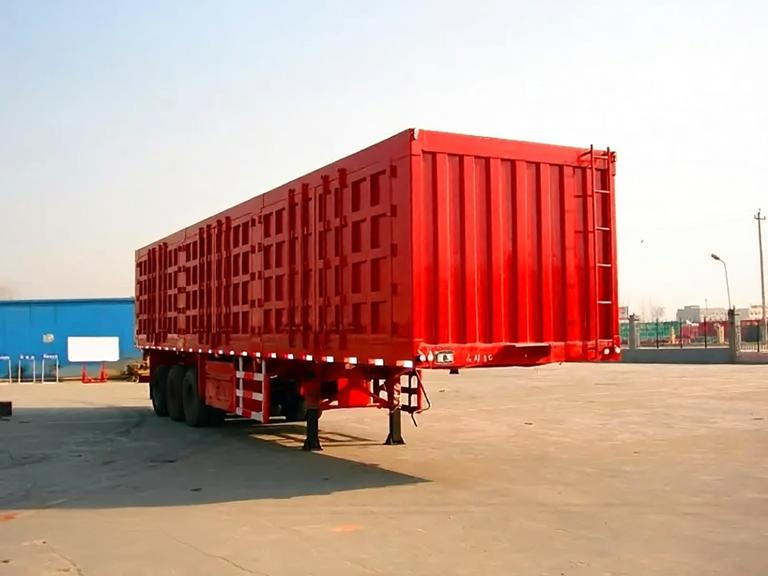
Frequently Asked Questions
What lengths are available for short semi trailer boxes?
Short semi trailer boxes are commonly available in 28-foot and 32-foot lengths from North American trailer manufacturers, with Chinese factories building to these and intermediate dimensions on request. Mckinney Trailers lists dry van lengths from 28 feet through 57 feet, and Manac’s standard dry van lineup spans 28 to 60 feet . The 28-foot pup trailer is the standard North American configuration for urban LTL and multi-trailer combinations, offering superior maneuverability compared to full-length highway trailers . Chinese manufacturers build short boxes to order, with the overall length, internal volume, and payload rating customizable to the buyer’s specification .
What payload can a short semi trailer box carry?
A short semi trailer box typically carries 25 to 40 tons depending on axle configuration and construction, with the shorter length generally rated lower than a standard 40-foot or 53-foot van unless the axles and frame are upgraded. Chinese manufacturer specification tables list a 2-axle light dry van at 25–30 tonnes payload and a 3-axle standard dry van at 35–40 tonnes . The payload rating is governed by the axle group capacity, main beam dimensions, and floor rating—not by the box length alone. A buyer specifying a short box for dense cargo should request reinforced beams and higher-rated axles rather than assuming the standard rating applies.
What axle and suspension options are available for short box trailers?
Short semi trailer boxes are offered with 2, 3, or 4 axle configurations, using FUWA, BPW, or domestic brand axles with mechanical leaf spring or air suspension. Chinese export builders commonly quote 13-ton or 16-ton axles, with 2-axle setups for light urban work and 3-axle setups for standard regional freight . Air suspension is available for fragile loads or applications requiring ride height control. The axle brand choice affects parts availability in the destination market—FUWA and BPW have distributor networks in most export regions, while domestic Chinese brands may require sourcing from the original factory.
What is the typical FOB price range for a short semi trailer box from China?
A short semi trailer box from China typically prices from $7,800 to $12,500 FOB for standard export configurations, with the 2-axle light dry van at the lower end and the 3-axle standard configuration at the higher end. Shandong Nanou’s 2026 price guide lists a 2-axle 40-foot dry van at $7,800–$9,500 and a 3-axle 40-foot dry van at $10,200–$12,500 . A shorter 28-foot box would generally price at or below the 40-foot equivalent, depending on the axle count and component specification. These prices exclude ocean freight, insurance, import duty, and inland transport, which can add substantially to the landed cost.
What documentation should accompany a short semi trailer box export?
A short semi trailer box export should be accompanied by the certificate of origin, commercial invoice, packing list, bill of lading, and the trailer’s VIN or chassis number plate, with additional certification depending on the destination market. Nanou’s buyer guide specifies that every export trailer should ship with a Certificate of Origin, VIN/chassis number plate, axle and tire certificates, and a sales contract matching the invoice, and notes that some countries also require a CCC or COC certificate . The buyer should confirm in writing what conformity documentation the factory can provide for the destination’s registration process, because a trailer that arrives without the required certification may be unusable until the gap is resolved.
What pre-shipment inspection should a buyer require for a short box trailer?
A buyer should require a pre-shipment inspection that verifies dimensions against the order, frame straightness and weld quality, axle brand and quantity, tire condition and date codes, brake and electrical function, and the presence of all specified accessories. Inspection checklists for Chinese semi trailers specify checking the main longitudinal beams and cross members for straightness, examining welds at high-stress areas such as suspension brackets and the kingpin plate, confirming axle model and quantity, and testing the air brake system for leaks with the brakes applied . The inspection should be performed by a third party at the factory before loading, not after arrival at the destination port.
How does a short box trailer compare to a standard 53-foot dry van for fleet use?
A short box trailer trades cargo capacity for maneuverability and route flexibility, making it suitable for urban delivery and multi-stop routes where a 53-footer cannot access tight docks or navigate narrow streets. A 53-foot dry van carries more pallets and offers stronger line-haul economics on long routes with full loads, but it is less maneuverable in city conditions . The short box’s advantage is not payload—it is access: a 28-foot pup can reach locations and complete turns that a full-length trailer cannot, and it can be combined with a second trailer for line-haul capacity where regulations permit. Fleets should select the length based on shipment records and route profiles, not on the largest available capacity.
Conclusion
Specifying a short semi trailer box is a trade-off decision between capacity and access. Confirm the payload rating against the actual cargo density, specify the axle and suspension configuration for the intended duty cycle rather than accepting the base quotation, and verify the export documentation before shipment. The 28-foot pup has a defined role in urban LTL and multi-trailer operations; the trailer that arrives with the correct axles and the right paperwork is the one that enters service without a capacity or registration problem.