

Overview
A semi trailer shot blasting machine is a surface preparation system that uses high-velocity steel shot to clean trailer chassis, frames, and body structures before painting, galvanizing, or powder coating. Fleet managers and repair facility operators encounter this equipment when establishing an in-house refurbishment line, when outsourcing chassis preparation proves too slow or inconsistent, or when a trailer manufacturer specifies shot-blasted surface quality for warranty and coating adhesion requirements.
The procurement problem is not whether shot blasting produces a better surface than manual preparation—it is which machine configuration matches the trailer geometries and production volume the facility actually handles. A hanger-type machine that suspends a complete chassis vertically is a different capital commitment and floor-space requirement from a roller conveyor tunnel that passes long frame sections horizontally. This FAQ addresses the configuration, capacity, and maintenance questions that determine whether a semi trailer shot blasting machine delivers the throughput and surface quality the operation requires.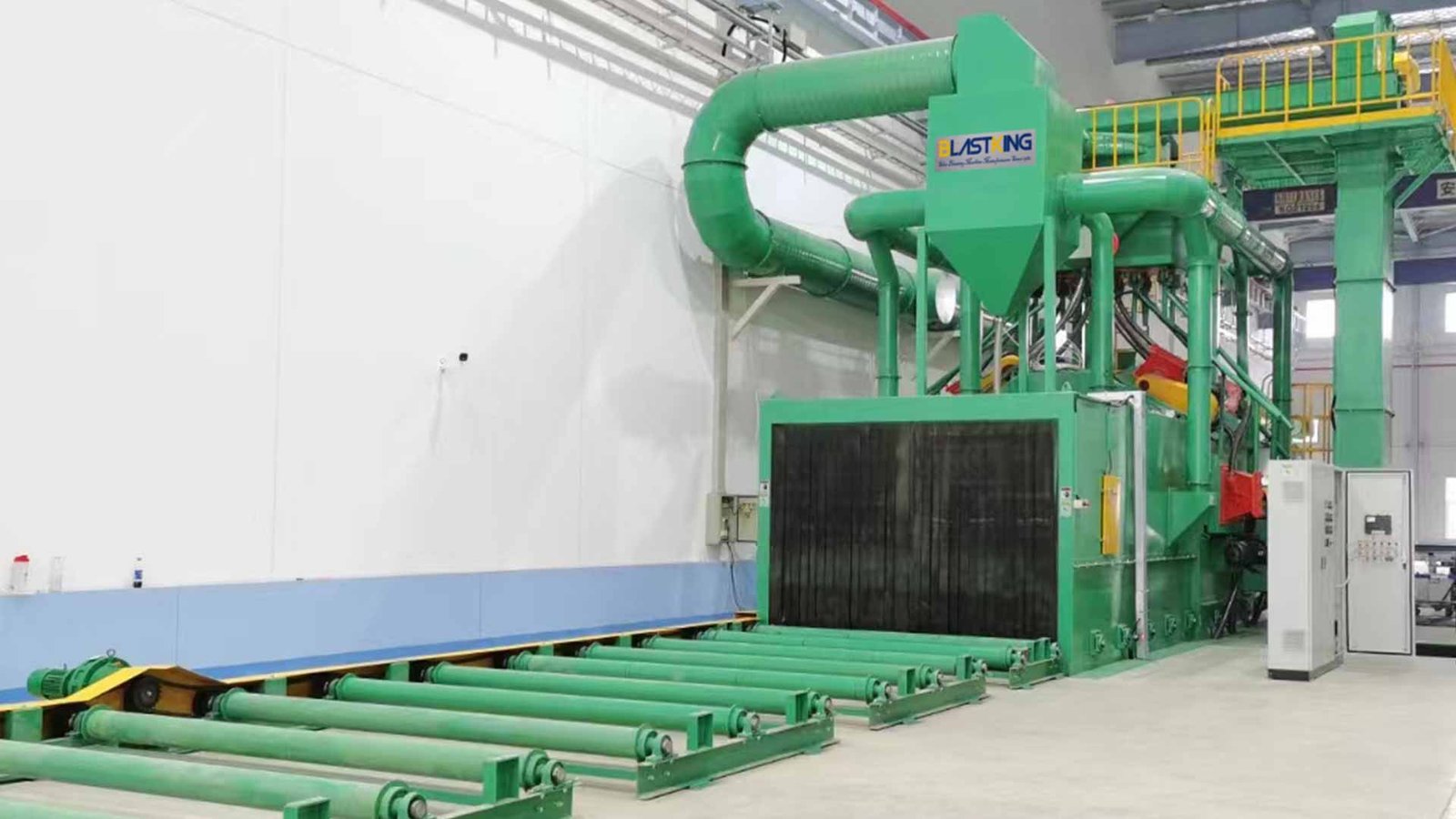
Frequently Asked Questions
What machine configurations are used for semi trailer shot blasting?
Two configurations dominate semi trailer shot blasting: hanger-type machines that suspend the chassis or frame from an overhead trolley or crane, and roller conveyor machines that pass long sections horizontally through a blast tunnel. Hanger systems are suited to complete trailer chassis and bulky fabrications that cannot be conveyed on rollers, with load capacities typically from 1 to 10 tons . Roller conveyor machines are suited to long, relatively uniform sections and can be integrated into a continuous production line, with OMSG supplying a 16-wheel roller machine to Italian trailer manufacturer Omar Rimorchi for chassis treatment before coating . A third configuration, the trolley/crane monorail, combines overhead transport with rotation inside the blast cabinet to expose all surfaces without manual repositioning .
What load capacity is required for a semi trailer chassis shot blasting machine?
A semi trailer shot blasting machine should be rated for a load capacity that exceeds the heaviest chassis or frame assembly the facility will process, with a margin for fixtures and accumulated abrasive. Hanger-type systems for trailer and semi-trailer structures are offered with loading capacities from 1 to 10 tons, with turbine configurations from 3 to 10 units . A production case study from Rösler describes a continuous hanger machine installed at trailer manufacturer Hüffermann with a hanger transport system rated for a maximum payload of 10 metric tons, processing chassis and frames up to 3.2 m wide, 13.0 m long, and 2.0 m high . The capacity specification should be confirmed against the actual chassis weight, not the trailer’s gross vehicle weight rating, because the blasting fixture carries the bare structure.
How many blast wheels are needed for effective trailer chassis cleaning?
The number of blast wheels required depends on the geometry complexity and the required surface coverage, with 3 to 10 turbines common on hanger systems for trailer structures and 12 to 16 wheels typical on high-throughput roller conveyor machines for long sections . Rösler’s installation at Hüffermann uses twelve 11 kW turbines arranged in a ring around the blast chamber, angled to achieve ideal coverage of frontal and rear surfaces as well as the web and flanges, reaching 90 to 95 percent of surface areas automatically with the remainder touched up manually . The procurement implication is that wheel count and angular placement determine whether the machine can clean complex chassis geometries in one pass or requires manual touch-up that erodes the labor savings.
What abrasive consumption should a trailer shot blasting machine expect?
Abrasive consumption for trailer chassis shot blasting varies with machine size and wheel count, with typical ranges from 45 kg/hour on an 8-wheel structural machine to 81 kg/hour on a 12-wheel high-speed configuration . These figures assume continuous production and depend on the steel surface condition, the required cleanliness grade, and the efficiency of the abrasive separation and recycling system. A poorly maintained separator can waste 15 to 25 percent of usable abrasive, and dust content as low as 2 percent in the operating mix can increase equipment wear by 50 percent or more . Fleets budgeting abrasive cost should treat separator maintenance as a direct operating cost control, not a secondary housekeeping task.
What surface cleanliness grade can a semi trailer shot blasting machine achieve?
A semi trailer shot blasting machine with properly configured blast wheels and abrasive can achieve Sa 2.5 to Sa 3 cleanliness grades, which is the standard preparation for protective coating adhesion on trailer chassis . The Rösler installation at Hüffermann was specified to prepare chassis surfaces before hot-dip galvanizing and painting, with the automatic process covering 90 to 95 percent of the surface and manual touch-up limited to 10 to 20 minutes per chassis . Achieving consistent Sa 2.5 requires correct abrasive size and condition, properly maintained blast wheels, and a blast pattern that targets the work piece rather than missing it—worn blades or a misaligned control cage can shift the pattern and leave sections under-blasted .
What are the most common wear parts on a trailer shot blasting machine?
The highest-wear components on a semi trailer shot blasting machine are the blast wheel blades, impeller, control cage, and cabinet liners, all of which are subject to continuous high-velocity abrasive impact . Blade wear beyond 2 mm on one side or cracks requires replacement in groups on some machine designs . Control cage wear of 6 mm on the beveled edge can lengthen the blast pattern to the point that abrasive misses the work piece . Cabinet wear plates and liners protect the machine housing; if worn liners are not replaced, the housing itself becomes damaged and repair costs escalate . Rösler specifies 8 mm manganese steel chamber walls with 25 mm thick overlapping cast steel liners in high-impact zones for its trailer chassis machines .
What preventive maintenance schedule applies to a semi trailer shot blasting machine?
A semi trailer shot blasting machine requires daily, weekly, monthly, and quarterly maintenance tasks, with the separator, blast wheels, and abrasive circulation system as the priority items. Daily checks include cleaning residual shot from the chamber floor and inspecting the separator screen for blockages—if more than one-fifth of screen holes are blocked, clean with a wire brush; if more than three holes are damaged, replace the screen . Weekly tasks include blast wheel blade wear inspection, dust filter backflushing, and vibration monitoring, with vibration exceeding 4 mm per second requiring shutdown for calibration . Monthly tasks include electrical terminal tightening, separator function verification, and motor amperage checks . Quarterly tasks include overhaul of the shot circulation system and safety device testing .
How does a shot blasting machine affect trailer refurbishment total cost of ownership?
A shot blasting machine affects trailer refurbishment total cost of ownership by replacing manual preparation labor with a capital and consumable cost structure, and the break-even point depends on throughput and the cost of the manual process it displaces. The Hüffermann case study documents that the previous manual shot blast process took two employees between three and five hours to prepare one chassis; the automatic machine reduced this to a pass-through operation with 10 to 20 minutes of manual touch-up . For a facility refurbishing multiple chassis per week, the labor savings compound against the machine’s capital cost, abrasive consumption, power draw, and wear-part replacement. The total cost calculation should include abrasive at the quoted kg/hour rate, blast wheel and liner replacement intervals, and the floor space and utilities the machine requires.
Conclusion
Specifying a semi trailer shot blasting machine starts with the chassis geometry and production volume, not the headline wheel count. Confirm whether a hanger or roller conveyor configuration matches the structures being processed, size the load capacity against the heaviest bare chassis, and select blast wheel count and placement for one-pass coverage of complex geometries. The separator and blast wheel maintenance program is the operating cost control: worn components shift the blast pattern, increase abrasive consumption, and erode the labor savings that justified the capital purchase. The manufacturer’s specification for the selected configuration remains the controlling reference for capacity, power, and maintenance intervals.