

Overview
Semi trailer safety steps are the access equipment—fixed steps, folding bumper steps, or portable stairs—that allow drivers, loading crews, and maintenance personnel to reach the trailer deck without relying on improvised climbing. Fleet managers and safety officers encounter this category when auditing fall hazards at loading sites, specifying new trailer builds, or retrofitting aging equipment that was delivered without adequate access provisions.
The regulatory landscape is deliberately non-prescriptive in the United States: OSHA does not specifically require stairs or railings on semi trailers, but the General Duty Clause obligates employers to provide a safe means of access where a fall hazard exists. That gap between specific regulation and general obligation places the specification burden on the fleet. This FAQ addresses the step geometry requirements, product configurations, and procurement criteria that determine whether a semi trailer safety step system meets the operational and compliance needs of a working fleet.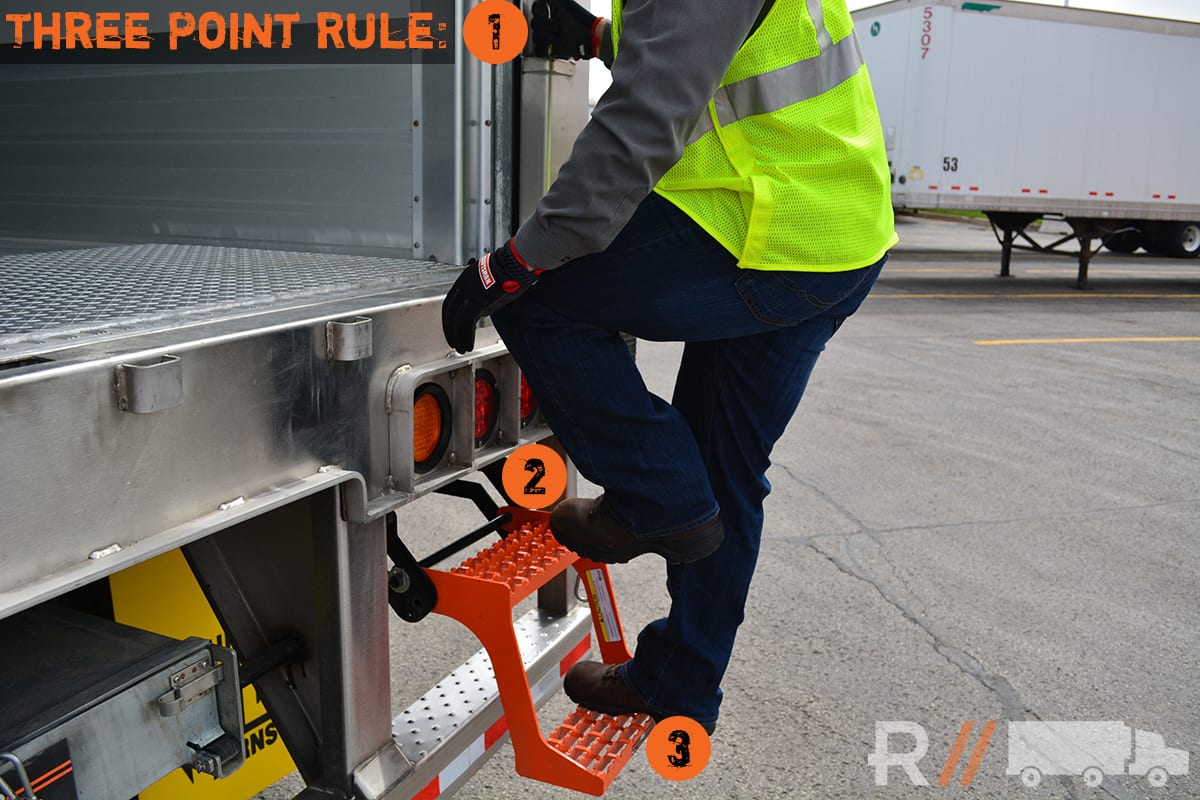
Frequently Asked Questions
Does OSHA require safety steps on semi trailers?
OSHA does not specifically require stairs or railings to access semi trailers, but employers are still obligated under the General Duty Clause to provide a safe means of access where employees face a fall hazard. OSHA’s 2015 interpretation states that while no specific standard mandates trailer access equipment, the employer must provide a safe workplace under Section 5(a)(1) of the OSH Act, and if employees are exposed to a fall hazard entering or exiting the trailer, the employer has the obligation to provide a safe means of access. In practical terms, a fleet cannot rely on the absence of a specific standard as justification for no access provision—the hazard exists, and the employer owns the obligation to address it.
What rung spacing and width requirements apply to semi trailer steps?
OSHA’s general ladder requirements specify rung spacing of not less than 10 inches and not more than 14 inches apart, with a minimum clear width of 11.5 inches on portable ladders and 16 inches for fixed ladders. These dimensions establish the baseline for step geometry on trailer access systems. The first rung or step should be easy to reach from the ground—ideally about 40 cm (16 inches), and never more than 70 cm (28 inches). Rungs and steps should be level and comfortable to use, with a slip-resistant surface that does not allow mud, grease, or oil to accumulate. Grating or open-tread designs allow debris to pass through, maintaining traction in wet or dirty conditions.
What is the difference between fixed and portable semi trailer safety steps?
Fixed steps are permanently mounted to the trailer frame or bumper beam, while portable stairs are positioned beside the trailer during loading and unloading and removed afterward. The choice is determined by trailer type, access frequency, and the operating site. Fixed steps suit dedicated fleets with consistent loading positions, while portable stairs offer flexibility for drop yards and varied sites. A common fixed configuration is the folding rear entry step, which bolts onto the trailer’s bumper beam and stows automatically when the trailer backs up. One representative product in this category carries a 600-pound workload limit, uses 7-gauge steel construction, and features grated treads for traction. Portable hook-on ladders offer an alternative for sites where permanent mounting is impractical, with models specifying step spacing of 235 mm and a maximum load of 150 kg.
What load capacity should a semi trailer safety step be rated for?
A semi trailer safety step should be rated for the heaviest single user plus a margin for dynamic loading, and commercially available fixed bumper steps commonly carry a 600-pound workload limit. This rating reflects the step’s intended use by a single person accessing the cargo area, not for carrying cargo or multiple users simultaneously. Portable ladders in the trailer access category may carry lower ratings—one hook-on model specifies a 150 kg (330 lb) maximum load—so fleets should match the capacity rating to the actual user population and any equipment they may carry while climbing. A step that flexes or deflects under load should be removed from service, as deformation indicates the rating has been exceeded or the mounting has loosened.
What materials are suitable for semi trailer safety steps?
Semi trailer safety steps are commonly constructed from steel or aluminum, with the choice driven by weight, corrosion exposure, and mounting requirements. Fixed bumper steps in the North American market typically use high-strength 7-gauge steel with a zinc-plated finish for corrosion resistance. Portable access ladders favor aluminum construction to keep the unit light enough for one-person positioning—one hook-on model weighs 8 kg for an 8-step ladder. For fleets operating in corrosive environments or washdown-heavy applications, the finish specification matters as much as the base material: galvanized or zinc-plated surfaces resist road chemicals, while bare steel will corrode at welds and mounting points. The step surface should be slip-resistant even when wet, which is why grating and ribbed tread designs are standard in this category.
How should a fleet manager verify that a semi trailer step is safely mounted?
A fleet manager should verify that the step is mounted to the trailer’s structural member—typically the bumper beam or frame rail—using the manufacturer’s specified hardware and torque values, and that the mounting resists vibration and loading cycles. Fixed steps must be securely attached to the trailer frame or body, with brackets that resist vibration and loading cycles. For folding bumper steps, the auto-stowing mechanism should be inspected for proper function: the counter-balanced design should keep the step stowed during travel, and the roller mechanism should allow the step to fold on contact without damage. Mounting hardware should be checked for looseness at each preventive maintenance interval, and any step that shows cracked welds, bent brackets, or a non-functional stow mechanism should be removed from service.
What fall protection measures complement semi trailer safety steps?
Semi trailer safety steps address the access hazard, but they do not replace fall protection for work performed on the trailer deck. SafeWork NSW guidance on flatbed truck falls recommends remaining on the ground during loading and unloading where possible, using pre-configured loads or load restraints to avoid climbing. If working from the ground is not feasible, a safe way to access and work upon the trailer must be provided, which can include guard rails, work platforms, or retractable ladders or steps with handrails. For fleet procurement, this means the step system should be evaluated as part of a broader access strategy: steps get the worker up and down safely, but work performed at height on the deck requires a separate assessment of guard rails, anchor points, or platform solutions depending on the task duration and frequency.
Conclusion
Semi trailer safety steps are a specification decision that sits between a general-duty obligation and a specific product choice. Confirm that the step geometry meets OSHA’s rung spacing and width baselines, match the load rating to the actual user population, and verify that the mounting method attaches to structural members with hardware that will survive vibration and loading cycles. The step is the first point of contact in every trailer access event, and a step that is inadequately rated, poorly mounted, or missing entirely is a hazard that the fleet owns regardless of what the regulation does or does not specifically require.