

Overview
A semi trailer kingpin is the hardened steel pin mounted in the trailer’s upper coupler plate that the tractor’s fifth wheel jaws lock around, forming the only mechanical connection between the towing vehicle and the trailer. For fleet maintenance teams, the kingpin is a wear item with a defined replacement limit and a non-negotiable inspection schedule: a worn or bent kingpin accelerates fifth wheel jaw wear in every tractor it couples to, and a loose or damaged kingpin is a coupling failure risk that roadside inspectors treat as an out-of-service condition.
The inspection practice is standardized. SAE J2228 defines the wear limits for commercial trailer kingpins conforming to SAE J700, and the inspection is recommended every three months or 30,000 miles . This FAQ addresses the sizes, wear limits, inspection procedure, and replacement rules that determine whether a kingpin remains serviceable or must be renewed.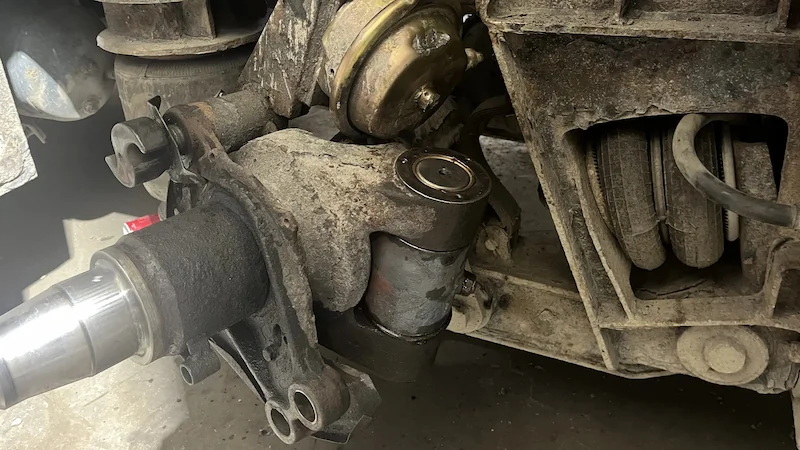
Frequently Asked Questions
What are the standard kingpin sizes for a semi trailer?
The two standard kingpin diameters are 2 inches (50.8 mm) and 3.5 inches (89 mm), defined in SAE J700 and ISO 337 respectively . The 2-inch pin is the dominant specification for highway combinations under normal weight limits, while the 3.5-inch pin is used for extra-heavy-duty and specialized applications.
The kingpin size must match the fifth wheel’s jaw class. A 2-inch kingpin cannot be safely coupled to a fifth wheel designed for a 3.5-inch pin, and a mismatch is a coupling failure risk rather than an inconvenience . Fleets operating mixed tractors and trailers should confirm the kingpin size on the trailer data plate and the fifth wheel class on each tractor before pairing them.
What is the maximum allowable kingpin wear?
The maximum allowable kingpin wear is 1/8 inch (0.125 inch) on the kingpin diameter, measured with an SAE J700 go/no-go gauge . A kingpin that enters the gauge’s out-of-spec area has reached the wear limit and should be replaced.
The gauge is designed as a no-go inspection tool: if the kingpin enters the area marked out of spec, the inspector should confirm the measurement with a caliper or micrometer before replacing the kingpin . The 1/8-inch limit applies to the SAE J700 2-inch kingpin; the same wear allowance is referenced in fifth wheel manufacturer service bulletins for the standard diameters . A kingpin worn beyond this limit allows excessive movement in the fifth wheel jaws, accelerates jaw wear, and can compromise lock security.
How often should a semi trailer kingpin be inspected?
A semi trailer kingpin should be inspected every three months or 30,000 miles, whichever comes first, according to the inspection schedule recommended in SAE J2228 and referenced by fifth wheel manufacturers . The inspection should cover the kingpin’s diameter, straightness, length, mounting security, and surface condition.
The three-month interval is a maintenance recommendation, not a legal inspection requirement. However, the kingpin is a safety-critical coupling component, and a defect that develops between annual inspections can produce a roadside violation or a separation risk. Fleets with high-utilization trailers or trailers operating in corrosive environments should consider a shorter interval based on their own wear data.
How do I check a kingpin for straightness and length?
Check straightness with a square or a dedicated kingpin gauge, and replace the kingpin if it exceeds 1 degree from square in any direction . A bent kingpin accelerates lock wear and may prevent the fifth wheel jaws from closing fully around the pin.
Check length with the same gauge, comparing the measurement against the SAE specification for the upper coupler thickness. If a lube plate is used between the fifth wheel and the upper coupler, the kingpin length must be sized to compensate for the lube plate thickness—a standard-length kingpin installed with a lube plate may sit too short for the jaws to engage fully . An improperly sized kingpin should be replaced rather than shimmed or modified.
Can a worn or damaged kingpin be repaired by welding?
No. A worn, bent, or damaged kingpin must be replaced, not repaired by welding. Kingpins are made from quenched and tempered alloy steel, and weld repairs of any type affect the strength and wear resistance of the pin. Arc strikes or weld craters can develop stress risers that lead to fatigue failure .
The prohibition applies to the kingpin itself, not just to field repairs. A kingpin that has been welded is no longer a certified component, and its heat treatment has been compromised. The replacement kingpin must match the original type and be matched to the upper coupler thickness, and the installation requires a qualified welder and an adequate upper coupler design meeting SAE J133 requirements . A fleet that receives a trailer with a welded kingpin should treat it as a non-compliant coupling and plan for replacement.
What causes a kingpin to wear or become loose?
A kingpin wears from friction against the fifth wheel jaws and from lack of lubrication at the coupling interface. A dry fifth wheel top plate and locking mechanism rapidly consumes both the plate and the pin together, and a jaw-pin clearance that is allowed to grow accelerates the wear on both components .
A kingpin becomes loose from improper mounting, missing or loose fasteners, or a cracked upper coupler structure. A loose mounting causes excessive chucking and rapid lock wear, and it is a safety hazard independent of the kingpin’s own condition . The inspection should check the mounting bolts and the welds around the kingpin attachment at the same interval as the kingpin measurement, because a sound kingpin on a cracked upper coupler is not a secure coupling.
What should a pre-trip coupling inspection check on the kingpin?
A pre-trip coupling inspection should confirm that the fifth wheel jaws are fully closed around the kingpin and that the release handle is in the locked position with the safety catch engaged. The driver should perform a visual check of the lock and a tug test with the trailer brakes applied before the vehicle moves.
The pre-trip check is not a substitute for the quarterly kingpin measurement. It is a confirmation that the coupling is secure for the current trip. If the lock does not engage fully, the driver should pull the release handle, move the tractor away, and repeat the coupling procedure rather than driving with an incomplete lock. A kingpin that is worn near the limit may still couple securely on one tractor and fail to lock on another with a more worn jaw, which is why the measurement is the controlling check.
Conclusion
Semi trailer kingpin maintenance comes down to three practices: measuring the diameter against the 1/8-inch SAE J2228 wear limit with a go/no-go gauge, inspecting every three months or 30,000 miles for wear, straightness, length, and mounting security, and replacing rather than welding any kingpin that is worn, bent, or damaged . The kingpin is the single point of mechanical connection between the tractor and trailer, and its condition determines whether the fifth wheel lock can hold. A kingpin that passes the gauge check and sits on a sound upper coupler is a secure coupling; one that has been welded, worn past the limit, or mounted on a cracked plate is a risk that no amount of fifth wheel adjustment can correct. The SAE J2228 inspection criteria and the fifth wheel manufacturer’s service bulletin remain the controlling references for every measurement and replacement decision.