

Overview
Semi trailer fenders are protective covers mounted above the wheels to deflect road debris, water spray, and mud away from the trailer body and following traffic. For fleet managers and procurement teams, the fender is a low-cost component with a high-consequence failure mode: a fender that contacts the tire under suspension travel damages both the tire and the fender, and a fender that cracks and separates at highway speed becomes a road hazard.
The material choice—steel, aluminum, or plastic—determines the fender’s weight, corrosion behavior, and impact durability, while the mounting method determines whether it survives years of vibration or cracks within a season. This FAQ addresses the material trade-offs, clearance requirements, mounting practices, and maintenance checks that matter most when specifying or replacing semi trailer fenders.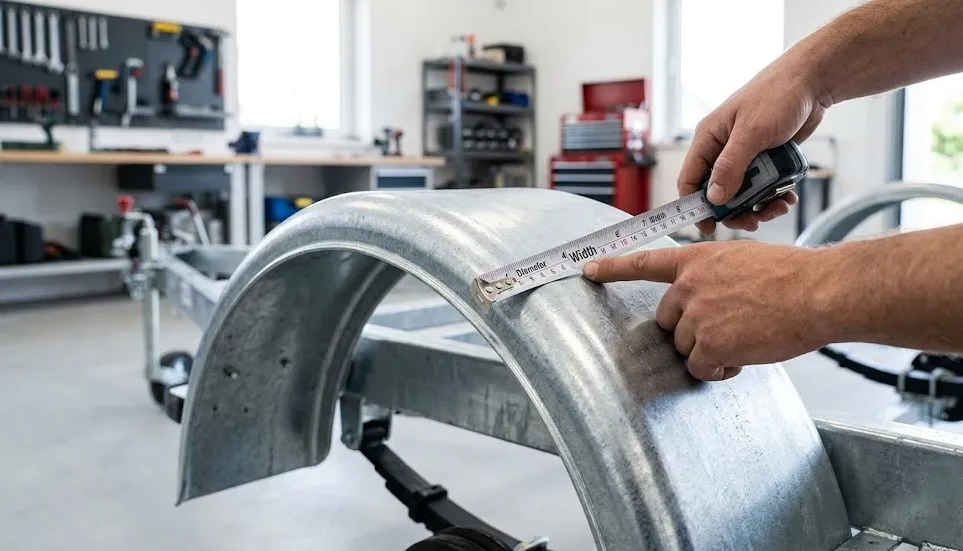
Frequently Asked Questions
What materials are used for semi trailer fenders?
Semi trailer fenders are commonly made from steel, aluminum, or plastic, with each material offering a different balance of durability, weight, and corrosion resistance. Steel fenders are durable and suitable for welding, but they can rust in salty or wet environments unless properly coated. Aluminum fenders resist rust, are lightweight, and are preferable for coastal areas or winter-salt exposure. Plastic fenders are flexible, resist cracking, and are suitable for lighter applications or environments where rust is a concern .
For heavy-duty semi trailer service, the material choice should follow the duty cycle. A fleet operating in corrosive environments with weight-sensitive payloads should default to aluminum. A construction or remote-site operation prioritizing impact durability may accept the weight penalty of steel. Plastic fenders are generally not specified for heavy-duty semi trailer service because their impact resistance and mounting rigidity are lower than metal alternatives.
What is the minimum clearance between a fender and the tire?
The minimum clearance between a fender and the tire is 3 degrees of angular clearance, measured to ensure the fender does not contact the tire under any operating condition. For trailers with air ride suspension, the clearance must be verified with the suspension deflated, because the tire rises closer to the fender when air pressure is released .
Clearance is the single most important installation dimension. A fender mounted too close will contact the tire during suspension compression on uneven roads or under load, damaging the tire sidewall and cracking the fender. A fender mounted too high leaves a gap that allows debris and spray to escape, reducing the fender’s protective function. The 3-degree minimum is a starting specification; the trailer manufacturer’s body builder guidelines may require more clearance for specific suspension and tire combinations.
How should a semi trailer fender be mounted?
A semi trailer fender should be mounted with brackets positioned no more than 6 inches from the end of the fender, and tube-style brackets should not extend more than halfway up the fender’s curve, to prevent excess vibration. Rubber isolators should be placed between the fender and the mounting brackets before drilling or tightening .
The mounting sequence should confirm that the fender is positioned over the tire with the required clearance, that the mount tubes and brackets are square to the fender, and that all fasteners are tightened evenly. Drilling the trailer frame should follow the manufacturer’s recommendations, and existing frame holes should be used where possible. A fender mounted with brackets too far from the ends or without rubber isolation will flex more under vibration, which is the primary cause of cracking in aluminum and plastic fenders.
Why do semi trailer fenders crack, and how can it be prevented?
Semi trailer fenders crack primarily from fatigue failure caused by flexing beyond the material’s elastic limit, not from vibration alone. A fender mounted without adequate bracing will flex as the trailer moves over uneven roads, and repeated flexing at the mounting points or along the unsupported span eventually produces a crack.
Prevention follows from the failure mechanism. The fender should be braced to reduce flexing, particularly on long tandem-axle fenders where the unsupported span between the tires is greatest. Mounting hardware should be tightened to specification and checked periodically, because a loose fender moves more than a tight one. Rubber pads or washers between the fender and the bracket reduce vibration transmission and prevent metal-to-metal rubbing. A cracked fender can sometimes be repaired by welding and adding bracing, but a fender that cracked from inadequate support will crack again unless the bracing is corrected.
What hardware is recommended for mounting semi trailer fenders?
Stainless steel bolts and nylon-insert locknuts are recommended for mounting semi trailer fenders, with rubber washers or isolators placed between the fender and the bracket to reduce vibration and prevent fastener loosening. Carriage bolts are commonly used for frame-style brackets, with rubber washers, metal washers, and nylock nuts to distribute the clamping force and protect the fender surface .
The hardware choice matters because a fender that loses a fastener begins to flex at the remaining attachment points, accelerating fatigue. Locknuts resist vibration loosening better than standard nuts. Rubber washers serve two functions: they isolate the fender from bracket vibration and they seal the mounting hole against water intrusion, which is particularly important for steel fenders where corrosion at the mounting point can enlarge the hole.
What maintenance do semi trailer fenders require?
Semi trailer fenders require periodic inspection of the mounting hardware for tightness, the fender surface for cracks, and the clearance between the fender and the tire. The inspection should be performed at every preventive maintenance interval and after any impact with a dock, curb, or road debris.
The maintenance routine should cover:
-
Hardware check: Inspect bolts and brackets for loosening, rust streaks, or elongation at the mounting holes.
-
Crack inspection: Check the fender surface and mounting points for hairline cracks, particularly after any impact or rough-road operation.
-
Clearance check: Confirm that the fender has not shifted into contact with the tire or suspension components.
-
Corrosion check (steel fenders): Inspect for rust at the mounting points and along the lower edge, where road spray accumulates.
Does a semi trailer legally require fenders?
Fender requirements vary by jurisdiction, but many states require trailers and semi trailers to be equipped with adequate fenders to cover the tires, unless the trailer’s body or load-carrying area covers the tires. Wisconsin’s administrative code, for example, requires every trailer or semi trailer to have adequate fenders, and specifies that fenders or mudguards must cover the tire from a line drawn vertically through the center of the axle and extend rearward and downward, and must be at least as wide as the tire they protect .
The legal requirement is a minimum standard, not a maintenance target. A fender that is present but cracked, loose, or missing fasteners may satisfy the letter of the regulation while failing its protective function. Fleets should treat fender condition as a safety and compliance item, not a cosmetic accessory, and should confirm the specific requirements for every jurisdiction in the operating network.
Conclusion
Semi trailer fender procurement and maintenance come down to three practices: matching the material to the duty cycle and corrosion environment, verifying the 3-degree tire clearance with the suspension in its worst-case condition, and mounting with brackets close to the fender ends and rubber isolation to prevent fatigue cracking. Steel, aluminum, and plastic each have a role, but heavy-duty semi trailer service generally favors metal fenders with adequate bracing. The fender is a low-cost component that becomes an expensive problem when it contacts the tire or separates at speed. The trailer manufacturer’s mounting guidelines and the applicable state fender regulations remain the controlling references for every installation.