

Overview
Semi trailer aero kits are combinations of aerodynamic devices—side skirts, boat tails, gap reducers, and rear fairings—installed on a trailer to reduce aerodynamic drag and improve the fuel economy of the tractor-trailer combination. Fleet managers and procurement teams encounter these kits when evaluating fuel cost reduction programs, when specifying new trailer builds against EPA SmartWay or California Air Resources Board requirements, or when comparing vendor claims against verified performance data.
The procurement problem is not whether aerodynamic devices reduce drag—it is which device combinations carry verified fuel savings figures, how those figures translate to a specific fleet’s duty cycle, and what maintenance burden the devices introduce. A side skirt verified at 5% fuel savings in a wind tunnel may deliver less in regional stop-and-go service and may require bracket inspections after every trip. This FAQ addresses the verification framework, the realistic savings ranges, and the operational trade-offs that determine whether a semi trailer aero kit delivers a defensible return.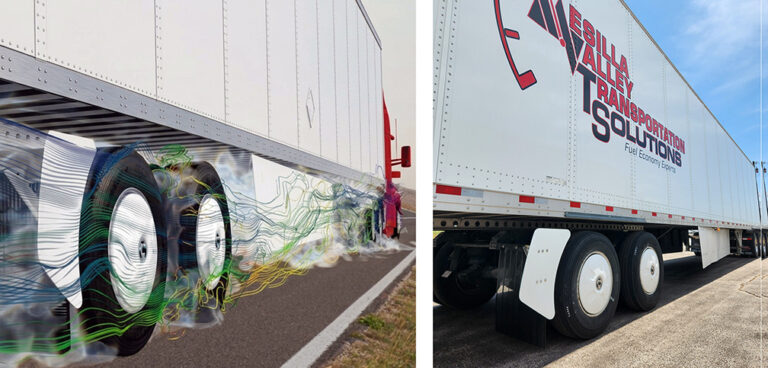
Frequently Asked Questions
What devices are included in a typical semi trailer aero kit?
A typical semi trailer aero kit combines two or more of the following: side skirts (also called belly fairings) that shield the trailer’s undercarriage from airflow, boat tails or rear fairings that extend the trailer’s rear profile to reduce wake turbulence, and gap reducers that close the space between the tractor and trailer. The EPA SmartWay program verifies device combinations for trailer designation: a skirt and rear fairing combination such as the Transtex Edge Elite Aero System 1630T Amazon is verified at 5% fuel savings . Combination packages that achieve 9% total fuel savings qualify a 53-foot dry box or refrigerated trailer for SmartWay Elite designation when paired with low-rolling-resistance tires . Individual device verifications range from 1% for aerodynamic splash guards to 5% for side skirts and boat tails .
How are semi trailer aero kits verified for fuel savings?
Semi trailer aero kits are verified through EPA SmartWay testing protocols or California Air Resources Board approval, with fuel savings expressed as a percentage against a baseline trailer configuration. EPA verification letters specify the device category, the test method (often wind tunnel using post-2014 protocols), and the fuel savings category—5% for a skirt and rear fairing combination, 9% for an Elite package . CARB approval requires submission of test data, an attestation statement, warranty documentation, and maintenance instructions, with devices approved against a measured aerodynamic performance threshold of 0.40 delta CdA for certain trailer model years . Fleets should confirm that a vendor’s claimed savings figure corresponds to a current verification letter for the exact device configuration being purchased, not a superseded product name or a different trailer type.
What fuel savings can a fleet realistically expect from a semi trailer aero kit?
A fleet should expect verified fuel savings to represent an upper bound under favorable conditions, with real-world results varying by speed, duty cycle, and route type. EPA verification letters themselves state that “fuel savings in real-world applications may vary” . Historical fleet data illustrates the range: in CARB proceedings, one large fleet reported less than 3% improvement at speeds above 60 mph and none below 45 mph with first-generation skirts, while other fleets reported 2–3% at high-speed cruise and one reported 10% . A Canadian analysis estimated a four-panel boat tail at approximately 1,900 liters saved per tractor per year at 100 km/h, with a fuel cost savings of about **$2,600** at $1.35/liter . Fleets operating primarily at lower speeds or in regional service should discount the verified figures accordingly.
What maintenance burden do trailer side skirts introduce?
Trailer side skirts introduce a recurring inspection and repair burden that fleet managers must budget for, because damaged or misaligned skirts can increase drag rather than reduce it. Fleet Maintenance guidance recommends visual inspections after each trip, covering holes, deep scratches, delamination, broken brackets, and loose flange bolts; a thorough inspection takes about 10 minutes . Damaged, bent skirts “can actually drag down fuel economy more than if a side skirt wasn’t even installed” . Common failure points are mounting brackets and bolts—vibration from wind loading loosens hardware, and a single missing bolt can cascade into broader bracket damage . Skirts are also vulnerable to dock approaches, railroad crossings, snowbanks, and road debris, and they can interfere with sliding tandem adjustment and railcar loading unless the specific skirt model is designed to accommodate those operations .
How should a fleet calculate ROI for a semi trailer aero kit?
A fleet should calculate ROI by applying the verified savings percentage to its own annual fuel consumption and fuel price, then subtracting the kit’s purchase price, installation cost, and estimated maintenance and repair costs over the intended service life. The calculation should state its assumptions explicitly: annual miles per tractor, baseline fuel economy in gallons per mile, fuel price per gallon, and the savings percentage the fleet deems achievable for its duty cycle. A conservative approach uses the lower end of the verified range and a speed profile below highway cruise. The Canadian analysis’s boat tail example—1,900 liters saved per tractor per year and $2,600 in fuel cost savings—illustrates the order of magnitude for long-haul operation at highway speed . A regional fleet with lower average speed should expect proportionally lower savings and a longer payback.
Are semi trailer aero kits required by regulation in any jurisdiction?
Semi trailer aero kits are effectively required for certain trailers operating in California under CARB’s greenhouse gas regulations, and they are a condition of EPA SmartWay trailer designation. CARB regulations specify that a driver shall not operate a heavy-duty tractor pulling a 53-foot-or-longer box-type trailer on a California highway if the trailer has aerodynamic technologies that are not deployed or not in their operational configuration . The SmartWay program is voluntary at the federal level, but fleets that participate or that ship for SmartWay partners may face contractual or shipper requirements to operate SmartWay-designated trailers . Fleets operating in California or serving shippers with sustainability requirements should treat aero kit specification as a compliance decision, not only an economic one.
What selection criteria should a fleet apply to a semi trailer aero kit?
A fleet should apply four selection criteria: current verification for the exact device combination and trailer type, duty cycle match to the speeds and routes the fleet actually operates, maintenance accessibility for brackets, bolts, and panel replacement, and operational compatibility with sliding tandems, dock approaches, and any intermodal loading. A skirt verified at 5% for a 53-foot dry van at highway speed may not suit a fleet running regional routes with frequent dock changes and tight turns. The vendor should provide installation instructions, a maintenance schedule, and a warranty statement that covers the device under normal operating conditions . A kit that cannot be maintained without specialized labor or that conflicts with the fleet’s loading infrastructure carries a total cost of ownership that the fuel savings may not offset.
Conclusion
Semi trailer aero kits are a verified fuel-saving technology with a real but conditional return. Match the device combination to the fleet’s actual speed profile and duty cycle, confirm that the vendor’s savings figure is backed by a current EPA or CARB verification for the exact configuration, and budget for the inspection and repair burden that skirts and fairings introduce. The verified percentage is the starting point for the ROI calculation, not the answer—the fleet’s own annual mileage, fuel price, and maintenance experience determine whether the kit pays back within the intended service life.