

Introduction
A powder tank semi trailer is a specialized bulk transport vehicle designed to carry dry powdered and granular materials—such as cement, fly ash, mineral powder, flour, and chemical powders—in a sealed tank and discharge them using compressed air rather than gravity or mechanical tipping. Unlike a tipper trailer or a curtain-side trailer, the powder tanker relies on a pneumatic conveying system: air is forced through a fluidized bed at the tank bottom, causing the compacted powder to behave like a liquid, after which it flows through discharge piping to a receiving silo or storage vessel.
The operational pressures driving investment in this equipment class are familiar to bulk logistics managers: packaging costs, material loss during handling, dust pollution, and labor requirements for bagged cargo. A powder tank semi trailer eliminates the bag entirely, reducing packaging waste and material residue while enabling rapid, enclosed transfer at both loading and discharge points. For cement distributors, fly ash handlers, and mineral processing operations, the tanker format has become the default solution for high-volume dry bulk movement.
This article examines the engineering of powder tank semi trailers, the pneumatic and structural systems that determine their performance, and the commercial factors that shape selection and ownership cost. All specifications are presented as typical industry ranges; actual values vary by manufacturer, tank configuration, material density, and regulatory market.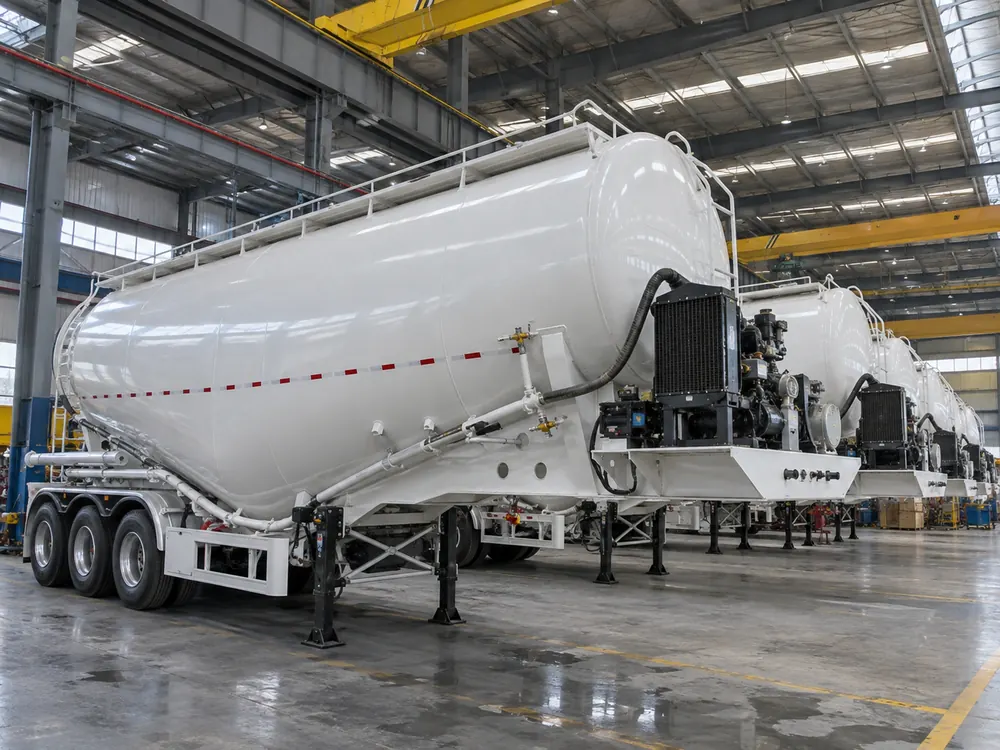
Core Powertrain and Structural Design
Tank Construction and Fluidized Bed System
The tank is the defining component of a powder tank semi trailer. Most designs use a horizontal cylindrical or V-shaped/W-shaped tank shell constructed from carbon steel, high-strength alloy steel, or aluminum alloy depending on the application and weight targets. Food-grade materials such as flour and starch require stainless steel or food-grade aluminum to prevent contamination . The tank interior contains a fluidized bed—a permeable membrane made from fabric, sintered metal, or porous plastic—through which compressed air passes to aerate the compacted powder .
The geometry of the tank bottom is critical to discharge performance. A V-shaped or W-shaped bottom directs material toward the discharge outlet under gravity while the fluidized bed introduces air along the tank length. Without adequate aeration, compacted powder—particularly cement, which can expand by roughly 40% when aerated—would form a channel through which air escapes without carrying material . The fluidized bed ensures the entire product mass becomes flowable, enabling complete clean-out with residual rates typically below 1%, and in well-designed systems below 0.3% .
Pneumatic System: Compressor, Piping, and Discharge Control
The pneumatic system generates and controls the air that fluidizes and transports the powder. Most powder tank semi trailers are equipped with a dedicated air compressor driven by a small diesel engine or, in some configurations, by a power take-off from the tractor. Typical compressor displacement ranges from approximately 10 to 12 m³/min, with discharge pressures of around 0.2 MPa (approximately 2 bar) . Trailers are generally restricted to 1–2 bar operating pressure to keep tank weight within payload limits .
The discharge sequence follows a defined procedure: the compressor pressurizes the tank and air chambers, the fluidized bed activates, and the discharge valve (often a butterfly or disc valve) is opened to release the aerated powder into the product line. Discharge piping routes the material to the receiving point, with typical horizontal conveying distances of up to 40 meters and vertical lift of approximately 20 meters depending on product characteristics and compressor capacity . Pressure control is essential; if line backpressure rises excessively, a pressure control valve dilutes the product-air mixture to maintain flow without overpressurizing the tank.
Chassis, Running Gear, and Structural Durability
The tank rests on a semi trailer chassis that must support both the static weight of the loaded tank and the dynamic loads of highway operation. Typical configurations use three axles with 13-ton or 16-ton capacity ratings from suppliers such as FUWA or BPW, coupled with leaf spring or air suspension . The chassis frame is fabricated from welded steel beams, and the tank-to-frame mounting must accommodate thermal expansion and vibration without introducing stress concentrations at the shell.
Structural integrity of the tank is verified through pressure testing and weld inspection. Typical tank shells use Q345 or equivalent low-alloy high-strength steel with automatic submerged arc welding for uniform, leak-free seams . Sealing is critical not only for pressure retention during discharge but also for preventing moisture ingress during transport, which can cause caking and discharge difficulty. Manhole covers, discharge valves, and piping connections are the primary points requiring routine inspection.
Technical Specifications
The table below presents typical industry ranges for powder tank semi trailers. These are not specifications for any single model. Actual values depend on manufacturer design, tank volume, material density, axle configuration, and regulatory market. Buyers should obtain confirmed specification sheets and verify compliance with local road transport regulations.
| Key Parameter | Typical Technical Specification | Operational Significance |
|---|---|---|
| Tank volume | 40–58 m³ (configuration-dependent) | Determines payload for low-density powders; match to material density and axle limits |
| Rated payload | 28–32 t (typical for 40 t gross weight) | Must account for powder density; cement and fly ash differ significantly |
| Tank material | Q345 steel, aluminum alloy, or food-grade stainless | Steel for general powders; aluminum for weight savings; stainless for food-grade |
| Compressor displacement | 10–12 m³/min at ~0.2 MPa | Determines discharge speed and conveying distance; undersized unit slows turnaround |
| Discharge rate | ≥1.2 t/min (typical for cement) | Affects receiving site turnaround; verify against blower capacity and line length |
| Residual rate | Typically below 1%; well-designed systems below 0.3% | Low residual reduces material loss and cleaning time between loads |
| Axle configuration | 3 axles, 13–16 t capacity each | Distributes loaded weight; affects tire wear and road regulation compliance |
| Conveying distance | Up to 40 m horizontal, ~20 m vertical | Must match receiving silo location and elevation at discharge site |
Comparative Advantages TCO and ROI
The commercial case for a powder tank semi trailer versus bagged or containerized powder transport rests on material savings, labor reduction, and discharge speed.
Material loss and packaging. Bagged cement or mineral powder incurs packaging cost, handling labor, and material loss through bag breakage and residual contents. A pneumatic tanker eliminates packaging entirely and achieves residual rates below 1%, with well-designed fluidized beds reaching 0.3% or lower . For a fleet moving 10,000 tons of cement annually, the material savings from reduced residual loss alone—assuming a conservative 0.5% differential versus bagged handling—represent a quantifiable annual benefit that accumulates over the trailer’s service life.
Labor and turnaround. Bagged cargo requires manual or forklift handling at both loading and discharge. A tanker requires only connection of air and product lines, with discharge controlled by valves. The labor reduction is significant for high-volume operations, though it must be weighed against the capital cost of pneumatic receiving equipment at the destination.
Maintenance and downtime. The powder tanker’s maintenance profile centers on the compressor, fluidized bed condition, valves, and tank shell integrity. Compressor servicing (air filters, oil, belts) is routine. Fluidized bed fabric or membrane degradation is the most common discharge performance issue; replacement intervals depend on product abrasiveness and operating hours. Tank shell inspection for internal corrosion is important when transporting materials with moisture content or chemical aggressiveness.
Total cost of ownership assumptions. A TCO comparison should state its basis. Consider a fleet operating a 40 m³ powder tanker at 80,000 km per year over eight years, primarily carrying cement at approximately 1.3 t/m³ bulk density. The trailer’s gross weight limit constrains payload to roughly 30–32 tons depending on tare weight. Fuel consumption is attributable to the tractor and the trailer’s aerodynamic profile; tankers present a smoother frontal area than flatbeds but are comparable to other tank configurations. Resale value for powder tankers is supported by steady demand in construction and energy markets, though condition of the fluidized bed and tank interior affects liquidity.
Return on investment. ROI is most favorable when annual tonnage is high and the receiving site is equipped for pneumatic discharge. At low annual utilization or where the destination lacks air supply and receiving silo infrastructure, the economic advantage over bagged or tipper transport narrows. Buyers should model their specific material flows, receiving site capabilities, and regulatory weight limits before committing to the tanker format.
Heavy Duty Application Scenarios
Powder tank semi trailers are deployed across several heavy-duty bulk handling sectors:
-
Cement distribution. The most established application. Tankers move bulk cement from production plants to concrete batch plants, terminals, and large construction sites. The sealed tank protects against moisture and eliminates dust during transfer, which is increasingly important in urban areas with air quality regulations.
-
Fly ash transport. Coal-fired power plants generate fly ash that is used as a supplementary cementitious material in concrete. Powder tankers move fly ash from plants to concrete producers or disposal sites. The low density of fly ash (often 0.8–1.0 t/m³) means volume, rather than weight, may limit payload, making larger tank volumes (50–58 m³) advantageous .
-
Mineral powder and industrial fillers. Limestone powder, silica fume, and other mineral fillers require sealed transport to prevent contamination and moisture absorption. Food-grade applications such as flour and starch demand stainless steel or coated tanks with sanitary design .
-
Chemical powders. Certain industrial chemicals in powder form are transported in specialized tankers with corrosion-resistant linings or stainless construction. Compatibility between the product and tank material must be verified before service.
-
Construction and infrastructure projects. Large concrete pours and road construction projects require reliable bulk cement supply. Tanker configurations with higher discharge rates and longer conveying distances reduce dependency on receiving site infrastructure.
In all applications, the duty cycle determines configuration priorities. Short-haul cement delivery favors rapid discharge and minimal residual; long-haul fly ash transport may prioritize larger tank volume and fuel-efficient tare weight.
Selection and Maintenance Considerations
Selecting and maintaining a powder tank semi trailer requires attention to material characteristics, receiving infrastructure, and regulatory compliance:
-
Match tank volume to material density. Cement (bulk density approximately 1.3–1.5 t/m³) reaches weight limits at lower volumes than fly ash (0.8–1.0 t/m³). A 40 m³ tank may be weight-limited for cement but volume-limited for fly ash. Confirm the intended material’s density and the gross weight limit before specifying tank size.
-
Verify compressor capacity against conveying distance. The compressor must provide sufficient air volume and pressure to fluidize the product and overcome line backpressure at the longest conveying distance expected. Undersized compressors cause slow discharge and incomplete clean-out.
-
Inspect fluidized bed condition regularly. The aeration membrane is the heart of the discharge system. Fabric degradation, tearing, or clogging reduces discharge rate and increases residual. Inspect at intervals determined by product abrasiveness and operating hours.
-
Confirm tank material compatibility. Carbon steel is adequate for cement and fly ash; stainless or coated tanks are required for food-grade, corrosive, or contamination-sensitive powders. Aluminum offers weight savings but may not suit abrasive minerals.
-
Verify regulatory compliance. Tank volume, axle loads, and gross weight must comply with local road transport regulations. In markets with strict weight enforcement, the payload advantage of a larger tank may be unusable if axle limits bind first.
-
Train operators on discharge procedure. Incorrect valve sequencing or inadequate aeration can cause line blockage or overpressurization. Operators should understand the relationship between tank pressure, fluidization, and product flow, and should never open discharge valves before the fluidized bed is fully activated.
-
Parts availability and service support. Compressor components, fluidized bed membranes, and discharge valves are the critical wear items. Prioritize designs with widely available component footprints and dealer support in the operating region.
Conclusion
The powder tank semi trailer is an engineering solution to a specific logistics problem: moving dry bulk powders efficiently without packaging, material loss, or dust emissions. Its performance depends on the interaction of tank geometry, fluidized bed design, and pneumatic system capacity—components that must be matched to the material being carried and the receiving infrastructure at the destination. For fleets with high annual tonnage and destinations equipped for pneumatic receiving, the economic case is strong: material savings, labor reduction, and rapid discharge combine to reduce cost per ton moved. For operations with low utilization or destinations lacking air supply, the capital and maintenance burden may not be justified. Buyers should verify tank volume against material density and axle limits, confirm compressor capacity for the longest expected conveying distance, and establish a fluidized bed inspection routine from the first day of service.