

Overview
Semi trailer height is governed by two separate numbers that fleet buyers often conflate: the overall legal height limit set by regulation, and the actual operating height of a specific trailer and load combination. The European Union caps vehicle height at 4.0 meters, several U.S. states set a legal maximum of 13 feet 6 inches, and Australia uses a conditional 4.6-meter allowance for specified semitrailers. The trailer’s own height depends on deck height, suspension setting, tire size, and fifth wheel coupling height.
This FAQ addresses the height questions that directly affect procurement, route planning, and regulatory compliance. All figures should be verified against the specific jurisdiction’s current regulations and the trailer manufacturer’s data plate, because height limits and bridge clearances vary by state, country, and route.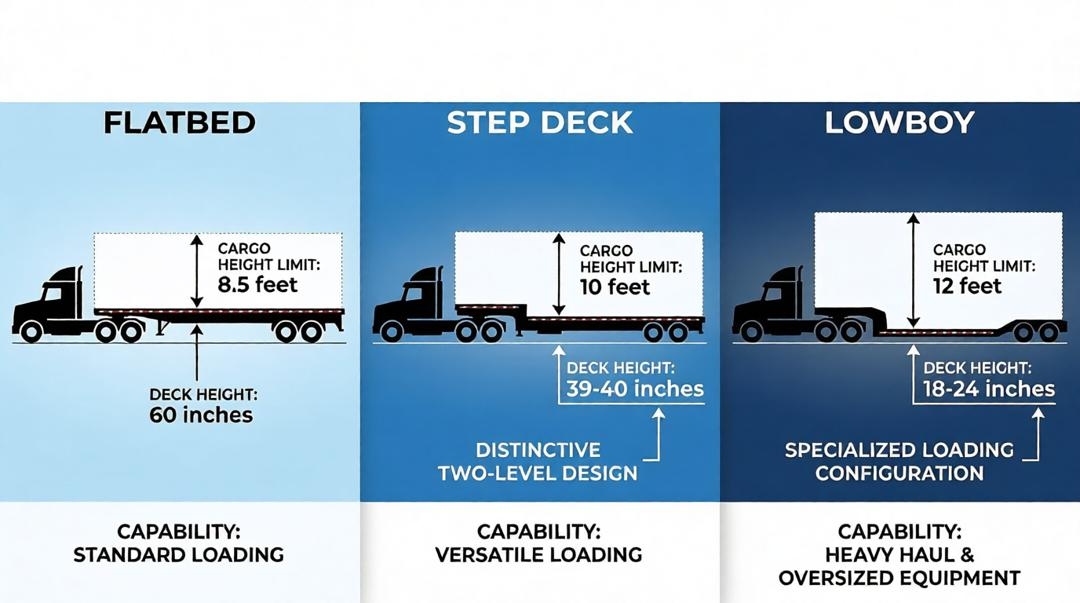
Frequently Asked Questions
How tall is a semi trailer in Europe?
The maximum legal height for a semi trailer combination in the European Union is 4.0 meters, measured from the ground to the highest point of the vehicle including any load. This limit is set under EU type-approval regulations for masses and dimensions and applies to vehicles operating under EU rules .
Actual trailer height depends on the body type and suspension setting. A European reefer semi trailer such as the Schmitz Cargobull S.KO COOL lists an overall height of approximately 3,960 mm when unloaded, with an internal body height of about 2,600 mm . A Krone curtainside semi trailer lists a vehicle height of 405 cm (4.05 m) with an internal height of 280 cm . These figures illustrate that a trailer can approach or reach the legal limit even before cargo is loaded, which is why high-cube and specialized trailers require careful route planning.
What is the maximum legal height for a semi trailer in the United States?
Several U.S. states set a maximum legal vehicle height of 13 feet 6 inches (4.11 meters), though height limits are set at the state level rather than by a uniform federal standard. Mississippi, for example, lists a maximum legal height of 13 feet 6 inches for oversize vehicle permitting purposes .
Unlike length and width, which have federal minimums on the Interstate System, height is primarily a state-regulated dimension and is constrained in practice by bridge clearances. A trailer that is legal in one state may exceed the limit in another, and a legal trailer can still strike a low bridge if the route is not surveyed. Fleet operators should confirm the height limit for every state on the route and check bridge clearances for any combination approaching the legal maximum.
How tall can a semi trailer be in Australia?
Australia permits specified semitrailers to operate at heights up to 4.6 meters, above the general heavy vehicle height limit, subject to conditions including air suspension with effective dampers and a deck height limit of 1.2 meters for at least 50% of the trailer’s length . The 4.6-meter allowance is granted through dimension exemption notices and is not a blanket increase for all trailers.
The general height limit for heavy vehicles in Australia under the Heavy Vehicle National Law is lower, and the 4.6-meter allowance applies only to trailers that meet the specified conditions and operate on approved routes. Operators should verify the applicable notice for each state or territory and confirm that the trailer and load combination satisfies the deck height and suspension requirements.
What determines a semi trailer’s deck height?
A semi trailer’s deck height is determined by the fifth wheel coupling height, suspension type, tire size, and frame design, and it directly affects the overall height of the loaded combination. A standard European curtainside trailer lists a chassis height of 121 cm and a kingpin height of 112 cm .
Specialized trailers can achieve significantly lower deck heights. A semi low loader with independent wheel suspension lists a loading floor height as low as 780 mm, compared with conventional low loaders that sit higher . For high-cube van trailers, the deck height is higher because the floor sits above the frame and suspension. Buyers specifying a trailer for height-restricted routes should request the deck height, kingpin height, and overall trailer height from the manufacturer and calculate the loaded height with the expected cargo.
How does fifth wheel height affect overall trailer height?
Fifth wheel height sets the vertical position of the trailer’s kingpin, and a higher fifth wheel raises the front of the trailer, increasing overall height and affecting load distribution. ISO 1726-1 addresses the interchangeability dimensions between tractors and semi trailers, including the height of the fifth wheel of the laden and uncoupled tractor .
In practice, the tractor’s fifth wheel height and the trailer’s kingpin height must be matched within the manufacturer’s specified range. A mismatch can cause the trailer to sit nose-high or nose-low, which affects braking stability and load distribution as well as overall height. Fleets standardizing tractors and trailers across a mixed fleet should confirm that the fifth wheel height range of the tractors is compatible with the kingpin height of the trailers, particularly when combining units from different manufacturers.
What bridge clearances should I check for a tall semi trailer?
Check bridge clearances for the lowest clearance on the intended route, not the average or posted maximum, and add a margin for resurfacing and load movement. In the United States, the Federal Highway Administration designates 14 feet (4.27 meters) as the low-clearance threshold for urban non-Interstate routes, 15 feet for some state inventories, and 16 feet (4.88 meters) for rural areas and urban single routings .
A trailer operating at or near the legal height limit has little margin for error on routes with older bridges, construction zones, or tree canopy. Route surveys should identify the specific clearance of every bridge and overpass on the intended path, and the driver should be provided with a written clearance list rather than relying on memory or posted signs. For repeated routes, a one-time survey pays for itself by preventing a bridge strike that can damage the trailer, the bridge, and the cargo.
What height should I specify for a new semi trailer order?
Specify the lowest overall height that meets the cargo volume requirement, and verify that the loaded combination stays within the height limit of every jurisdiction on the operating network. A trailer that is legal in one country or state may require a permit or be prohibited in another.
For standard dry freight and curtain-side applications, the trailer’s own height (typically around 4.0 meters in Europe) is already close to the legal limit, so cargo loading must account for the remaining margin. For high-cube or specialized cargo, a low-deck trailer or a low-loader may be necessary to stay within the limit. Procurement teams should request the manufacturer’s overall height, deck height, and kingpin height, and calculate the loaded height using the tallest expected cargo rather than an average load.
Conclusion
Semi trailer height comes down to two separate checks: the legal height limit of each jurisdiction (4.0 meters in the EU, 13 feet 6 inches in several U.S. states, and a conditional 4.6 meters in Australia) and the actual operating height of the specific trailer, tractor, and load combination. The trailer data plate, the manufacturer’s dimension sheet, and a route-specific bridge clearance survey are the controlling references. Fleets specifying tall trailers or high-cube bodies should treat height as a route-planning constraint from the procurement stage, not as an operational detail to be resolved after delivery.