

Introduction
Goodyear semi trailer tires occupy a specific position in the commercial tire market: the brand offers both dedicated trailer tires under the Endurance name and regional all-position tires under the Endurance RSA line that can serve trailer positions in mixed-fleet operations. For procurement managers and maintenance planners, the relevant questions are not brand reputation but specification fit: which Goodyear line matches the trailer’s axle load, speed profile, and duty cycle, and what does the tire cost per kilometer over its service life rather than at the point of purchase.
The operational pressures on trailer tires are familiar. Underinflation generates heat and accelerates casing degradation. Irregular wear from misaligned axles consumes tread life that the fleet paid for. A tire that is under-specified for the axle load fails earlier than its tread depth suggests. Goodyear’s trailer-specific products address these pressures through construction features—steel belts, decoupling grooves, and scuff guards—but those features only deliver value when the tire is matched to the application and maintained at the correct pressure.
This guide examines the Goodyear product lines relevant to semi trailer applications, the load and speed specifications that govern selection, and the fleet support programs that affect total tire cost. It does not rank Goodyear against competitors; it explains what the specifications mean so that buyers can evaluate whether a given Goodyear tire fits their operation.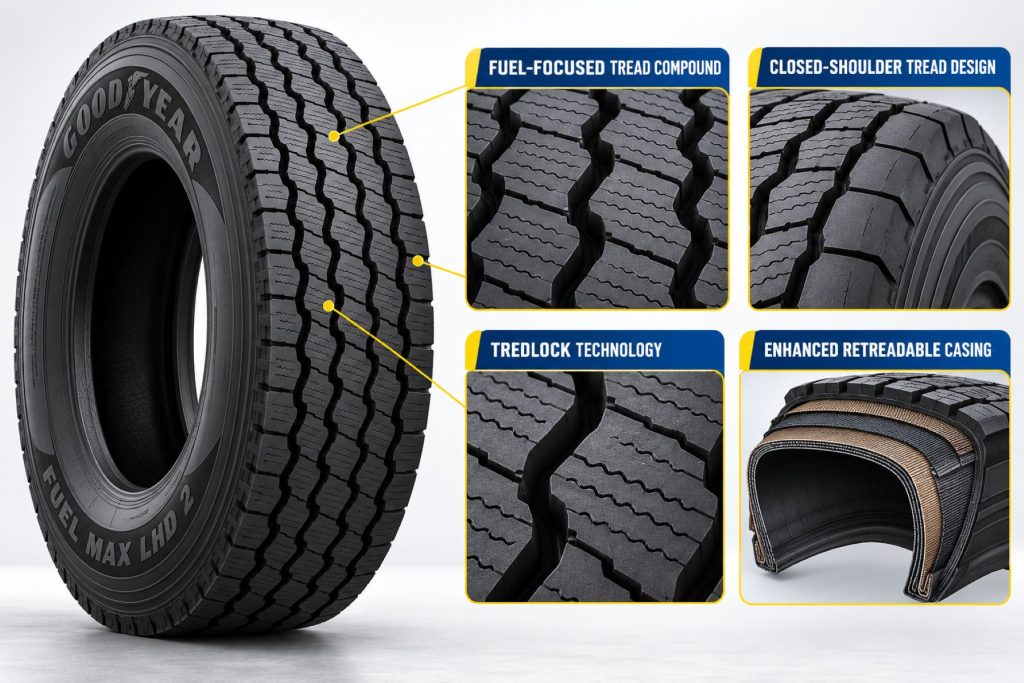
Core Powertrain and Structural Design
Engine and Transmission
A semi trailer tire has no relationship to the tractor’s engine or transmission. Its performance is defined by its load-carrying capacity, speed rating, tread construction, and the condition of the axle and suspension it mounts to. The tractor’s air system affects trailer tire life indirectly: a failing compressor or dryer can cause brake drag that generates heat and accelerates tire degradation.
Hydraulic System
Trailer tires do not interface with hydraulic systems. On trailers equipped with hydraulic functions, hose routing must avoid contact with tires to prevent chafing and heat damage.
Chassis and Structural Durability
The tire’s structural relationship is with the axle, suspension, and wheel. A misaligned axle produces lateral scrub that wears tread faster than load alone would explain. Worn suspension bushings allow the axle to shift under load, compounding misalignment. Goodyear’s trailer tires use construction features intended to resist these stresses: the Endurance trailer tire uses a redesigned polyester construction reinforced with steel belts, an optimized tread depth and decoupling groove to operate at lower temperatures, and Durawall Technology with a scuff guard to defend against sidewall scuffs and punctures .
For regional and urban trailer service, the Endurance RSA is positioned as an all-position tire for long miles to removal, with a load range G and speed rating of 120 km/h in the 245/75R22.5 size . This tire is not a dedicated trailer product but can serve trailer positions in fleets that standardize on one tire line across tractors and trailers.
Technical Specifications
The table below presents representative specifications for Goodyear tires relevant to semi trailer applications. Values are drawn from published product data and manufacturer documentation; actual load capacity varies with inflation pressure, dual versus single configuration, and axle load distribution.
Comparative Advantages TCO and ROI
The Goodyear trailer tire decision is a specification-fit and support-network decision rather than a simple price comparison. A dedicated ST trailer tire like the Endurance is engineered for trailer-specific loads and scrub patterns, while an all-position tire like the Endurance RSA offers fleet standardization benefits at the cost of a less specialized tread compound. Neither is universally superior; the correct choice depends on the fleet’s axle loads, route profile, and maintenance capability.
A critical distinction in the ST tire category is speed management. Industry standards restrict ST-designated tires to 65 mph under normal inflation and load conditions unless the sidewall indicates otherwise. Operation between 66 and 75 mph requires increasing cold inflation pressure by 10 psi above the recommended pressure for the load, without exceeding the wheel’s maximum pressure . A fleet that routinely runs at highway speeds above 65 mph without adjusting pressure is operating its trailer tires outside the intended condition, which accelerates heat buildup and casing degradation. This is not a Goodyear-specific limitation; it applies to ST tires generally.
A defensible cost comparison requires stated assumptions. Consider a fleet evaluating dedicated trailer tires against all-position tires for trailer service. Dedicated ST tires may cost less per unit but carry the 65 mph restriction and are not intended for drive or steer positions. All-position tires cost more but allow fleet standardization and may simplify inventory. If the fleet operates at sustained speeds above 65 mph, the ST tire requires pressure adjustment or speed management, which may be impractical on long-haul routes. The all-position tire avoids that constraint but may wear differently in trailer service. The decision hinges on route speed profile and inventory strategy rather than on unit price alone.
Fleet support is a material factor in total cost. Goodyear’s Fleet HQ program has surpassed 5 million service events and is supported by more than 2,300 service providers, with most customers serviced in about two hours . For a fleet operating high-utilization trailers, the difference between a two-hour roadside response and a half-day wait can exceed the tire’s purchase price in avoided downtime. This support network is part of the value proposition that a lower-cost tire brand may not match.
Warranty coverage for Goodyear commercial tires includes free replacement during the first 2/32-inch of treadwear or 12 months from purchase, whichever comes first, followed by prorated replacement based on remaining usable tread . The prorated calculation uses the current advertised selling price multiplied by the percentage of usable original tread worn, plus mounting, balancing, and FET . Fleets should retain proof of purchase and DOT serial numbers to support warranty claims.
Heavy Duty Application Scenarios
-
Long-haul highway freight: The speed profile matters. If the fleet sustains speeds above 65 mph, ST-designated trailer tires require pressure adjustment per the 10 psi rule, and the wheel’s maximum pressure may cap this option . An all-position tire like the Endurance RSA avoids the ST speed restriction but must be evaluated for trailer-specific wear patterns.
-
Regional and urban delivery: The Endurance RSA’s positioning as a regional and urban all-position tire suits duty cycles with frequent stops and moderate speeds . Lower sustained speeds reduce heat buildup, and the all-position construction allows rotation between tractor and trailer positions if the fleet standardizes.
-
Travel trailer and specialty trailer applications: The Goodyear Endurance ST line is designed for travel trailers, 5th wheels, boat trailers, and utility trailers . These applications typically involve lower annual mileage and seasonal use, where the ST construction’s sidewall protection and cool-running design are appropriate.
-
Fleets prioritizing roadside support: Goodyear’s Fleet HQ network provides service coordination and emergency response through 2,300+ providers . Fleets operating in regions where tire service is sparse may value this network more than a marginal difference in tread life.
Selection and Maintenance Considerations
Selecting a Goodyear semi trailer tire begins with the axle load and speed profile, not the brand name. The load index must support the maximum axle load divided by the number of tires on that axle, with margin for load transfer. The speed rating must match the fleet’s sustained operating speed, and for ST tires, the 65 mph restriction and pressure adjustment rule must be understood before the tire enters service.
Key considerations include:
-
Verify the load index against the actual axle load. The Endurance ST235/80R16 carries Load Index 123 (3,420 lb max load at 80 psi) in the size shown . Confirm that the sum of tire capacities across the axle meets or exceeds the legal axle limit with margin.
-
Understand the ST speed restriction and pressure rule. ST tires are restricted to 65 mph under normal inflation unless the sidewall indicates otherwise. For 66–75 mph operation, increase cold inflation by 10 psi above the load-recommended pressure, not exceeding wheel or tire maximum . If the wheel cannot accept the increased pressure, the speed must be restricted to 65 mph.
-
Check cold inflation every morning during trips and monthly in storage. Underinflation is the leading cause of trailer tire failure and irregular wear. The trailer manufacturer’s inflation specification, found on the placard or certification label, governs the correct pressure .
-
Retain proof of purchase and DOT serial numbers for warranty. Goodyear’s free replacement period covers the first 2/32-inch of treadwear or 12 months, with prorated coverage after that . Without proof of purchase, the date of manufacture determines eligibility.
-
Match the tire line to the duty cycle. Dedicated ST trailer tires for travel and specialty trailers; all-position tires like the Endurance RSA for regional fleets that want standardization and avoid the ST speed restriction.
Conclusion
Goodyear semi trailer tires are specified by load index, speed rating, and construction rather than by brand alone. The Endurance ST line is a dedicated trailer tire with steel-belted construction and sidewall protection for travel and specialty trailer applications . The Endurance RSA is a regional all-position tire that can serve trailer positions in fleets that prioritize standardization . Both require disciplined inflation maintenance, and the ST line carries a 65 mph speed restriction that must be managed through pressure adjustment or speed control .
The engineering priorities are clear: match load index to axle load, understand the ST speed and pressure rules before operation, and check cold inflation at the specified intervals. The commercial priorities follow: weigh the dedicated trailer tire’s application-specific construction against the all-position tire’s standardization benefits, and factor Goodyear’s Fleet HQ service network and warranty coverage into the total cost calculation . The Goodyear tire that fits the axle, the speed profile, and the support network is the one that delivers the service life the fleet paid for.